




Reviewed by Nemo C. Mörck
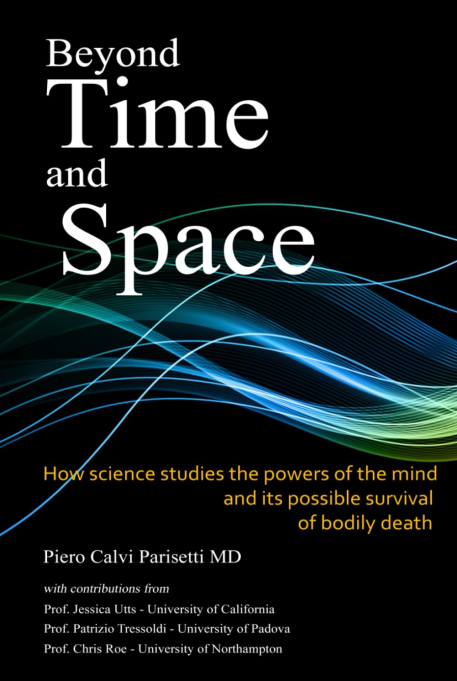
Piero Calvi Parisetti is a medical doctor and an author. Parisetti writes that he is also a clinical parapsychologist, ”someone who studies the relationship between exceptional experiences and mental health” (p. 241). Parisetti considers his main contribution to be ”an approach to grief therapy based on the knowledge and critical examination of the evidence suggestive of survival” (p. 241). However, this book does not concern clinical parapsychology. Parisetti presents a ”systematic review of a significant number of articles” (p. 7), fifty in total. However, Extra-Sensory Perception after Sixty Years (Pratt et al., 1940) and a few other publications are also included despite the fact that they are not articles. Professors Chris Roe, Patrizio Tressoldi, and Jessica Utts have made brief, valuable contributions (about consciousness, mediumship, and statistics). Parisetti alone is responsible for most of the book. Beyond Time and Space is self-published and may get revised. It first appeared in Italian and the version I review here is dated 7 January 2025, and was published in English this year (2026).
This book is not intended as a part of some kind of ’crusade’ to establish the credibility of parapsychology, much less the validity of the experimental findings it has produced. Its main purpose is to inform, entertain curious and intelligent people and, hopefully, to inspire awe for the mysteries of a universe that turns out to be far stranger than one can imagine (p. 7).
A single look at the table of contents makes it clear that this is an ambitious undertaking. The book is wide-ranging. Parisetti has basically tried to cover the entire field on 243 pages (there is no reference list or index). He presents evidence for psychic phenomena but also for survival after bodily death.
Parisetti begins by relating that Prof. Jessica Utts ended her presentation at the annual meeting of the American Statistical Association, in 2019, by asking: ”To be convinced that precognition exists, would you want more scientific evidence or a personal experience?” Most wanted a personal experience. This is not a rational stance, but understandable. People want to dream about lottery numbers, get rich by buying stocks on a hunch, or perhaps avoid an accident.
Parisetti presents Cox’s (1956) study whose results suggested that people do indeed avoid boarding trains that are going to be involved in accidents. This is the kind of result that many like to believe in. However, Parisetti notes that Cox himself recognised that ”the sample of events is too small to draw definitive conclusions” (p. 31). Utts’s first media appearance concerned this study: ”I noticed that the accident days included a Monday that happened to be Labor Day, but in the analysis the ridership was predicted as if it was a regular Monday. So my first TV appearance was as a debunker!” (Rossman & Utts, 2014, p. 7).
Parisetti includes Schredl, Götz, and Ehrhardt-Knutsen (2010) and the reader understands what they did. However, Parisetti then complains that Prof. Caroline Watt never formally published the replication attempt she was involved in. He is right, but Watt and her colleagues presented their results at the annual SPR conference in 2015. They thought that there ”was a statistical artefact with Schredl’s original composite scoring method” (Caroline Watt, personal communication, 11 February 2026).
A chapter is devoted to Parisetti’s response to standard arguments made by sceptics (167-174). However, throughout the rest of the book the sceptics are often absent. Ray Hyman and James Alcock, both professors of psychology, only make brief appearances. Parisetti presents Pratt and Rhine (1954), but Hansel (1989) is not even dismissed in passing. Parisetti presents Targ and Puthoff (1974), but Randi (1982) is never mentioned. I could list more examples. My point is not that the sceptics were right: my point is that criticism needs to be acknowledged.
Parisetti does a good job by presenting one side of the argument and showing the variety of experiments that have been conducted. However, things are more complicated than this book suggests.
The parapsychological literature is overwhelming and the peer-reviewed journals are not always easy to access. Wikipedia more often than not focuses on the criticism while the Psi Encyclopedia is meant to present more balanced overviews. It is a challenge to do so even for people with access to most of the literature.
Parisetti presents his chosen articles in a way that is easy to follow. He often covers the procedure and the results and ends with a personal comment. I think this is a book appropriate for psychology students. Utts has contributed with some pages about statistics and explains the meaning of effect sizes and p-values (pp. 14-19) so laymen should be able to follow. However, Parisetti often mentions literature in the text, in passing, without providing references, so the reader needs to consult Google Scholar to learn more.
Parisetti presents Sicher et al. (1998), a study about distance healing, and in a concluding comment he mentions an ”astonishing study” (p. 144), namely Leibovici’s (2001) curious publication, which provoked many comments. Apparently, Leibovici did not really believe that he had found evidence for retroactive intercessory prayer, but he stated that ”...the details provided in the publication (randomization done only once, statement of a wish, analysis, etc.) are correct” in his response (Leibovici, 2002).
In addition to classical articles and meta-analyses about psi phenomena, Parisetti also presents one about the Maharishi effect and covers the Global Consciousness Project. However, Parisetti does not show the entire picture. He mentions a re-analysis by May and Spottiswoode (2001), but the criticism from the unnamed Peter A. Bancel (2017) is arguably more important.
I have made the author aware of some factual errors. For example, the CIA was not responsible for the remote viewing project in 1989, F. W. H. Myers was not a professor, and Charles T. Tart was not a physicist. What Parisetti does well is presenting the articles he has selected and the text has been edited by a professional editor, Beth Hilton. The text is easy to read.
Nevertheless, I do not follow Parisetti’s reasoning when he writes:
… we can conclude that prayer doesn’t work as a miracle cure for diseases. [Prof. Stephen] Braude’s preoccupation that there could be an ’evil eye’ power that would cause people to fall dead seems therefore unfounded (p. 153).
Do you truly believe in psi if you have no fear of psi? Braude argued that if you accept psychokinesis as real then it is natural to also ponder on whether it could be used to cause harm (e.g., see Reichbart, 2019).
Parisetti has clearly read much of the literature and seems particularly interested in William Bengston’s healing studies, and he asks: ”Why were dozens or hundreds of attempts to replicate this experimental procedure not immediately organized by independent laboratories and researchers?” (p. 152). Parisetti does not answer his own question.
He also covers out-of-body experiences and near-death experiences. However, he only presents one theory and model of psi, namely First Sight, proposed by Carpenter (2012). Evidence suggestive of reincarnation gets space alongside studies of mediumship. Parisetti also includes some personal recollections of a public séance held by the medium Gordon Smith.
Parisetti writes:
The vast majority of people who consider themselves mediums do not actually have any gifts: they delude themselves and, often, people who suffer from the loss of a loved one, eager to have some form of contact with the supposed afterlife (p. 217).
That is a claim one is more likely to find in more sceptical publications.However, later Parisetti writes:
Among the pioneers of this technique [hypnotic regression] are people like Dr. Brian Weiss, a psychiatrist of extraordinary scientific calibre, whose intellectual honesty is difficult to doubt (p. 239).
Sceptics would have expressed themselves in a different way, but Parisetti recognises that recall of past lives during hypnosis can come about from normal factors.
Parapsychology has always been mired in controversy, the literature is overwhelming, and it is not always easy to know what to believe. What Parisetti does well is presenting the studies and I believe that is all he wished to do.
References
Bancel, P. A. (2017). Searching for global consciousness: A 17-year exploration. Explore, 13(2), 94-101.
Carpenter, J. C. (2012). First sight: ESP in parapsychology and everyday life. Rowman & Littlefield.
Cox, W. E. (1956). Precognition: an analysis II. Journal of the American Society for Psychical Research, 50(1), 99-109.
Hansel, C. E. M. (1989). The search for psychic power: ESP and parapsychology revisited (3rd Ed.). Prometheus Books.
Leibovici, L. (2001). Effects of remote, retroactive intercessory prayer on outcomes in patients with bloodstream infection: randomised controlled trial. British Medical Journal, 323(7327), 1450-1451.
Leibovici, L. (2002, March 12). Rapid response: Author’s comments. British Medical Journal https://www.bmj.com/rapid-response/2011/10/28/authors-comments
May, E. C., & Spottiswoode, S. P. J. (2001). Global Consciousness Project: An Independent Analysis of the 11 September 2001 Events. Laboratories for Fundamental Research.
Pratt, J. G., Smith, B. M., Rhine, J. B., Stuart, C. E., & Greenwood, J. A. (1940). Extra-sensory perception after sixty years: A critical appraisal of the research in extra-sensory perception. Henry Holt.
Randi, J. (1982). The truth about Uri Geller. Prometheus Books.
Reichbart, R. (2019). The paranormal surrounds us: Psychic phenomena in literature, culture and psychoanalysis. McFarland.
Rhine, J., & Pratt, J. (1954). A review of the Pearce-Pratt distance series of ESP tests. Journal of Parapsychology, 18(3), 165-177.
Rossman, A., & Utts, J. (2014). Interview with Jessica Utts. Journal of Statistics Education, 22(2), 1-24.
Schredl, M., Götz, S., & Ehrhardt-Knutsen, S. (2010). Precognitive dreams: A pilot diary study. Journal of the Society for Psychical Research, 74(900), 168-175.
Sicher, F., Targ, E., Moore, D., 2nd, Smith, H. S. (1998). A randomized double-blind study of the effect of distant healing in a population with advanced AIDS. Western Journal of Medicine, 169, 356-363.
Targ, R., & Puthoff, H. (1974). Information transmission under conditions of sensory shielding. Nature, 251, 602-607.