




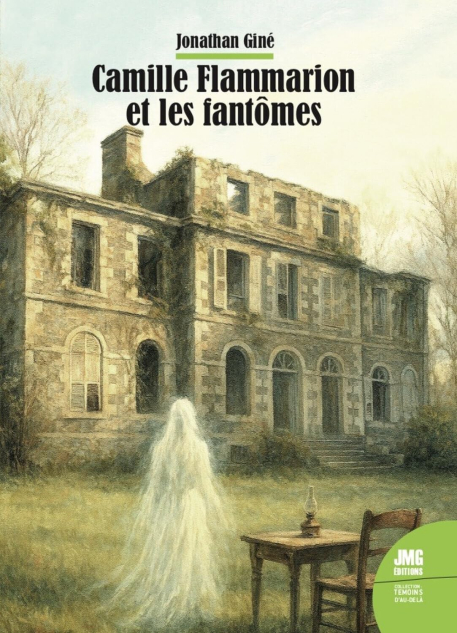
Camille Flammarion et les fantômes [Camille Flammarion and ghosts].
Reviewed by Renaud Evrard
Jonathan Giné is an amateur astronomer with a particular interest in ufology and parapsychology. The book concerns the French astronomer and naturalist Camille Flammarion (1842–1925), who himself explored these subjects.
The work is prefaced by Véronique Geffroy (pp. 9–13), the owner of a château reputed to be haunted. Her contribution adds to the general praise of Flammarion, who is presented as a paragon of scientific curiosity, a ‘seeker after truth’, and a Charles Fort (1874–1932) before his time.
Giné has also written a companion volume, in a similar format, entitled Camille Flammarion et les bradytes, contribution à l'histoire de l'astronomie et de l'ufologie (that is, Camille Flammarion and Bradytes: A Contribution to the History of Astronomy and Ufology). ‘Bradytes’ was the term Flammarion used for ‘slow vehicles,’ of which he collected numerous observations from the second half of the nineteenth century onwards, in what amounts to a particularly interesting anticipation of ufology (Giné, 2025).
A foreword (pp. 15–24) introduces both Flammarion and the book’s author, Giné. The writing style is rather informal. There are numerous short paragraphs that lack focus, followed by bullet-point lists and accompanied by copious, occasionally lengthy footnotes that provide raw information. Black-and-white photographs appear throughout the book to illustrate the discussion. Overall, this book resembles a blog more than a scholarly essay. The following prologue (pp. 25–27) merely extends the foreword.
Chapter 1 (pp. 29–55) deals with the allegedly haunted presbytery at Cideville in 1851, a case that Flammarion never investigated personally, although he owned a book on the subject in his library. The chapter is a lengthy narrative of an account, ending with a telegraphic analytical table of the phenomena. The rationale for including the chapter is unclear.
Chapter 2 (pp. 57–82) examines a case investigated by Flammarion in Calvados. The presentation is equally superficial: protagonists, dates, alleged phenomena, extracts from testimonies, a compilation of the material with a few statistics, and a discussion of hypotheses. This format does not lend itself to critical analysis. In this respect, it is fairly representative of Flammarion’s own books, which were often compilations of only moderately well-documented facts.
Chapter 3 (pp. 83–92) concerns the haunted house case at Labastide-Paumès. The reader is suddenly thrown into the case. Flammarion’s account is simply reproduced, followed by a brief analysis (pp. 89–92).
Chapter 4 is entitled ‘Camille Flammarion and Ghosts’ (pp. 93–120), yet it does not provide a general essay setting out his scientific approach in its historical context. It is instead another pasted-together reproduction of Flammarion’s investigation of a haunted house in Auvergne. However, Giné adds analytical tables in blocks and bullet-point lists.
Chapter 5 (pp. 121–136) introduces the concept of place memory and curses associated with mummies. Following a brief introduction, several cases that Flammarion dealt with are juxtaposed without synthesis.
Chapter 6 (pp. 137–163) addresses poltergeists. Giné draws on a selection of cases published by Flammarion (1923) in his book on haunted houses, as well as on classic cases (such as the Jöller house) and cases occurring after Flammarion’s time, such as the Arcachon clinic case of 1963. Flammarion’s core thesis is once again obscured.
Chapter 7 (pp. 165–291) is the chapter that most justifies the book’s existence. In the Flammarion Collection of the Société astronomique de France, Giné discovered a notebook cataloguing more than 1,000 letters received by Flammarion, reporting alleged hauntings, telepathic experiences, apparitions or materialisations of the dead, and so forth. Flammarion had attempted to classify them as follows:
1. Manifestations and apparitions of dying persons.
2. Manifestations and apparitions of living persons who were not ill.
3. Manifestations and apparitions of the dead.
4. Seeing events occurring at a distance.
5. Precognitive dreams; foreknowledge of the future.
6. Dreams featuring the dead.
7. Anticipated encounters (one case).
8. Premonitions that came true.
9. Doubles of living persons (one case).
10. Movements of objects without apparent cause.
11. Communication of thoughts at a distance.
12. Impressions experienced by animals.
13. Calls heard over great distances.
14. Bolted doors opening by themselves.
15. Haunted houses (one case).
16. Spiritualist experiments.
17. Nil, insignificant, uninteresting, mediocre, incomplete, vague, doubtful, etc.
The notebook is reproduced in full, with summaries and, at times, case details (up to p. 288). Despite the strangeness of its contents, reading it generates no more enthusiasm than reading an administrative document. Giné provides a brief descriptive statistical analysis of the 784 recorded cases (pp. 289–291), according to the setting of occurrence and the witness’ sex and age. Indoor phenomena predominate (63% of cases); 24% occur in broad daylight and 40% at night; 10% involve children; 28% of cases involve men and 29% women, while the sex is indeterminate in one-third of cases.
Chapter 8 (pp. 293–320) reproduces the address sent by Flammarion to the SPR on taking up its presidency. Giné’s analysis (pp. 313–320) is interesting, addressing epistemological, methodological, and metaphysical aspects, even if it moves beyond the question of ghosts.
Chapter 9 (pp. 321–325) is particularly rough-hewn as it lacks both a transition and an introduction. It presents a list of communications arising from spiritualist practices in short paragraphs without commentary. Unfortunately, at times, one wonders whether anyone has proofread or edited the book.
Chapter 10 (pp. 327–346) reproduces a text by Flammarion published in 1906 on ‘Unknown Natural Forces’. The passages written by Giné and those in which the reader encounters Flammarion are very poorly distinguished. Giné uses the final two pages of the chapter for a brief commentary. The following epilogue (pp. 347–349) leaves the reader wanting more.
The appendices include a lengthy and dispensable glossary of paranormal terms (pp. 351–356), as well as a biography and bibliography of Flammarion, accompanied by engravings and suggestions for further reading (pp. 358–365). The volume contains neither a general bibliography nor an index.
I am sorry to say that considerable effort is required to derive any enjoyment from reading this book. Neither its style nor its layout is helpful. Its content concerns very old cases from which it is difficult to draw any conclusions. It feels more like a tabloid than a scientific investigation. Is the book aimed at readers seeking spooky stories? References to the scientific literature on haunting experiences are entirely absent. The work is too imprecise to be useful to researchers and too unoriginal to add much of value to Flammarion’s own works, whose prose was far sharper. In short, Jonathan Giné has produced a work that attempts to popularise an author who was famous in his day but is now almost entirely forgotten, despite his contribution to introducing readers to some of the wonders of our universe.
References
Flammarion, C. (1923). Les maisons hantées [The Haunted Houses]. Flammarion.
Giné, J. (2025). Camille Flammarion et les bradytes, contribution à l'histoire de l'astronomie et de l'ufologie [Camille Flammarion and Bradytes: A Contribution to the History of Astronomy and Ufology]. JMG Editions.