




Reviewed by Nemo C. Mörck
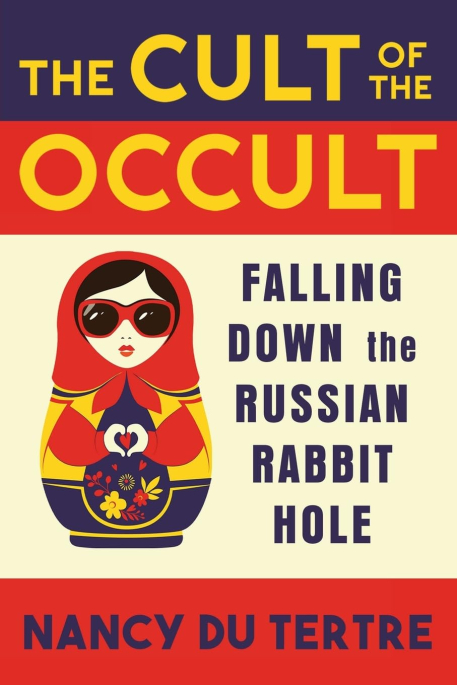
The author, Nancy du Tertre, is known as “The Skeptical Psychic” and has written books before. She appears to have done and experienced everything paranormal. This book, The Cult of the Occult, came about because she wanted to see how psychokinesis (PK) was taught at an institute in Russia.
Dale Graff, known for his involvement in remote viewing, has provided a foreword. His work involved making threat assessments during the Cold War, including about parapsychological research in Russia, but he does not say how Nancy’s experiences tally with what he learned back then. Graff ends his foreword by stating: “The book is an adventure in self-understanding and for learning about the limits of perception. It prompts us to wonder if we are actually in control of everything we do” (p. 3).
The subheading, Falling Down the Russian Rabbit Hole, suggests that it will be a wild story. Unfortunately, it would be a terrible movie because the reader ends up with far more questions than answers.
The book comes with a disclaimer that most of the names of the people mentioned have been changed. Nancy does not indicate which names. It took her four years to write the book, which concerns the two weeks that she spent in Russia in 2019. She made notes during her stay, but she did not speak Russian. The trainers also spoke little English, but the reader does not miss much about PK training, since most of the training Nancy and a friend she calls Rochelle underwent consisted of physical exercises, about six hours a day (p. 41). PK remains mysterious and it remains so for Nancy too, given her different techniques for provoking it (p. 69).
Nancy begins her story by sharing some memories from her childhood that make her wonder if she might have been a subject in an MKUltra experiment, but most of the book concerns her time in Russia.
It is hard to review this book without spoiling the story. Nancy writes that the training in Russia “turned out to be a clandestine indoctrination into a psychic cult by the application of mind-control” (p. 6). It certainly sounds like a fascinating story. Much in the story is strange and people behave oddly. Nancy had prepaid $4,000 and knew a man who had been at the institute before. He had a very different experience. Nancy and Rochelle had to adhere to very strict rules and could not even go to the toilet as they pleased. In addition, they were not allowed to drink coffee, eat meat, and so on. However, they were allowed to use their mobile phones during breaks, so they were not completely isolated from the outside world.
The leader, whom Nancy calls Vadya, did not adhere to the same rules. Nancy only spoke to him once after she had just seen him drink coffee. The women at the institute clearly admired him, but suffice it to say, he did not make a good impression on Nancy and Rochelle. He came across as rude and rambling. Apparently, one of his books had been translated into English, but it did not give a better impression of him. Initially Nancy only learned that he had cured people and that he had a total of fourteen children with different women.
They also observed Vadya during a business roundtable. After presentations, a documentary about psychic healing was shown and Nancy writes: “These business professionals were being carefully groomed to become Vadya’s psychic cult followers” (p. 196).
Another mystery emerges in the book at this stage. Rochelle had seen a woman with a striking appearance, “bangs that looked as if they had been combed with a garden rake” (p. 196) three times, yet Nancy could only remember having seen her once even though she and Rochelle were almost always together. Nancy speculates: “Perhaps she had mastered the art of invisibility and had purposely hidden her presence from me” (p. 198).
Two weeks after returning to the United States Nancy suddenly experienced very severe back pain and soon found out that it was not without reason. She explains what doctors found and wonders if she was cursed in Russia, when Roza, Vadya’s apparent second-in-command, asked Nancy to move black energy down her spine. The story about how Nancy got rid of her back problem is as curious as the sudden emergence of the issue, but I am not spoiling that part.
After having worked on her book manuscript, Nancy searched for information about the institute and learned that Vadya, the 62-year-old founder, had been accused of having sexually abused a girl in 2022. The police had seized photos that showed naked adults with children and Vadya was dead. According to the articles she read, Vadya had either jumped or fallen from a roof and died from his injuries.
Now I finally understood, with a breath of deep relief, that the Institute and Retreat constituted, at bare minimum, a secret sex cult. The cult was dominated by a psychotic, megalomaniac pedophile (p. 225).
On the final page, Nancy observes that “Everything we know is just an incomplete narrative of circumstantial evidence as recounted by different people” (p. 228). There is clearly an interesting and scary story to tell about Vadya and his followers, yet Nancy only spoke to him once. I sense that she needed input from others to understand what actually happened. I think her book represents her attempt to make sense of what she and Rochelle experienced during their time in Russia. The reader is left with more questions than answers.