




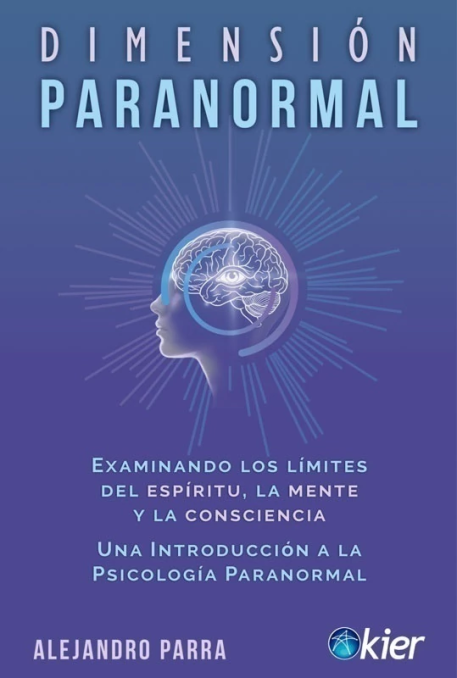
Dimensión Paranormal. Examinando los limites del espíritu, la mente y la consciencia: Una Introducción a la Psicología Paranormal [The world of the paranormal. Examining the Limits of Spirit, Mind, and Consciousness: An Introduction to Paranormal Psychology]
Reviewed by Massimo Biondi
One or two generations ago, virtually every overview of psychical research followed much the same pattern, reflecting the principal division: experimental research and field research. The subject was then defined in terms of the distinction between ESP and PK phenomena; ESP was discussed first, PK deferred to later chapters; mediumship was then examined, followed by phenomena that resisted easy classification (such as out-of-body experiences and deathbed visions), before concluding with a broader critical and theoretical discussion.
Today, the field lacks any comparable overarching structure. Research is often fragmented and self-referential, and authors writing about the “paranormal” tend to organise their accounts according to their own interests or professional experience. In this popular introduction, presented as “a modern and up-to-date synthesis of parapsychology,” Alejandro Parra has clearly drawn on the work carried out at the Instituto de Psicología Paranormal (IPP) in Buenos Aires, incorporating into the volume most of the topics covered in its lectures and workshops. Whether the resulting book can retain the same relevance outside its original cultural context, however, is open to question.
The opening chapter attempts to establish a preliminary theoretical definition of what is meant by the “paranormal”, although the term is occasionally used interchangeably with “parapsychological”. Through a series of conceptual and linguistic clarifications, and by approaching the issue from different perspectives, Parra seeks to distinguish the paranormal from the merely anomalous. The discussion, however, does not entirely avoid contradiction: for instance, the “anomalous character” of an event is itself presented as one of the defining characteristics of a paranormal phenomenon.
Particularly noteworthy in Parra’s book is a table outlining the potential applications of the studies on “paranormal phenomena” in clinical practice, in wider social contexts (including military, artistic and journalistic settings), for “demonstrative”—that is, scientific—purposes (aimed at countering scepticism and providing evidence for survival after bodily death), and in education. Although some of these proposals are highly debatable or perplexing, others remain both persuasive and unquestionably important.
The second chapter is devoted to extrasensory perception, an older label under which Parra groups together a remarkably diverse range of experiences, including spontaneous telepathy and clairvoyance, experiences in the psychomanteum, psychic readings, the “paranormal behaviour of domestic animals,” and other related phenomena. The chapter is wide-ranging and divided into numerous subsections, conveying an impression of a rich and varied field of enquiry. Its discussion, however, is less convincing. The text contains frequent repetitions, an unsystematic accumulation of facts and quotations (without bibliographical references), some inaccuracies of varying importance, and occasional references to isolated cases or individual studies, none of which is adequately contextualised. Unfortunately, as a result, they remain little more than anecdotes with limited evidential value.
Some omissions are also unfortunate. Here, as elsewhere in the volume, there is no discussion of several issues that now occupy a central place in international parapsychological research: the cumulative evaluation of case collections, including spontaneous experiences; the use of meta-analyses and systematic qualitative reviews; the reappraisal of past cases through new methodologies or theoretical perspectives; and continuing efforts to improve investigative procedures. However, Parra’s decision to discuss these topics not primarily from a historical perspective, as is customary, but in terms of their current status within the body of ongoing research and contemporary first-hand testimony, is welcome. Equally valuable is the chapter’s concluding section on theories of extrasensory perception, which offers a clear and balanced summary of the main objections to the simplistic interpretations often advanced by parapsychologists and enthusiasts to explain apparent psi effects.
The following chapter, on psychokinesis, is organised around the familiar tripartite distinction between micro-PK, macro-PK and bio-PK. For these categories, Parra respectively concentrates on the Global Consciousness Project, a single Argentine poltergeist case, and psychic healing. He does not, however, distinguish clearly between spontaneous phenomena and those observed under controlled experimental conditions, nor between the outward appearance of alleged phenomena and the results of systematic investigations. Likewise, insufficient attention is paid to the extent to which the isolated examples discussed may reasonably be regarded as representative of the wider classes of phenomena to which they belong.
Chapter Four, devoted to altered states of consciousness, is perhaps the most problematic in the volume. These states are treated as “paranormal phenomena” in themselves, rather than as the psychological context within which anomalous experiences are generally believed to occur. Chapter Seven, explicitly entitled “Beyond the Paranormal,” sits equally uneasily within the book, as it turns instead to miracles traditionally associated with Christianity, including Marian apparitions, the bilocation of saints, and the incorruptibility of the body after death.
Chapter Five examines the psychological interventions that may be employed—and are reportedly employed at the IPP in Buenos Aires—to assist individuals who report anomalous experiences such as out-of-body experiences (OBEs) or ADCs (After-Death Communications), as well as those distressed by perceived encounters with invisible entities.
Chapter Six, one of the most extensive, is devoted to the question of survival, now one of the dominant themes in contemporary parapsychological research. Parra considers four principal categories of evidence: near-death experiences (and, to a lesser extent, certain OBEs), children’s memories of previous lives, channelling, and apparitions. With the exception of cases suggestive of reincarnation, for which he relies chiefly on the work of Ian Stevenson, the treatment of the remaining topics is almost entirely qualitative and overlooks much of the extensive empirical research and theoretical discussion produced over recent decades. This limited engagement with the experimental dimension of contemporary parapsychology constitutes one of the book’s principal weaknesses.
The volume opens and closes with brief reflections on an important methodological issue: the role of laboratory research and rigorous scientific investigation within contemporary parapsychology. In offering his own highly personal reflections, Parra illustrates that this question remains unresolved, just as the broader issue of whether the findings of parapsychology will ever gain acceptance within the scientific mainstream continues to divide opinion and is unlikely to be settled in the foreseeable future. Any overall assessment of the volume should nevertheless acknowledge the value of including these broader topics, although readers less familiar with the field would undoubtedly have benefited from additional guidance to help them navigate such a complex subject.
Overall, there can be little doubt that Alejandro Parra’s book provides an accessible introduction to several important areas of contemporary psychical research. At the same time, the treatment of individual topics would have benefited from more careful revision, in order to address a number of significant omissions, together with more thorough editorial work, to eliminate unfortunate repetitions, inconsistencies, and factual inaccuracies.