




Reviewed by Nemo C. Mörck
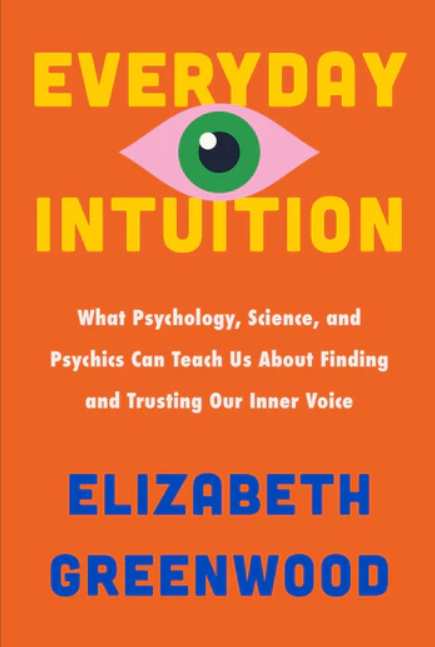
In hindsight, it seems as if the seed for this book was planted by Elizabeth Greenwood in 2019. That year she attended a tarot-for-intuition workshop and wrote “I want everyday intuition” in her journal. She has now written a book about the subject. Greenwood wrote her book “… to fill a gap between the pithy bullet points of self-help and the dense tomes of academic studies translated into pop psychology.” There is an index and Greenwood lists her sources. She has mainly relied on the secondary literature and a number of interviews.
The definition of intuition turns out to be elusive and varies between interviewees. The focus is not on the paranormal interpretation, though Greenwood is open to that explanation and writes: “The women in my family are seers—they connect with the dead, they get visions in dreams, they know when someone is pregnant before they have been told.” She has interviewed one sceptic, Kenny Biddle, associated with the Committee for Skeptical Inquiry. Deirdre Barrett, known for her research in dreams, is also sceptical of paranormal interpretations. Most interviewees take intuition for granted. Some favour normal explanations and others seem to lean towards paranormal interpretations. Greenwood makes a point of treating mediums and psychics with as much respect as she grants researchers.
She has adopted a rather informal style and has sprinkled the book with some humour. I found “spiritual charlatans self-publishing in Comic Sans” memorable. Greenwood seems happy to present different perspectives on intuition without judging. In her introduction she writes that intuition is “a knowing, without always knowing why.” However, she recognises that it is not always easy to separate from anxiety and throughout the book Greenwood returns to the question of how to tell them apart. Anxiety might mean going back home to check if the stove was really turned off while intuition might mean going back home to turn the stove off. Parapsychologists are naturally interested in the cases in which normal factors are unlikely to offer an explanation, but, in practice, in everyday life they are often hard to rule out.
Greenwood certainly does not insist on a paranormal interpretation. However, some cases are curious. For example, in 1973, a girl got upset when her grandfather was about to sit in his favourite chair and told him not to do so: “Moments later, a crack ruptures the ceiling above the grandfather’s chair. Moments after that, the crack gives way, raining down plaster and cement.” At a psychiatric hospital, a woman joked about “getting punched in the face by a particular patient” and about ten minutes later she was really assaulted by that patient.
A couple of familiar names turn up in the book. For example, Jessica Utts, Theresa Cheung, and Julia Mossbridge. Utts tells Greenwood that “I think this is a skill that could be taught and you could get better at with practice. What you can teach people is to not have such an analytical overlay.” Cheung and Mossbridge suggest that “intuitions are more neutral in tone; anxiety comes with more emotional agitation.” However, Greenwood also talks with more mainstream researchers such as John Bargh, who likens unconscious processes to dolphins: “They can swim in the waters of unconscious processing, but they need to come up for air, into consciousness.” She also speaks to people who are less well-known, such as Lucy Easthope, who apparently experiences several bodily sensations prior to disasters.
Overall, Everyday Intuition is a pleasant book. I sense that Elizabeth Greenwood never presents a proper synthesis of what she has learned, but what she does well is to present a variety of perspectives on intuition and to connect them with a rather informal style that is easy to read.