




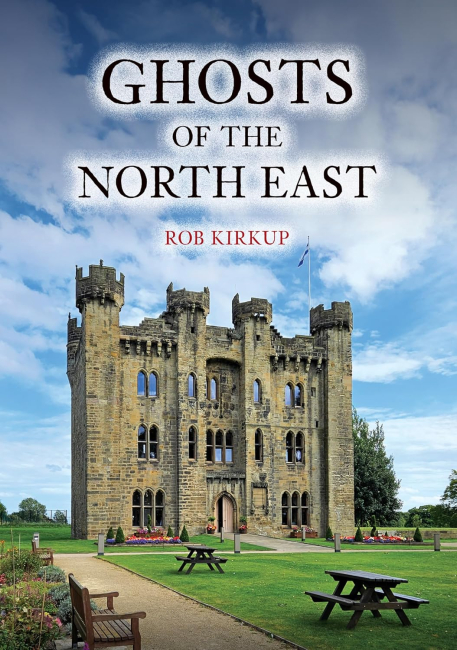
Reviewed by Ashley Knibb
Rob Kirkup is very much a “local voice”: born in Ashington, Northumberland, and (by his own account) a lifelong North-East resident with a long-standing interest in myths, legends, and paranormal experiences. That rootedness shows in Ghosts of the North East, which reads less like an abstract survey of British hauntings and more like a guided tour through a particular landscape—coastal sites, castles, inns, battlefields, museums, and public buildings—each carrying a mixture of history, folklore, and alleged encounters.
Kirkup’s wider output helps explain the book’s approach. He has written multiple titles touching on regional history across Northumberland, Tyne & Wear, County Durham and beyond. In addition, in 2022 he launched the podcast How Haunted?, with episodes focusing on ghost stories. In that sense, Ghosts of the North East feels designed to be accessible and episodic: a succession of “places to know” and “stories to tell,” rather than a single sustained argument about why hauntings occur or how best to investigate them.
Structure and coverage
The book is organised geographically, moving through Northumberland, Tyne & Wear, County Durham, and Teesside. For readers who enjoy “armchair travel” through haunted Britain, this structure works well: the locations come thick and fast, and there’s a clear sense of variety in setting and theme.
However, the balance between local history and ghostly material is uneven across the sections. Some entries lean heavily into background, context, and local colour with the haunting element arriving late, briefly, or as an afterthought while others deliver what many readers will come for: a more direct presentation of reported phenomena, recurring figures, and traditional case motifs.
Northumberland: strong highlights alongside lighter sketches
In the Northumberland section, the opening on the Holy Island of Lindisfarne provides a pleasant overview, but it can feel more like a short introduction to the site than a developed account of its reported hauntings. By contrast, Flodden Field is more satisfying as a story; the ghosts are better integrated into the narrative, and the mention of experiences around the A697 road raises an interesting interpretive question. Is the report being framed as “battlefield ghosts” in the familiar sense, or does the description drift closer to a time-slip style account? The book doesn’t (and perhaps isn’t aiming to) settle that question, but it’s one of the moments that nudges the reader into thinking about classification rather than simply collecting anecdotes.
Several of the shorter entries, such as The Dirty Bottles and Winter’s Gibbet, read as quick stops. They may function as prompts for further reading, but as stand-alone “haunting” chapters they can feel thin, especially when paranormal detail is scarce.
Two of the more engaging Northumberland inclusions are The Schooner Hotel and Chillingham Castle. The Schooner section benefits from a better balance of history and ghost tradition, and it’s presented as a location with extensive claims (including many alleged individual ghosts and a substantial volume of reported sightings). Chillingham Castle, meanwhile, is written in a way that does what a good “haunted places” chapter should; it makes the site feel visit-worthy. The history and the alleged phenomena are woven together effectively, and one comes away with the sense that; at least within North-East haunting culture, Chillingham is treated almost as a rite of passage for ghost hunters.
Tyne & Wear: an improved history–haunting balance in places
Tyne & Wear continues the pattern: some entries feel light on detail (Souter Lighthouse), while others are more developed and suggestive. Hylton Castle, for example, offers enough paranormal content to raise the possibility of poltergeist-like themes (without pushing any firm conclusion). The Castle Keep stands out as one of the better-balanced sections, with a welcome expansion into legend and even a touch of witchcraft material, giving it a broader cultural texture than “a ghost was seen here.”
Marsden Grotto also works well because it naturally accommodates layered storytelling, smuggling history, secrecy, and the expected addition of ghost tradition. The Angel View Inn is built around a classic haunted-inn narrative; tragic death leading to lingering presence, but it’s comparatively brief, and the emotional weight of the origin story arguably deserves more space than it gets. Gibside is interesting for its historical links (including an association with the Bowes-Lyon family), but here the paranormal content feels more loosely attached than fully explored.
County Durham: history often leads, but the book finds its stride
In County Durham, several entries again foreground history, with ghost material arriving late or lightly. Bowes Castle introduces intriguing ideas—anniversary ghosts, curses, hidden treasure; yet the account feels short, as though it is sketching a promising outline rather than presenting a developed treatment. Barnard Castle is similarly history-heavy, with the haunting component compressed into the closing portion.
Cauldron Snout shifts the emphasis back toward legend and the uncanny via the Peg Prowler, leaning into cryptid-like territory more than architectural or genealogical history. It’s one of the instances where the book broadens beyond the “standard” haunting repertoire, though the treatment still feels like an introduction rather than a deep dive.
Durham Castle and Crook Hall are again weighted toward history, with Crook Hall leaving its key ghost figure, the White Lady, until very late. For a book titled Ghosts of the North East, those late-arriving hauntings can leave the reader wanting the “ghosts” earlier, fuller, and with more context.
By contrast, Lumley Castle is one of the strongest chapters in the book for paranormal content. It contains richer detail, incorporates the appealing “famous witness” element (well-known visitors reporting experiences), and offers a range of motifs; the classic nineteenth-century spectral girl, a headless horseman, and even a true-crime crossover flavour. This is “good on the ghosts” in the straightforward sense.
The North of England Lead Mining Museum chapter is another highlight, moving beyond a single apparition to a small ecology of reported experiences; tommyknockers, footsteps, whispers, and apparitional reports tied to named or semi-named figures and local legend. Beamish Hall also delivers effectively, offering multiple ghosts (including a grey lady) and a set of concise but memorable stories.
Teesside: broad range, variable depth
Teesside sustains the same rhythm; some chapters are better balanced than others. The Dorman Museum offers a decent mix of history and haunting, though the ghostly element could go further. Seaton Hotel (formerly the Ship Inn) provides interesting history with brief ghost stories. Camerons Brewery leans history-heavy again.
Middlesbrough’s Central Library is a strong inclusion, particularly with mention of a figure reportedly caught on camera; material likely to interest readers who are drawn to modern “evidence narratives,” even if the book itself is not a technical analysis of such evidence. Acklam Hall continues the grey lady tradition (here linked to Charlotte Hustler in the 1800s) and is presented in an engaging, balanced way.
The Swatters Carr adds theatrical history (notable performers associated with the venue) and ties it to reported audible phenomena such as loud sounds and even growls while Wynyard Woodland Park introduces a different flavour again; an apparition (a stationmaster) and a large shadowy cat, keeping the book’s “uncanny zoology” thread alive. Preston Hall Museum returns to the familiar combination of a grey lady, a phantom highwayman, and a First World War soldier, but sensibly balanced.
Overall assessment
As an introduction to allegedly haunted North-East locations, Ghosts of the North East does a lot right. It offers breadth, readability, and a steady stream of places that a curious reader or an amateur investigator might genuinely want to visit. At its best (Chillingham Castle, Lumley Castle, the Lead Mining Museum, Beamish Hall, and several Tyne & Wear entries), it strikes an effective balance between history and reported phenomena, and it reminds the reader that “haunted place” traditions are often inseparable from the social history and storytelling culture that surround them.
Its main limitation is inconsistency of depth. A few entries feel truncated, with paranormal claims sketched rather than examined, and with some chapters placing the “ghosts” in the final paragraph after a longer historical preface. For an SPR audience often attentive to the detail of testimony, the layering of tradition, and the difference between legend, second-hand report, and first-hand account; those shorter treatments may feel more like prompts for further research than satisfying case presentations.
Still, there are genuine “gems” here; a wide range of recurring motifs (grey ladies, servant-girl apparitions, headless horsemen), the occasional flirtation with time-slip-like framing, and the inclusion of cryptid-leaning material such as the shadowy cat. Taken as a starting point rather than a final word, the book succeeds; it’s a practical and entertaining map of North-East haunting lore, and a useful springboard for readers who want to begin their own enquiries; ideally with a critical eye, good note-taking, and a clear separation between local tradition and evidential case material.