




Reviewed by Nicholas Duffy
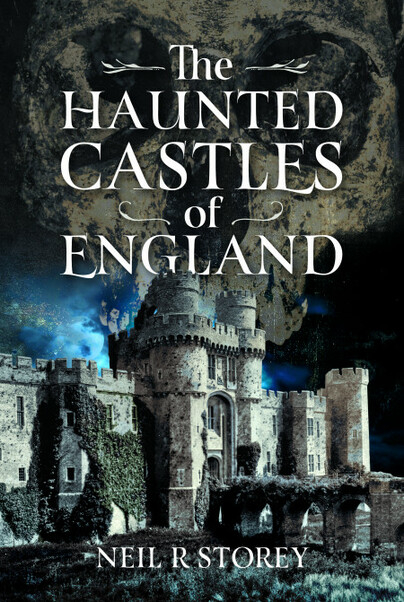
Save for, perhaps, ‘public houses’, there is very little that epitomises the ghostlore of our country more than an allegedly haunted castle, and, in this impressive-looking volume, the reader is taken on a tour of such locations that spans the length and breadth of this ‘green and pleasant land’ of ours. Of course, given the subject matter concerned – reflecting on the myriad tragedies and intrigues acted out inside these mighty edifices – there is very little that could be construed as particularly ‘pleasant’ on offer in these (falling just under) 200 pages. But there are ‘no complaints’, of course – as this is precisely what we’re here for, isn’t it? Literally every form of ‘cide’ imaginable: regicide, fratricide, patricide, suicide, infanticide – oh, and, of course, the ghosts, hauntings and folklore supposedly deriving from such horrific acts – are all deftly presented here by this highly recognised historian and author, with, impressively, some 40 to 50 books, on a variety of different historical topics, under his belt!
Admittedly having no experience of the literary works of Neil Storey previously, and having never attempted the challenge of putting together a book review before either, I did consider that I was somehow, ‘kindly’, being ‘eased into the task’ in being introduced to this specific volume. I was bluntly informed, by way of introduction to the subject matter, that, ‘There are a ton of books like this, but this one might be among the better given the author…’, and, having now scrutinised it at length, I’m sure this is, most likely, the literal truth!
The volume is written in an easy-to-digest manner, over the space of seven chapters – each of these dedicated to a different portion of the map – with the reader being introduced to every site, alphabetically, within the aforementioned geographical segment, via a fairly standard historical overview of the location, interlaced with its relevant ghostlore. The work itself stands as an entertaining ‘stroll through the haunted history of castles’, very much a fascinating ‘guidebook’, rather than anything more involved or unnecessarily cumbersome… plainly put. Storey informs us that he has had the distinct pleasure of being present at many investigations of these – and numerous other, we presume – historic sites. Thankfully, there is little to no ‘personal’ take offered within the text – no superfluous, subjective instances of perceived ‘high strangeness’ hailing from the aforementioned ‘ghostly explorations’ – distractions which, on the whole, would, most likely, only serve to detract from the overall ‘historical-based’ tone of the book.
Unlike with a lot of authors, there is clearly no ‘crusading on behalf of personal belief’ present here. Information is proffered ‘as found’, for the reader to digest for themselves, however they might see fit. Storey’s personal ‘fascination for ghosts’, it is shared, has humble, innocent childhood-born beginnings… something that, I’m certain, has to resonate with a great many of us here – myself included, most definitely!
In an explanatory introductory note, it is stated that the earliest examples of the ghostlore covered herein are the references mostly proffered here and are ‘reported as they appeared’, criteria which Storey admits to ‘putting stock in’ himself and something a great many readers – again, myself included, as someone who approaches such topics from a more folklore-based standpoint – will surely appreciate. In a field where ‘pop culture influence’ now has long-established and accepted ghostlore frequently changing or ‘becoming transmogrified’ – seemingly by the second and quite unfathomably, on a whim, in most instances – it is, of course, preferable to view each and every theme from its oldest known source… for the sake of creating an objective, more measured timeline of reported events.
Indulging myself from a purely personal viewpoint momentarily: as a lifelong resident of ‘the Black Country’ and, of course, a keen paranormal enthusiast, I’m certainly NOT accustomed to discovering a chapter of a ‘Haunted England’-style publication that covers ghostly dealings within my own region! In fact, it was the process of literally growing up reading such literature – and, almost invariably finding nothing at all listed for the English Midlands (and, particularly the West Midlands county) – that provided me with my own ‘particular course’ throughout the bulk of my adult life: the simple task of specifically seeking out such history and pertinent references, wherever they might appear. (This was, of course, a scene very much based in the days well before every Waterstones had a local history section positively bursting with ‘regional’ ghost titles – seemingly written by anyone who could ‘tap on a keyboard’, in many instances; unfortunately, it should be pointed out!) How thoroughly refreshing, therefore, to discover that The Haunted Castles of England contains a whole chapter dedicated to this very topic, such a simple fact, but one that gave me so much delight! (Amusingly – and I certainly couldn’t miss such an irony – one of the very few locations that just might have received a mention ‘back in the day’ was the diminutive – but beautiful – South Staffordshire fortress of Tamworth Castle… which also just happens to be covered, albeit only in one of the briefest of references, in this book.)
Also included in ‘Chapter 3: The Midlands’ are a handful of sites – Moreton Corbet Castle, Warwick Castle, Hopton Castle, Astley Castle, and others – that I happen to have had the distinct pleasure of visiting and investigating for myself. In decades gone by, the latter-mentioned romantic ruin at Astley, situated just outside Nuneaton, Warwks. – along with the adjoining churchyard of St Mary the Virgin, also rumoured to be haunted – played host to many an overnight vigil of mine. Similarly, in more recent times, the Civil War ravaged remnants of Hopton Castle, in Shropshire, has become a firm favourite too…
As far as a critique of this volume is concerned, there are very few observations that I can make, which might point towards anything of a ‘downside’, and, on the whole, any moderately low-key observations that I might offer would purely boil down to wholly subjective wants, on my behalf, and, thereby, have no place in an attempt at an objective appraisal. However – and I’m quite loath to mention this, given such an enjoyable and visually pleasing volume – one particular ‘fault’ that couldn’t be ignored involves what appears to constitute a ‘publication oversight’ and, thereby, cannot really be ‘laid at the feet of the author’. Simply put, there were a number of punctuation issues noticed throughout, including a somewhat haphazard usage of commas (mainly ‘the lack of’), as well as, occasionally, ‘missing’ full stops, letters from words and, unfortunately, whole words themselves at a few junctures. As someone who has lived with fairly severe concentration issues for a number of years now, I have to consider such factors in an honest appraisal of (at least this print of) the book, as I’m certain that more able or pedantic readers – especially considering the ‘reasonable’ cover price involved – will not fail to notice such details.
By way of summary, I would suggest that, for someone coming to this volume completely ‘blind’, the book might strongly be suggested as something of a ‘primer’, of sorts, easily suitable for someone being introduced to the topic at hand – a younger family member, perhaps, or someone not particularly interested, or versed in the complexities of paranormal research – or, as in my own experience with it, equally viewable as a historically informative nostalgic ‘revisit’ to places that I’d once read of in decades past. Given the autumn release of this book, I can well imagine that – just a couple or so months further on – copies will potentially be chosen to grace many Xmas stockings and be exchanged as gifts over the festive season. It would, most certainly, serve as an admirable present for readers both young and old alike!
Harking back to my own formative reading days – many of which would certainly have been set against the backdrop of dark, cold wintry nights, sitting next to a roaring coal fire! – volumes very much akin to this one were absolutely instrumental in both feeding my fledgling passion for all things ‘ghostly’ – in the earlier years – and, subsequently, serving as a catalyst for my own lifelong pursuits within the field of (albeit, almost entirely, ‘parochial-based’) paranormal research… In signing off on this brief appraisal, I sincerely hope that The Haunted Castles of England will also go on to serve as similar motivational stimuli for future generations of investigators to come!