




Reviewed by Karen Stollznow
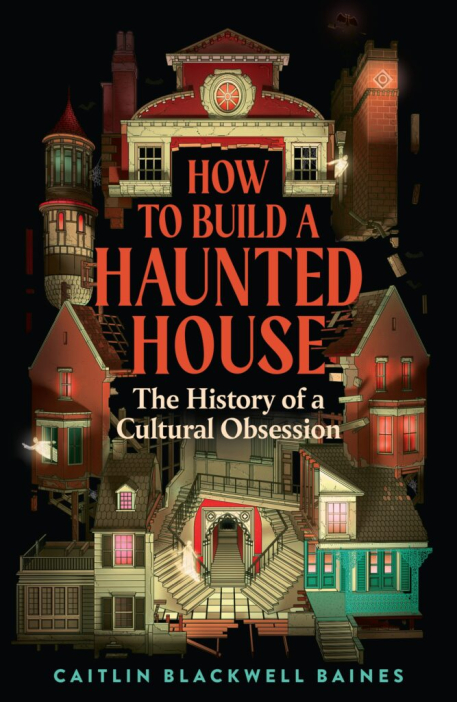
With a playful title like How to Build a Haunted House, I expected that this book would be a kind of blueprint for a haunting, a breakdown of the essential ingredients that make a house feel haunted. The introduction certainly suggests this approach, posing enticing questions about why certain architectural details, atmospheres, and recurring ghost story tropes appear in hauntings across time and culture. It’s a strong hook, and one that positions the book at the intersection of folklore, history, psychology, and architectural storytelling. But rather than offering a step-by-step anatomy of hauntings, the book takes a different route. What follows isn’t a guide so much as a guided tour. It presents a series of case studies of well-known “haunted” locations, with each site explored through its legends.
Each chapter takes on a different building and, rather than chasing proof or debunking claims, it digs into the cultural anxieties woven into its folklore. The author, Caitlin Blackwell Baines, isn’t asking: Did this really happen? So much as: Why do we tell these stories? And why here? It’s a clever twist that breathes new life into familiar stories.
The chapter on the Myrtles Plantation highlights the legacy of enslavement that often gets glossed over in modern ghost tour narratives. The Borley Rectory chapter moves past the usual ghost lore and instead follows the real drama: the lives of the Bulls, Smiths, and Foysters who called it home, and the showmanship of Harry Price, who helped turn the rectory into a paranormal attraction that endures to this day (even though the house is long since gone).
The chapter about the Winchester Mystery House explores the alleged ghosts of Indigenous peoples as an embodiment of past atrocities. Others, moving from Hampton Court and Raynham Hall to Amityville, follow this same pattern. Each site becomes less of a stage for its resident ghosts and more a mirror reflecting social fears, cultural tensions, and unresolved histories. The author’s tone remains quietly sceptical, but the book closes with a personal encounter that suggests she hasn’t dismissed the possibility entirely.
Blackwell Baines is an art historian who specialises in Gothic art and architecture and her expertise is evident throughout the book. Her descriptions of the buildings themselves, like the Georgian Gothic Strawberry Hill House, and the irregularities of the eclectic Winchester house, are vivid and atmospheric. The book also benefits from the fact that she visited some of the sites profiled. This is not a new idea, but it lends an immersive, first-hand quality that is often missing in books built on armchair research. It ends up somewhere between a travelogue and an exploration of haunting traditions, so readers with a taste for dark tourism or legend-tripping will feel right at home.
The inclusion of legends in Japan hints at a more global scope, yet the overall mix of locations feels somewhat eclectic, and at times, even arbitrary. The cases mostly focus on locations in the United Kingdom and United States, but without an explicit framework tying them together, the selection feels more curated by personal curiosity than by clear criteria. The choices are interesting, but as a reader, you’re occasionally left wondering: Why these stories in particular? And why not the many others that are out there?
And there’s a sense that the central thesis never fully lands. The ideas raised in the introduction surface again throughout the book, though mostly in passing. They hover in the background rather than driving a unified argument, leaving the reader wishing those broader insights had been developed with more depth and clarity. These places have been written about extensively, yet here, some of the folklore and history is incomplete or occasionally off the mark, while the references are surprisingly thin. In the end, the book opens more doors than it closes, but perhaps that’s intentional.
The book is an entertaining read and the writing style is conversational and approachable. At times, however, the narrative treads familiar ground and lapses into some repetition. Details or ideas resurface without clearly deepening the analysis. Still, when the author grounds a location in its architectural history, the book feels at its strongest. These moments suggest a richer line of inquiry, not just cataloguing haunted sites, but exploring how history, environment, and narrative work together to make a haunting take hold.
How to Build a Haunted House succeeds in reframing these hauntings, not as mysteries to be solved, but as cultural expressions that ultimately tell us more about the living than the dead. Even with its gaps, this book offers a thoughtful and engaging contribution to ongoing conversations about why certain sites become haunted in the first place, and why these hauntings persist.
Dr Karen Stollznow is a linguist, author, and researcher at the University of Colorado Boulder.