




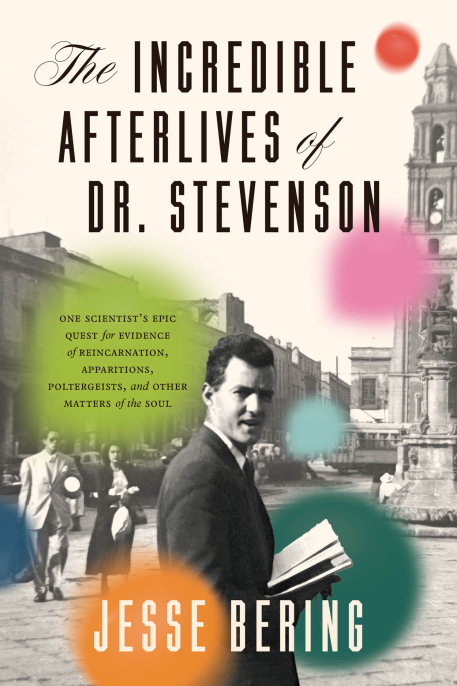
Reviewed by Nemo C. Mörck
The author, Jesse Bering, is Professor of Psychology at the University of Otago in New Zealand. He has been familiar with Ian Stevenson and his research for some time now, having written about him and the research in the Scientific American (Bering, 2013). He has also published in the Skeptic (Bering, 2019). Bering remains sceptical after having studied Stevenson’s life and research more closely. His wording occasionally makes that clear. However, it is not bothersome. In addition, fortunately, as Bering is Head of the Science Communication Programme, The Incredible Afterlives of Dr. Stevenson is easy to read.
I imagine that people in the parapsychology community might feel somewhat apprehensive when an outsider like Bering decides to pick up his pen. It is hence a relief that he acknowledges that James G. Matlock has helped him get the facts right. I noticed only a few minor errors, for example, F. W. H. Myers was an inspector of schools (not a director of schools). There are also far more cases of veridical perception during out-of-body experiences than Bering suggests (e.g., Holden, 2009). However, there is much that is laudable about this book about Stevenson, who was rather reluctant to talk with journalists about his personal beliefs. Bering has clearly done his homework. In addition to Stevenson’s research, he has also read correspondence and conducted interviews.
Bering has written a biography of Stevenson, but Stevenson sometimes ends up in the background. For example, Bering devotes pages to Eileen Garrett and Chester F. Carlson. Garrett, with the financial aid of Frances Bolton, supported much research, including Stevenson’s through the Parapsychology Foundation. Carlson also had deep pockets, and, in addition to Stevenson, the American Society for Psychical Research and the Rhine Research Center also benefited. It was also thanks to Carlson’s generosity that the Division of Perceptual Studies was founded. So, it seems appropriate that they are both given space, though the section about Garrett appears to have been written before Coyle (2024) and Warwood (2025) complicated the picture of her.
Bering allows the reader to get to know Stevenson better. He also covers a sample of Stevenson’s research and interjects his own humour, studies, and personal experiences. For example, Bering presents the Pollock twins, Imad Elawar, and research involving the medium Hafsteinn Björnsson. What he writes is sensible, and I am sure he recognises that it is possible to dwell longer on the criticism Stevenson’s research received (see Matlock, 1990), but Bering remains sceptical and shares his own concerns. Besides, the main point of a biography is not really to evaluate the evidence for and against.
I have a few concerns. The book ends rather abruptly. Perhaps an updated view of cases suggestive of reincarnation would have been appropriate? As Bering acknowledges, the research continued after Stevenson’s death. In addition, although Erlendur Haraldsson and Jürgen Keil are mentioned, it is not made clear that they walked in Stevenson’s footsteps along with Antonia Mills, who is never mentioned (see Mills et al., 1994).
I am also somewhat unsure about whether Bering truly appreciates the difference between Stevenson’s approach and the approach adopted by the Rhines, J. B. Rhine and Louisa Rhine. Stevenson was much more for what is generally known as psychical research, careful examination of cases and evaluations of statements made by mediums. J. B. Rhine famously came to promote controlled laboratory experiments while Louisa Rhine collected uninvestigated spontaneous cases. Bering only touches briefly on the different research traditions, and on Stevenson's (1988) commentary, which cannot have been appreciated by their followers.
Stevenson’s academic writing can seem rather dry, so I think Bering, and before him Shroder (1999), have done the parapsychology community a favour by presenting the research to the public. Kelly (2013) has previously presented a collection of Stevenson’s articles, and her book is a good complement for the reader who wants to know more.
Sceptics may complain about the solved cases – meaning cases in which a deceased person has been found whose life appears to correspond to the claims made, usually by a child, about a previous life. However, personally I am amazed by the fact that researchers have managed to solve any cases. From the literature I get the impression that people are not meant to remember their previous lives and when they, nevertheless, do, they only remember bits. For a case to be solved someone must first take the statements and sometimes unusual behaviour seriously. Then someone armed with little information needs to investigate.
As Bering recognises, remarkable lives are likely to be documented while the unremarkable lives are less likely to be documented. The evidential value of the former is dubious since normal sources of information can be readily available and the evidential value of the latter can be hard to assess.
Perhaps we have all lived before but are just unable to remember yet are affected by our previous lives. Stevenson (1977, 2000) pondered on this possibility. From my perspective, we gradually discover ourselves as we grow up. We learn what we like and what we don’t appreciate. Explaining why is not always easy. Perhaps previous lives in addition to nature and nurture in this life are what shape us. Bering remains sceptical, but he has treated both Stevenson and his research with respect. I am happy to recommend his book.
References
Bering, J. (2013, November 2). Ian Stevenson’s case for the afterlife: Are we ‘skeptics’ really just cynics? Scientific American. https://www.scientificamerican.com/blog/bering-in-mind/ian-stevensone28099s-case-for-the-afterlife-are-we-e28098skepticse28099-really-just-cynics/
Bering, J. (2019). Conversations with my dead mother: Why we see signs and omens in everyday events. Skeptic, 24(2), 16-18.
Coyle, J. (2024). The early life of Irish psychic and trance medium Eileen J. Garrett: Fact or fabrication? Independently published.
Holden, J. M. (2009). Veridical perception in near-death experiences. In J. M. Holden, B. Greyson, & D. James (Eds.), The handbook of near-death experiences (pp. 185-212). Praeger Publishers.
Kelly, E. W. (Ed.) (2013). Science, the self, and survival after death: Selected writings of Ian Stevenson. Rowman & Littlefield.
Matlock, J. G. (1990). Past life memory case studies. In S. Krippner (Ed.), Advances in parapsychological research 6 (pp. 184-267). McFarland.
Mills, A., Haraldsson, E., & Keil, H. J. (1994). Replication studies of cases suggestive of reincarnation by three independent investigators. Journal of the American Society for Psychical Research, 88(3), 207-219.
Shroder, T. (1999). Old souls: The scientific evidence for past lives. Simon & Schuster.
Stevenson, I. (1977). The explanatory value of the idea of reincarnation. Journal of Nervous & Mental Disease, 164(5), 305-326.
Stevenson, I. (1988). Was the attempt to identify parapsychology as a separate field of science misguided? Journal of the American Society for Psychical Research, 82(4), 309-317.
Stevenson, I. (2000). The phenomenon of claimed memories of previous lives: possible interpretations and importance. Medical Hypotheses, 54(4), 652-659.
Warwood, E. J. C. (2025). Behind the medium's mask: Eileen Garrett’s shadow self. New Directions Network.