




Reviewed by Ciaran Farrell
Jeremy Spillane is a rather ordinary and unassuming man who has been on an extraordinary voyage of discovery with his wife Caroline following the deaths of his mother-in-law, Joan, and his father-in-law, Roger. It is through this adventure that he has learnt ghost hunting and paranormal investigative skills in order to be able to explore, examine, and understand the strange happenings that began to occur after Joan’s death, which increased and also intensified after Roger’s passing a couple of years later.
Jeremy has dedicated his book to Caroline for supporting him throughout their journey, and to Roger, whom he believes has guided and inspired him to write the book (despite the fact that he never had any ambitions to become an author). Roger was a passionate, dedicated, lifelong teacher and educator who held very strong and definite materialistic views about life, the universe and the lack of an afterlife. Jeremy believes that Roger came back from beyond the grave in order to teach him and Caroline that he was wrong, and that his life with his beloved wife, Joan, continues unabated in the afterlife.
Jeremy opens his book with a series of four commentaries on his book’s contents from Ian Williams, who is a senior English teacher and the subject of a couple of episodes of Danny Robins’ series Uncanny. He considers Jeremy’s book to be a compelling read.
This is followed by an endorsement by the retired particle and nuclear physicist Mark Wentz, who was impressed by the SLS camera methods that Jeremy and Caroline devised in their search to prove the physical existence of Roger and Joan as spirits.
Then there is the endorsement by the UK’s Premier Psychic Medium, Stephen Holbrook, who commends Jeremy for the way in which he has put his book together and considers the approach he took in doing so to be both natural and humbling, which Stephen found enlightening.
The final endorsement is from Mark Penn, who is a parapsychologist and demonologist.
The book has an unusual format in that Jeremy asks readers to view various YouTube videos that he has made, which contain a lot of background information that supports the text and narrative of his book. There are also many videos of experimental sessions in which Jeremy uses ghost hunting equipment to detect Joan and Roger’s spirits, as well as that of his deceased spaniel, Poppy.
The book contains a list of references for further reading, as well as a film and TV series to watch.
The Introduction describes the happy family life Jeremy and Caroline had with Joan, Roger and their extended family. It also covers Joan’s sudden and unexpected death in 2017, after which signs of a haunting began to materialise. Roger’s health had been in decline, and his death followed some time later, during which the family were starting to wonder whether or not Joan was trying to communicate from the afterlife through various signs and signals. Roger had remained impervious to these suggestions and carried on with his life as best he could.
The subsequent chapters set out Jeremy’s search for answers and his quest to prove that Joan, and most particularly Roger, were trying to contact him and Caroline to tell them about the afterlife. The chapters cover both instrumental and mediumistic methods of enquiry by a number of different mediums, including the UK’s Top Medium, Ali Mather, and also Liz Murphy.
Three weeks after Roger died, Jeremy and Caroline went to see Stephen Holbrook, who had a message for them from Roger. It was this, and some strange light and other phenomena in the cemetery around Joan’s, and later Roger’s, grave, that led Jeremy to start watching paranormal reality TV programmes and documentaries. He purchased ghost hunting equipment, including a K2 EMF meter and an Ovilus 3, as well as an SLS camera system. He also read extensively about the paranormal and the way in which it can be investigated.
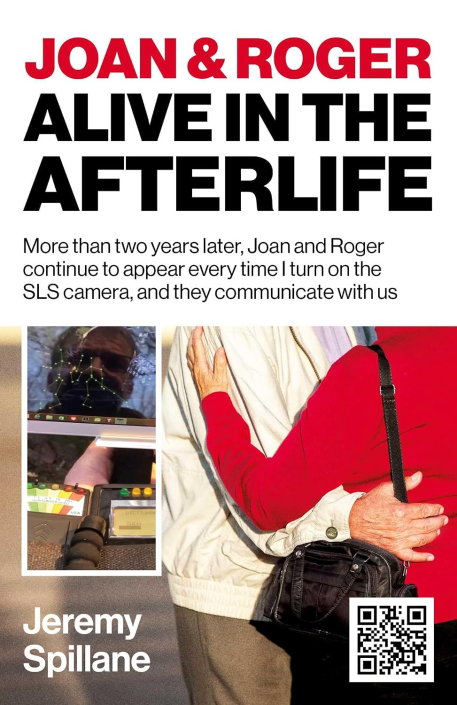
Some ghost hunters use SLS, or Structured Light Sensor, systems to detect the presence of ghosts. They are essentially a computer gaming setup that has been repurposed for paranormal investigation, which functions along similar lines to a radar system. An array of microdots is projected outwards into a room from the device, and the device, with the aid of a tablet or computer, interpolates the reflections it receives back from objects within the room. This is in order to be able to identify where a stick figure representing a person who is holding and manipulating the controls of a handheld game console might be. The system then interprets the person’s use of the console as part of a computer game’s control system. The use of these devices in paranormal investigation is problematic, as the system is programmed to find evidence of a person which it can interpolate as a stick figure, even when there is nobody within its microdot array.
The use of EMF meters to pick up on any electrical component that a ghost may have is common ghost hunting practice, but the K2 is known to be unreliable. The Ovilus 3, a dictionary-based device which will speak words from its memory bank either at random or under the influence or direction of a spirit wishing to communicate, is also controversial.
Through detailed experimentation described in the book and in YouTube videos, Jeremy explains how he considers that he has overcome the shortcomings of the various pieces of equipment by using them in combination in order to prove Joan and Roger’s existence in the afterlife. He not only draws together these instrumental means of spirit detection, but also combines them with mediumistic means of enquiry in a unique and novel method of investigation.
In addition to this, Jeremy describes in Chapter 8 how he approached the SPR’s Spontaneous Cases Committee, which resulted in SCC member and investigator Aaron Lomas carrying out a personal investigation of Jeremy’s claims and his SLS camera system.
Jeremy acknowledges that the SPR has a policy of holding no corporate opinion about the existence or causation of paranormal phenomena, which Aaron must work within. Aaron conducts a thorough and scientific investigation into Jeremy’s methods and claims, as well as the SLS camera system itself. This proves to be inconclusive from a purely objective and scientific point of view, and it reveals that the case has produced far more questions than answers. Jeremy takes this to be a tacit endorsement of his methods and findings, as a result of his desire for validation and enthusiasm for paranormal investigation based on his own personal knowledge and experiences.
In the remaining chapters of the book, Jeremy sets out and explores further mediumistic means of enquiry and investigation in order to extend and maintain his contact with Joan and Roger in the afterlife and provide a second set of proofs of their discarnate existence.
Finally, Jeremy considers the topic of reincarnation and the nature of the human soul before concluding his book with the life lessons that he believes Joan and Roger have taught him and Caroline, as well as humanity.
Joan and Roger: Alive in the Afterlife is an interesting and intriguing book, and for me, as a long-standing paranormal investigator, it is one that has certainly taken me on an emotional rollercoaster, from the heights of hope of finding scientific proof of the afterlife, to the depths of despair through the difficulties of being able to do so.
Jeremy has written his book in a direct, open, modern, accessible and very enthusiastic way, which carries the story of his journey of discovery with his soulmate, Caroline, about how to assess and interpret the signs and symptoms of a haunting through his initiation and practice as a fledgling paranormal investigator.
I think his enthusiasm for communicating a narrative on Joan and Roger’s behalf carries the day for me by compensating for a ragged timeline of events and the need for the reader to switch back and forth between his book and YouTube videos, which unfortunately leaves gaps in his arguments and evidence base. Consequently, I consider that his claim that “for the first time ever in human history, we now have incontrovertible proof of what awaits us all” owes more to his infectious enthusiasm to find proof of the afterlife than it does to conscientious scientific enquiry, particularly since the results he was able to obtain with the Ovilus 3 were rather varied.
Despite this, I would recommend Joan and Roger: Alive in the Afterlife as a good and easy read which would be of interest to ghost hunters, paranormal investigators, psychical researchers and anyone and everyone who has ever wondered how one might set about proving the existence of the human soul in the afterlife.