



Reviewed by Sarah Chumacero
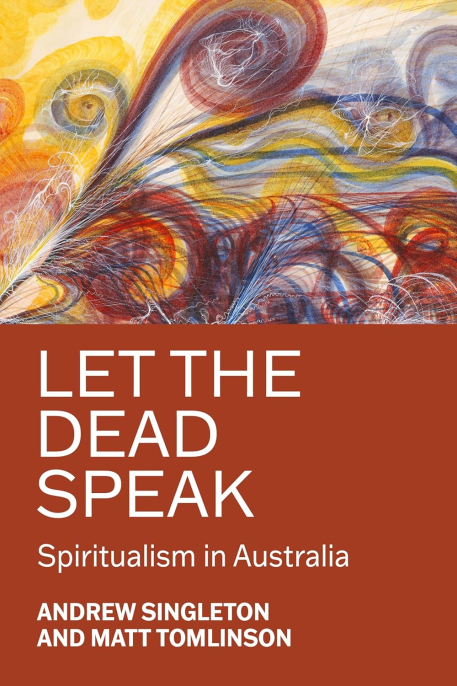
Andrew Singleton, a sociologist at Deakin University, and Matt Tomlinson, an anthropologist at the Australian National University, set out to give a factual account of Spiritualism and its evolution in Australia in their book Let the Dead Speak: Spiritualism in Australia. Whilst the book details the wider history of Spiritualism within Australia, it narrows its focus to Melbourne and Canberra, where the authors conducted most of their fieldwork.
The authors’ regular attendance at services of the Canberra Spiritualist Association in 2017 and 2018 offers a rare insight into the inner workings of the modern Australian Spiritualist movement, which is alive and well despite decades of stigma. In their opening, the researchers are careful to establish that their aim is neither to advocate for nor to debunk Spiritualism. Instead, they argue three distinct points: that belief deserves to be taken seriously as a subject of study, that women have led and sustained the movement, and that Australian Spiritualism has its own identity shaped by overseas influence.
Often, those who write about Spiritualism’s past have focused on the people from the perspective of what they did throughout their lives, which is usually heavily intertwined with controversy. This book, however, takes a different approach, offering a peek behind the curtain at what sits at the very core of belief. Instead of questioning paranormal phenomena and mediumship itself, the book challenges the reader to look at the motivations behind Spiritualists’ beliefs, which are often neglected when we navigate our past. It is a factual account rather than storytelling, and it never loses sight of the fact that, at its core, Spiritualism is a religion.
Much of the book explores the social dynamics of the Spiritualist church movement: who attends, why they go, and the wider stigmas associated with being a member. The chapter on the Sunday service walks the reader through healing, songs, the Seven Principles and an address, before concluding with a demonstration of mediumship. Other chapters cover professional mediums who charge for readings, the smaller yet highly controversial world of physical mediumship, and race and ethnicity in descriptions of the spirit world.
For me, the most interesting chapter was the one asking how Australian Spiritualism differs from that of other countries. The authors’ interviewees describe British mediums as traditional, and the authors note that Australian Spiritualism is not as showy as its American counterpart. As the authors put it, “In Australia, even Spirit gets a fair go.”
The book is largely observational, which is its strength but also its limit. Readers who are looking for a commentary or assessment of the observations or evidence presented through mediumship will not find one. A long reading by a Canberra medium, for example, is presented as skilled mediumship, even though it contains a few misses and the sitters fill in a lot of the detail themselves. While the concept of cold reading is mentioned, it is only briefly, in an endnote. I would have liked to see it sit more prominently and in more detail alongside the reading in the main text so the reader could weigh it up for themselves.
The book is very well researched. The authors attended services over a lengthy period to gain a proper and sympathetic understanding of the subject, rather than just relying on the archives. I would have liked the modern cases of fraud the book touches on to be explored further. They immersed themselves in this world over several years, and while they wrote the book from the perspective of observing a community with the objective to neither to advocate nor to debunk it, I would still have liked to know more of their own thoughts and opinions, how they were shaped and if they indeed changed over time from what they encountered.
I personally found the narrative framed around female leadership refreshing. Historically, female Spiritualists are often portrayed in a derogatory manner. This book puts women at the centre. Nine out of the ten mediums the authors observed in Canberra were women, and the afterword credits women with Spiritualism’s survival. I was glad to see their influence given the positive acknowledgement it deserves.
Overall, the book turned out to be a very different read from what I had anticipated. While I went in expecting to learn more about the history of Spiritualism in Australia, which I did, it left me with an unexpected and lasting impression. I left with questions about my own faith and purpose, as well as more understanding and compassion for the human paranormal experience. Whether we seek comfort in a church or in paranormal research itself, we are all just looking for answers that we will likely never receive in our own lifetimes. The very public and well-known cases of fraud shouldn’t paint everyone involved with Spiritualism with the same brush, something the book subtly emphasises. At every service there are in the authors’ words, “dedicated volunteers working hard to prove what they believe.”
Let the Dead Speak: Spiritualism in Australia will suit anyone who has an interest in the history of the paranormal or Spiritualism in Australia whilst also catering to those who are interested in why people believe what they do. Those who are hoping for a verdict or evidence on whether the dead really do speak to us will not find it in this book. What they will find, however, are the stories of the people at the very heart of it: people throughout time just like you and me, seeking a place and a community where they belong, so that their stories can be heard.