




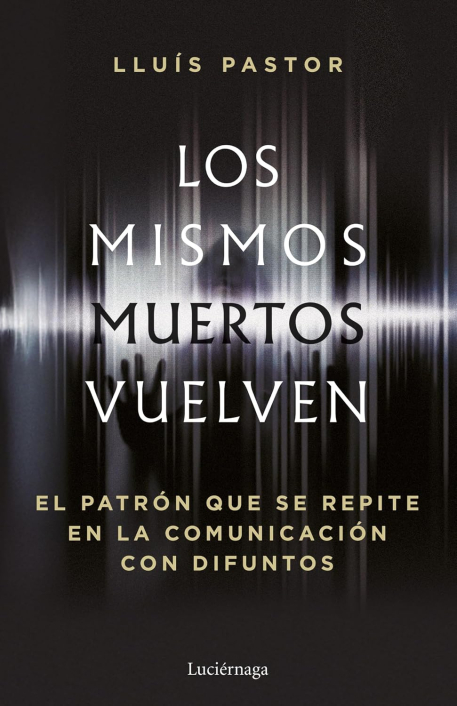
Los mismos muertos vuelven. El patrón que se repite en la comunicación con difuntos [The dead always return in the same way. The repeating pattern in the communication with the deceased].
Reviewed by Roberto R. Narváez
I think some comments about the unusual size of this nearly 890-page volume—which certainly is not, and certainly was not intended to be, a scientific monograph—would be appropriate. The final sentence of the title reads: ‘An investigation in the form of a diary’. Most of the contents are arranged, indeed, as the entries of a diary, in a chronological sequence. Lluís Pastor has included not only the dates and places where he wrote down his entries, but he has also noted the time of day.
The volume also includes exchanges. The first chapter is an interview with Pastor that covers nearly 70 pages. Another section which functions like an abstract of Pastor’s answers and reflections is less than 10 pages long. Pastor tries to make explicit his purpose and methods; hence it functions as an introduction to the book.
There are plenty of footnotes throughout the book, but practically none have an explanatory or otherwise relevant purpose in aiding the understanding of certain arguments. There is an unrelenting double-spacing between the diary-like entries, the interview, and the parts of email exchanges. There is an unnecessary amount of blank space.
The plan to write this book was born twelve years ago when Pastor—a university professor of Communication Sciences—began receiving emails from people he knew who shared their experiences of contacting the dead. Soon he found himself with a large collection of such messages.
The percipients were awake and not intoxicated in any way when the interaction took place. The visitors, or ghosts, or whatever they may be called, were generally easy to identify (because of their demeanour, clothes, and ways of speaking) as deceased loved ones. In many cases they appeared to be made of vapour or fog and were surrounded by an intense light. Normally they would utter one or two brief sentences, such as ‘I’m fine’ or ‘Everything is good’, before vanishing. The percipients had no time to reply or make any comment.
Pastor became quite intrigued by these experiences. He did a comparative examination of his samples and encountered the same or very similar descriptions repeatedly. This, he concluded, shows that all the stories form a pattern (pp. 80-82). Pastor seems to believe that the detection and critical analysis of that pattern represent a notable addition to earlier research efforts. However, there are problems with his very notion of pattern, the conceptual framework, and the methods Pastor applies to develop and illustrate his arguments.
He does not really explain why he chose the term ‘pattern’. He assumes that the constant elements counted in a sample of emails can be said to represent the normal, typical ingredients of every act of communication between a dead and a living person, but only when the dead appear without being summoned. The pattern, then, gets articulated by that which makes up the email narratives. But Pastor is primarily concerned with what his informants actually believe. He is certain that their testimonies are true because none of them have any reason to deceive him (p. 11). Pastor essentially relies on their stories and good faith.
After this comes the major object of investigation. Pastor does not claim to know where, when and how the aforementioned pattern was formed originally, because he ignores when, how, and where such experiences began to happen in human history. Maybe this is why he decided not to use a term like model or archetype, or some other technical word that normally require some qualification or semantic stipulation for its usage in certain research contexts and felt that pattern was adequate.
Pastor considered legitimate to ask whether the pattern could be discerned in accounts of similar events that have been accruing from the beginning of human history. To answer this, a review of a multitude of facts has to be done. In Pastor’s view, the first duty of a scientist is to collect facts. But what does he mean by facts? He never mentions having interviewed any of the people directly and personally. Pastor sometimes writes of his pattern notion as if it were a hypothesis. He apparently believes that an attempt to test the hypothesis means simply collecting testimonies.
It is undeniable that he read much literature produced by parapsychologists, historians of culture, historians of religion, historians of literature (classical, medieval, and modern), and other specialists, and from these texts he copied whatever he deemed supported his ‘pattern’ hypothesis. For Pastor, facts seem equivalent to those testimonies that he accepts for certain ‘theoretical convenience’, that is, as long as his pattern view is supported.
The sender who comes from the beyond not only conveys words, but also a host of other significant information (outfits, gestures, etc.). And all this is analysable, says Pastor, according to the academically normal communication scheme ‘sender-receiver’ (pp. 47-48). All the analyses in this sense, however, amount to asserting that the significant elements in the pattern (as exhibited by the visiting ghosts) correspond, one by one, to the elements which conform to that other scheme of every regular communicative process. This scheme, then, represents the technical model to describe, or if you like, the code to interpret the constituents of the testimonies.
Pastor underscores that the dead act as senders. Why would the ghost be the first one to talk? Perhaps because it knows that its visibility hardly lasts for more than two minutes. That aside, why are the visitors’ laconic messages of an optimistic nature? One could also ask, how come the recipients never start the conversation or reply to what they are told? Pastor admits that, at present, he cannot answer such questions.
That spontaneity of the apparitions is so prominent and intriguing, in his eyes, that it determined his selection criteria. He decided to set aside all those cases in which a person consciously seeks the contact either ‘directly’ or with the aid of a medium, because this implies that they believe that it can be done, and hence that there is an afterlife. This attitude, argues Pastor, is biased in a way that leaves no room for any ‘impartial analysis’. He argues that if one deliberately tries to contact the dead then one cannot honestly say that one doesn’t believe in an afterlife. This is his main reproach against the spiritists loyal to the teachings of Allan Kardec.
What happens if you suddenly find yourself in front of a talking spirit, and after it is gone you declare ‘I saw and heard, but I do not believe?’ Are you being honest in admitting your disbelief in something that you narrate to others as an event in which you played the role of a recipient? Pastor says that his informants have no reason to deceive him. However, does this mean that they are trustworthy and unbiased because of their passivity and candour?
They believed what they saw but cannot say if that was a ghost because they do not believe in such things. If they did, they could simply have gone to a medium to initiate communication. But in this latter case, according to Pastor’s principles, their action would have been dishonest, even if the entity showed up and looked and spoke exactly as it would have done without being summoned in any way…
Researchers, no matter their field of study, cannot entirely free themselves from prejudice. Pastor is partial regarding the validity of the theoretical model which he uses to give some substance and structure to his idea of a pattern. The investigation itself has very little to do with parapsychology or any field other than that of communications. In a great measure it was made by exploiting the results of specialists in these and other fields with only one goal, namely, to make Pastor’s own theory look and sound as plausible, rational, and comprehensive as any scientific theory must be to deserve at least some critical notice.
Unfortunately, Pastor’s discussions of hallucinations, illusions, memories, etc., are confusing and ambiguous. Let me say a few words about his conception of dreams and reality. He explains that dreams are only one channel through which the departed may get into contact with their still incarnate loved ones. However, dreams must be dismissed as a valid channel because they are hard to ‘corroborate’. Furthermore, in them there is not any clear distinction between senders and receivers.
Pastor only seems to accept information received by percipients when they were awake. Such reports are preferable, he argues, because they convey real events, ‘as long as we believe that they actually happened in reality’, and only from them can one get ‘clues’ and go deeper into the ‘nature’ of such occurrences (p. 40).
Pastor states that it felt as if he had a ‘labyrinth of knowledge’ during his project. He writes that this book is no less a ‘sentimental chronicle’ than a scientific exertion (p. 171-172). This is very precise, for chapters 3 to 14 are filled—all sentimentality aside—with notes, extracts, and quotations from works written by other specialists (anthropologists, historians, sociologists, psychologists, etc.) in which Pastor detects ‘clues’. However, I think that Pastor went straight after supporting evidence.
Nevertheless, Pastor also calls into question some tenets of those authorities, especially the anthropologists and historians of literature. An issue that Pastor dislikes is that anthropologists tend to regard ghosts as cultural projections. If I understand his point, the problem here is ultimately that of relativism, that is, the belief that it is the historical context, or the milieu, or some other factor which determines the general features of the otherworldly visitors. For instance, the witness of a ghost in the Middle Ages would describe it as a disfigured, tortured soul dragging chains, while in Victorian England the apparition prototype was a ‘translucent shadow’ (p. 63). This amounts to saying that for each changing historical era there is a corresponding change in the stereotype of the ghost.
In chapters 3 to 12, Pastor presents the results of what he discerned by ‘testing’ his theory through the ‘analyses’ of a multitude of cases he considered pertinent. He goes as far back as the proto-historical epoch (in the Western region of our world). Normally, his conclusions are optimistic: what his pattern, originally deduced from a set of emails in the 21st century (let us not forget this), predicts, becomes fulfilled in highlighted fragments taken from this or that text he read. In many instances, all the matching elements were found. Other times, however, he introduces qualifications or suggests adjustments in order to ensure (if not to force) the correspondences Pastor seems satisfied whenever he establishes at least a minimal similarity. In spite of all this, he never doubts the general validity, or, as he normally writes, plausibility of his pattern. This is rather curious, but nothing to exasperate the reader as the following statement:
The hypothesis that the dead return has never been present among historians and anthropologists, and no wonder, for nobody can imagine that any event whose occurrence has ever been demonstrated, has ever even once occurred (p. 173).
This book is not and was never meant to be a contribution to parapsychology. It certainly contains a good deal of historical summaries about this line of study, with some fine descriptions of what psychical researchers have done, from the later part of the 19th century to the first decades of the present century, regarding the question of survival after bodily death and related subjects.
However, much of this is covered in multiple diary-like entries, not necessarily in sequence. They are basically reading notes interspersed with some comments, interrogations, and casual observations, which cannot be taken as a critical examination of the issues. In fact, their inclusion seems to be merely a rhetorical strategy to assure the reader that there is, or at least must be, something in that maze of information that in one way or another adds plausibility to the ‘pattern’.
But even if that maze of data can be instructive by itself, only some portions of it are actually related to the main subject. The long passages about the history of spiritualism (pp. 529-535) and spiritualist photography (pp. 552-564), for instance, may be entertaining, but are in the end irrelevant. As such, they complement the footnotes: there are plenty and in the old-fashioned form of bibliographical citations. Clarifying notes designed to help the reader grasp the meaning of some difficult argument, or to display the reasons for introducing some technical or theoretical stipulations, there are very few. I think it would have been better to incorporate naturally in the end a section where only the fundamental, effectively used references in each chapter are described and commented. This would also justify the deletion of the long bibliography (pp. 841-884). In addition, is it not odd to invite anyone to read a diary with footnotes?
Let us return to the central contents and make a few final considerations. Let me confine myself to the chapter on ancient Greece and Rome. For his analyses, Pastor did not bother to read the original sources, which are mainly of a poetical, dramatic, philosophical, and historical nature (by Homer, Pindar, Hesiod, Plato, Plutarch, Pliny, Cicero, etc.), on the grounds that they do not convey truthful testimonies of visions, but only irrational, foggy depictions of how the dead return and talk to the living. The reason for this, he says, is that the ancient Greeks and Romans were as superstitious as any other primitive cultures, with no means to explain scientifically the ‘world around them’.
Pastor confined himself to relying on summaries and digests made by historians, classicists, and philologists, in order to reach only those ‘non-literary data’. He actually confesses to having only seen the ‘selections’ provided by scholars such as Cumont, Dodds, Jaeger, Otto, and others from the Spanish-speaking world (p. 198).
This manner of speaking about the Greco-Roman literary legacy is impertinent, if not a sheer proof of ignorance. One of Pastor’s ‘provisional inferences’ is that the funeral rites of the ancient Greeks were so sophisticated that they must have sprung from a shared experience, ‘although not explainable rationally’. That experience was, he suggests, visions of dead people returning as apparitions. He even states that from this derived their beliefs in the immaterial gods (p. 239). That aside, Pastor should have read himself the writings in question himself. Not necessarily in the original Greek dialects or in Latin, of course, but in some of the good Spanish translations available, many of which include magnificent critical aids arranged by highly reputed scholars. The neglect of this duty caused him to make remarks that cannot be accepted or even taken seriously.
Let us look at just one example: Plutarch’s narrative of M. Junius Brutus’ vision of an apparition one night, while meditating in his tent during a military campaign. (This is the Brutus who assassinated Julius Caesar.) The story goes that Brutus felt something, turned around, and saw a dreadful, monstrous apparition. He asked: ‘Who art thou of gods or men, and what is thine errand with me?’ and the phantom answered: ‘I am thy evil genius [daimon], Brutus, and thou shalt see me at Philippi’ (Plutarch 1918, p. 207). Pastor says, first, that the unknown visitor’s utterances merely serve to enhance the horrifying ‘dramatism’. Secondly, he argues that from the ‘dead man’s answer’ (how does he know the visitor is a dead man?) one can ‘infer’ that he was none other than Julius Caesar, for only so can we ‘rationalize the story taking the motive of vengeance as the key’. For the story to be even plausible, he adds, Brutus cannot but recognise Caesar in the visitor (pp. 241-3).
The only thing clear is that Pastor’s analysis overlooks many important aspects, for one obvious reason: he did not read Plutarch directly. This is why he could not consider the continuation of the story, beginning with the conversation of Brutus and Cassius regarding the phenomenon and Cassius’ attempted explanation of what or who the daimon could have been (Plutarch 1918, pp. 207-8). But this, of course, does not end in the positive identification of the daimon. This is a vexed point that still challenges the ingenuity of scholars.
To face this challenge, some literary comparisons can guide us. Dion was also visited by a ghost, and he interpreted this as an omen of his death (Plutarco, 2009, p. 55, 2). In this piece the phantom is identified as an Erinye, a goddess of vengeance. The daimon in Brutus’s case could also be an Erinye, given the pertinent passages in Plutarch’s life of Caesar, where the historian stresses that the dictator’s murder was abhorred by the gods (Plutarco, 2007, p. 69, 6; cf. also p. 373, n. 117). This would explain the persecution of the killers by divine powers that presented themselves in a dreadful shape to strike fear in the hearts of the guilty.[1]
Surely these problems of literary exegesis cannot be easily resolved, but it is always better to wait for the findings of scholars, and to consult them, than to accept uncritically Pastor’s following statements: ‘the testimonies of Classical Antiquity are stained by literature… they are not chronicles, but tales … that tend to form literary topics’; [in consequence,] it is impossible to decide whether stories like that of Brutus are ‘real or invented facts, distorted by the pen of writers.’ (pp. 244, 253).
For a different, more responsible approach we can see, for instance, Greek and Roman Necromancy (Ogden, 2001), in which the reader can find a careful analysis of how and why ghosts looked and sounded different in testimonies taken from a wide array of works. One may not entirely agree with Ogden’s views, but two points are undeniable: (1) he quotes from the original sources, and (2) his descriptions, classifications, and arguments indicate—if not show—that Pastor’s ‘pattern scheme’ would hardly find a place in classical studies concerning such cases.
The penultimate section offers ‘quantitative analyses’ of cases from the 20th and 21st centuries. Pastor gathers his data from quantitative estimations (‘210 cases’) published in other books. Again, he advises the reader that his major critical care was to disregard any bias in the statistical estimations. By such prejudices he means merely those considerations that he feels irrelevant in connection to his own interests, but that his authorities made for the exact opposite reason. So he proceeded thus: from the statistics at hand, he selected those calculations that could be said to represent the average of occurrences of the elements that conform his pattern. He introduces his own biased qualifications and asserts that the selected percentages support his view, even when the averages for each channel of recognition of the visitor (visual, auditory, olfactory, etc.) are normally quite low (pp. 811-12, n. 3; 813-814). All this suggests, once more, that Pastor has limited grasp of the scientific method. In the end, he does but manipulate, reorganise, adapt, and present a quantitative survey made by others as a frequency chart of the ‘pattern’ elements, a chart to be read as follows: these elements recur as frequently as you can expect them to. And so, the ‘pattern’ becomes ‘fulfilled’ (p. 811).
Consider Pastor’s concluding statement:
the ‘pattern’ of communication between the living and the dead has been repeating itself since the beginning of time, but we had not noticed [it] because the investigators of our history and that of other cultures failed to consider it as a plausible hypothesis; they ‘overlooked’ it … and contented themselves with a superficial knowledge… (p. 822).
Does this deserve any commentary? Pastor believes that, in his heart, he is right. This volume is not worthless, at all, but I must emphasise that it is more for those who like reading novel after novel, even if the central theme is difficult to see.
Footnote
1. In his Caesar (69, 6-14) Plutarch narrates two visitations of the daimon to Brutus: (1) before attacking Octavius and Antonius (23 October 42 BC), a battle which he won, and (2) when he was about to go into battle again, the daimon reappeared. Brutus understood his destiny and threw himself blindly into danger yet survived. He later committed suicide (Plutarco 2007, p. 21).
References
Ogden, D. (2001). Greek and Roman necromancy. Princeton University Press.
Plutarch. (1918). Lives. Dion and Brutus. Timoleon and Aemilius Paulus. William Hinemann, G. P. Putnam’s Sons.
Plutarco. (2007). Vidas paralelas [Lives] VI. Gredos, S. A.
Plutarco. (2009). Vidas paralelas [Lives] VII. Gredos, S. A.