




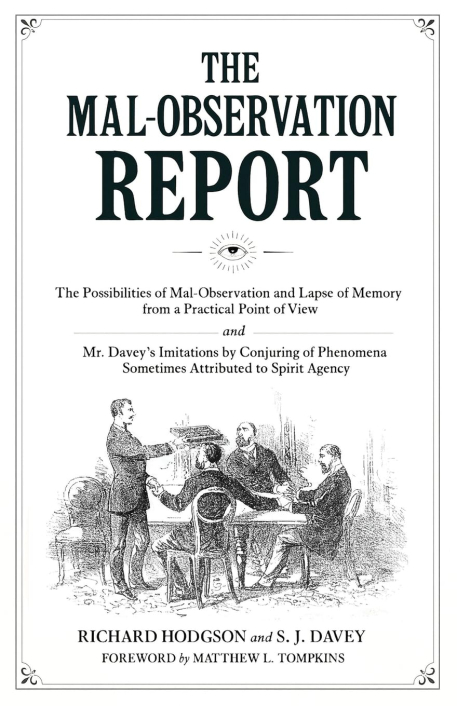
Reviewed by Samuel Varg
The Mal-Observation Report explores how easily the human mind can misinterpret what it sees and later remember events differently from how they actually happened. The book examines the subtle processes behind perception and memory, showing how our senses do not simply record reality but instead construct an interpretation of it. By doing so, it reveals how surprisingly unreliable our observations and recollections can be.
Readers are guided through examples and explanations that highlight just how readily the mind fills in gaps, reshapes details, and forms narratives that feel completely convincing—even when they are inaccurate. The result is an illuminating look at how the brain processes what we see and how quickly those impressions can change once they become memories.
This idea may feel familiar to anyone who has watched an illusionist or a magician perform. When audiences witness something that appears impossible, they often begin to describe what they saw in ways that differ from what actually took place. Details are forgotten, new ones are added, and people confidently recall events that never happened. Such moments demonstrate that perception is not a perfect recording device; it is shaped by expectations, assumptions, and the limits of attention.
As a magician myself, I chuckled more than once when I read the foreword by Dr Matthew Tompkins. Boy, do I recognise how a spectator can retell what he or she just observed a few minutes, or even seconds ago, in a completely different way from what really happened. This falls back on what this book is built on—the republishing of two almost 140-year-old written reports on this very phenomenon (i.e., Hodgson, 1892; Hodgson & Davey, 1887).
The Mal-Observation Report uses this kind of insight to show what happens in the mind when we believe we have clearly understood an event. It illustrates how easily the brain organises incomplete information into coherent stories, often without us realising it.
One of the book’s most striking lessons is also a humbling one: none of us can be entirely certain about our own experiences. Whether someone approaches unusual or extraordinary claims with belief, scepticism, or uncertainty, everyone shares the same cognitive limitations. Human perception is simply not as reliable as we tend to assume.
In the end, the book is less concerned with proving or disproving extraordinary phenomena than with reminding readers how fragile certainty can be. Paradoxically, the moment we feel most confident about what we saw or understood may be exactly when we should pause and question our conclusions—because that may be when mal-observation has quietly taken hold.
References
Hodgson, R. (1892). Mr. Davey’s imitations by conjuring of phenomena sometimes attributed to spirit agency. Proceedings of the Society for Psychical Research, 8, 253-310.
Hodgson, R., & Davey, S. J. (1887). The possibilities of mal-observation and lapse of memory from a practical point of view. Proceedings of the Society for Psychical Research, 4(8), 381-495.