




Reviewed by Nemo C. Mörck
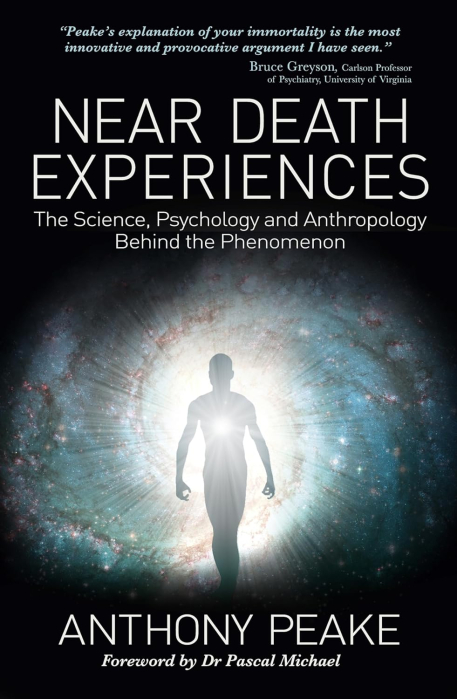
Anthony Peake has written a number of books. His latest, about near-death experiences (NDEs), is ambitious, as its subtitle indicates. The book consists of 228 pages, plus bibliography, index, and a foreword, by his friend Dr Pascal Michael. Naturally, Peake recognises that NDEs are open to different interpretations and that the more famous cases, such as Pam Reynolds and Eben Alexander, have been contested. Early in the book he repeats the well-known quote “An extraordinary claim requires extraordinary proof” (Truzzi, 1978, p. 11). He has tried to provide a fair assessment, acknowledging different viewpoints.
To me the main value of Peake’s books comes from the fact that he reads widely, talks to a variety of people, and has his own perspective and theory, Cheating the Ferryman, elucidated in earlier works (e.g., Peake, 2022). His books are interesting and Peake is clearly fascinated by everything, perhaps in particular neurological findings. However, I wish that he had adhered more strictly to APA style and thought more about which facts are relevant to the reader. Personally, I get by fine without reference information, such as article titles, in the text – as long as the references are given in a bibliography. Admittedly the references he lists are not always entirely complete, but the reader should be able to track them down. The result of Peake’s writing style is that space that could have been devoted to explaining his thought process is wasted on information that the reader does not really need.
It can feel as if the more one learns about NDEs the more complicated everything seems. Peake relates some of the more extraordinary phenomena associated with NDEs, for example, sometimes percipients see people that they did not know were dead during their experiences. However, Peake also acknowledges aspects that suggest that the percipient is involved in creating the experience. For example, apparently children sometimes see Nintendo characters. Nevertheless, the cultural impact is not always as strong as one may suspect. If I was told to draw an angel I would draw a figure with wings rather than a many-eyed monster, yet during an NDE I might encounter something that brings an alien abduction experience to mind. It is mysterious, and Peake does not shy away from the more curious aspects of NDEs.
In this book Peake decided to focus on non-Abrahamic experiences from Asia and Oceania. That is fine given how much else he wishes to cover. Much of his discussion concerning possible causes of various aspects of NDEs should be familiar to members of the SPR, but he provides good overviews of the viewpoints. There are a variety of mysteries to explore, such as why people can have typical NDEs despite not actually being in danger of dying. Why do not everyone that have had a brush with death recall an NDE? Peake guides the reader through mapped territory well. However, the aftereffects of NDEs on the percipient are, perhaps inadvertently, underplayed. They need to be recognised, especially when researchers compare groups, hoping to learn why some report having had NDEs while others do not. In general, I would also advise more scepticism concerning the use of the concept fantasy proneness (Ring, 1990). It does not only capture what one expects.
Nevertheless, I believe Peake has really tried to be fair while considering different viewpoints and conflicting results. That said, in his commentary about Tart’s (1968) study of a so-called special subject, Miss Z, a woman that experienced out-of-body experiences, he asks: “... what stopped her from simply detaching the various measuring devices and looking for herself?” (p. 96). Miss Z once reported having seen a series of numbers, 25132, hence Peake poses the question. However, how would you go about detaching the measuring devices and then reapplying them alone without this activity showing up on the records? Extraordinary claims require extraordinary proof.
More importantly, to me at least, it felt as if Peake failed to bring all his findings together at the end. Instead, in an epilogue, he presents an interesting account about strange experiences reported by Subject A involving entities. Apparently, the man has patents for a number of inventions, and attributes his success to his contact with the entities. Peake writes: “If evidence was needed that those communications are from somewhere beyond everyday human experience then these patents present the evidence” (p. 227). But do they really? Srinivasa Ramanujan, who credited a goddess for his own success also comes to mind. That aside, Peake ends the book by suggesting that “... we are at the start of a new paradigm, a paradigm that will explain a great deal more about the true nature of reality and the role of consciousness within the universe” (p. 228). We will live to see.
References
Peake, A. (2022). Cheating the Ferryman: The revolutionary science of life after death. Sirius.
Ring, K. (1990). Fantasy proneness and the kitchen sink. Journal of UFO Studies, 2, 186-187.
Tart, C. (1968). A psychophysiological study of out-of-the-body experiences in a selected subject. Journal of the American Society for Psychical Research, 62(1), 3-27.
Truzzi, M. (1978). On the extraordinary: An attempt at clarification. Zetetic Scholar, 1(1), 11-19.