




Reviewed by David Metcalfe
In 2019 two books were published that mark clear trends in the future of anomaly studies, or perhaps more accurately signalled where things were at and where they are going. The two books were The Flip: Epiphanies of Mind and the Future of Knowledge (Kripal, 2019) and American Cosmic: UFOs, Religion, and Technology (Pasulka, 2019). Both highlight a pivot from the standard academic practice of utilising the outré as a foil against which to frame abstract theory or a subject to be used as a marketable frame to introduce academic discussions that have nothing to do with the anomalous.
What distinguishes these works is not advocacy for paranormal claims, but a refusal to reduce anomalous reports in advance to pathology, symbolism, or media effect. These were not Science of the X-Files type books, nor were they Post-Marxist readings of odd cultural by-products or some other theory first reframings. Instead, they were attempts to explore the truly difficult question of treating the anomalous, exceptional, weird and uncanny as something that is valid in and of itself. They didn’t start with theory, they started with the reported experiences of individuals, specifically high functioning individuals in academia, the sciences, and other distinctly non-paranormal fields, in the face of something that shouldn’t happen based on the authoritative dictates of authorised reality.
Well, as the author William Gibson so astutely observed, “the future is already here – it’s just not evenly distributed.” And in this, we find there are still those in academia who haven’t made Kripal’s flip, nor immersed themselves as thoroughly in the lives of those who have had contact with the so-called paranormal as Pasulka has done.
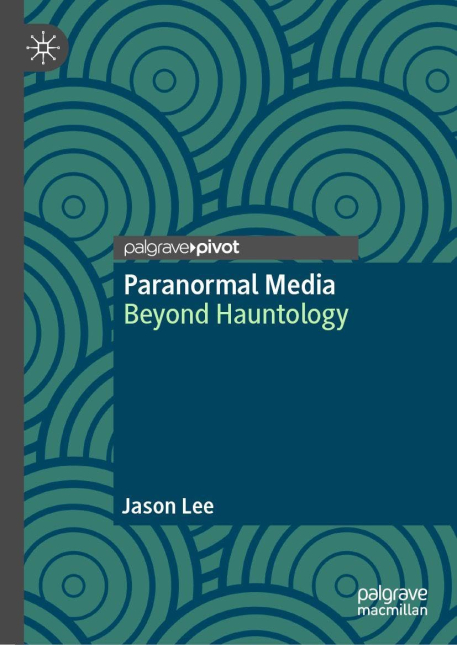
Jason Lee’s new short book (87 pages including references and index), Paranormal Media: Beyond Hauntology, represents a throwback to the kind of material and framework that has allowed for the paranormal to exist as a subject matter exclusive of any attempt to actually deal with the fact that surveys on belief are quite different from reported experiences of individuals. Belief can be mediated as can perceived interpretation of an experience, but serious scholarship can no longer dismiss such reports solely as mediated misperception without engaging the growing interdisciplinary literature surrounding anomalous experience.
Lee avoids the experiential while attempting the ambitious task of theorising paranormal media as a constitutive condition of technological modernity rather than a marginal belief system or genre. Drawing heavily on continental philosophy such as Deleuze, Derrida, Adorno, and Heidegger, alongside Jungian psychology and media theory, his book advances a sweeping argument: paranormal phenomena are best understood as effects of mediated absence, technological “presence,” and the psychic structuring of noise, silence, and digital circulation. Ghosts, cryptids, psychic experience, and occult media are treated less as empirical claims or belief systems than as philosophical figures through which contemporary subjectivity is negotiated.
The strongest aspect of the book lies in its sustained effort to read paranormal media as structurally embedded within communication technologies. The discussion of electricity, telegraphy, and contemporary digital platforms usefully extends Sconce’s (2000) influential thesis, suggesting that technologies of transmission consistently generate metaphors of presence, animation, and spectrality. Likewise, Lee’s engagement with Jungian theory, particularly the idea of the shadow and compensatory dream logic, offers a potential framework for interpreting paranormal experience as psychic externalisation rather than purely cultural delusion. At its best, the book suggests that paranormal media operates as a site where absence becomes legible, whether through silence, interruption, glitch, or narrative gap.
Unfortunately, the theoretical breadth of the work is not matched by sufficient historical or disciplinary grounding. Most notably absent is engagement with established scholarship in the history and anthropology of paranormal media. For example, the work of Simone Natale (e.g., 2017), has demonstrated that spiritualism and media technologies co-evolved across the nineteenth and twentieth centuries, from telegraphy and photography through to radio and early television. This is just one example of an entire swath of scholarship left off the table. In the present volume, by contrast, paranormal media is frequently framed as a contemporary condition intensified by digital culture, rather than as a long-standing media formation that digitality merely reconfigures. This leads to a subtle but important distortion where the internet begins to be treated as a point of origination rather than amplification.
Due to the focus on things like ghost hunting shows, series such as the X-Files, Lee’s attendance at a particularly moving Radiohead concert, the reader loses any chance at seeing just how pervasive the paranormal actually is in culture. This is surprising since Lee himself writes:
We should stop having these hierarchies and classifications which merely function as compartmentalising knowledge. It ultimately limits our understanding of the paranormal world and the so-called normal world because as we have found here these realms are not as separate as some would like to believe (p. 61).
Despite this, the text perpetuates one of the problems with contemporary attempts to frame these discussions in the enchantment and disenchantment narratives of Max Weber.
Any thorough review of media over the past few centuries demonstrates clearly that there has never been a period of disenchantment. The persistence of occult revival movements, UFO religions, charismatic Christianity, conspiracy cosmologies, New Age therapeutics, paranormal entertainment, and everyday paranormal and supernatural belief demonstrates that modernity did not produce disenchantment so much as redistribute enchantment into unofficial, commercialised, and culturally disavowed forms. As Hansen (2001) explores in his work, it is less a case of disenchantment than academic and cultural authorities unwilling to dirty their hands in the wider culture while producing tomes that ignores the experiences and beliefs of the majority. Whatever such authorities might write or say, there has never been any functional lack of paranormal belief or experience in the culture at large.
Lee moves along similar lines as these past attempts to artificially alienate the topic in his analysis, and the omission of contemporary scholarship on anomalous experience and belief systems allows for the theoretical interpretation to eclipse lived experience. The absence of Diana Pasulka’s work on UFO cultures and institutional epistemologies is particularly notable, as her research would have complicated the book’s tendency to treat paranormal belief primarily as symbolic or psychological projection.
Likewise, the text does not engage with Jeffrey Kripal’s work on “mystical” or “anomalous” consciousness, which explicitly resists reducing extraordinary experiences either to pathology or metaphor. And more to the point both scholars work addresses the fact that stigma has obscured the fact that a substantial number of academics, scientists, executives and other bastions of the supposedly disenchanted world have themselves had private paranormal experiences that not only deeply affected them, these experiences have deeply affected their own work in the fields that they operate in.
Without such interlocutors, the book’s treatment of paranormal phenomena remains largely interpretive rather than ethnographic or epistemologically plural, despite the inclusion of personal experiences such as Lee’s own encounters with haunt phenomena or his moving engagement with Radiohead.
More broadly, the book’s omissions include the fact that the work does not meaningfully engage with parapsychology, anomalistic psychology, or the empirical traditions that have historically attempted to study psychic phenomena. Outside of a brief reference to Dean Radin, most citations dealing with the paranormal refer to outdated or problematic material from sceptic literature or merely use the paranormal as a stand-in for Lee’s examination of alienation in contemporary culture. This absence matters because the book repeatedly oscillates between treating paranormal media as aesthetic-philosophical figure and as implied ontological condition. The lack of engagement with research traditions that attempt to distinguish signal from narrative makes it difficult to assess what kind of “paranormal” is actually being theorised: experiential, cultural, psychological, or ontological?
Conceptual clarity is further complicated by the conflation of “paranormal” and “supernatural.” Historically, the supernatural refers to theological frameworks in which phenomena are attributed to divine agency operating outside natural law, whereas the paranormal is a modern category for anomalous events presumed to occur within nature but beyond current scientific explanation. The book frequently moves between ghosts, religious visions, cryptids, and technological hauntings without consistently maintaining this distinction. As a result, theological, folkloric, and quasi-empirical registers are blended into a single undifferentiated field of “the uncanny.”
This slippage is not merely terminological. It obscures the historical emergence of ‘the paranormal’ as a specifically modern category produced in the wake of scientific rationalism and psychical research. By collapsing supernaturalism into paranormality, the book erases one of the defining distinctions that produced the modern category of the paranormal in the first place: namely, the attempt to relocate anomalous phenomena from divine exception into unexplained but potentially natural occurrences.
The historical scope of the argument is also uneven. While there are references to spiritualism and occasional nods to media history, the book largely bypasses the extensive genealogy of paranormal media cultures: the prevalence of paranormal themes in early twentieth-century radio programs, the popularity of spiritualist performances, mid-century horror comics, occult revivals of the 1960s and 1970s, and the New Age publishing and television boom of the 1970s and 1980s. These omissions contribute to a recurring impression that paranormal media is primarily a modern digital-era phenomenon, rather than a persistent feature of mass communication systems that predates the internet by well over a century.
Ultimately, Lee’s book is most successful when read as a speculative philosophical meditation on mediation, absence, and technological subjectivity. It is less successful as a study of paranormal media in any disciplinary sense grounded in media archaeology, anthropology, or anomalistic research. Lee writes in a highly associative style, moving rapidly between continental philosophy, popular culture, theology, autobiography, and media criticism. At moments this produces genuinely suggestive connections; at others, the argument becomes diffuse, with concepts accumulating faster than they are disciplined analytically. The conceptual ambition of the work is undeniable, but its lack of engagement with key empirical and historical literatures limits its explanatory reach. Paranormal media here becomes less an object of study than a metaphorical reservoir for anxieties about communication, identity, and reality under conditions of digital saturation.
In summary, Paranormal Media: Beyond Hauntology reads less like a contribution to the emerging post-stigma study of anomalous experience than as one of the last major examples of an older academic mode: a mode in which the paranormal remains valuable primarily as metaphor, discourse, or cultural symptom rather than as encounter, event, or epistemological challenge. What the book ultimately offers is not a history or theory of paranormal media so much as a philosophy of haunted mediation. It is suggestive, generative, and at times conceptually rich, but also methodologically unmoored, requiring substantial supplementation from the very fields it leaves largely unaddressed. Its central paradox is that a book devoted to expanding the boundaries of paranormal discourse remains curiously insulated from the very research traditions most directly concerned with anomalous experience itself.
References
Cavelos, J. (1998). The science of the x-files. Berkley Books.
Hansen, G. P. (2001). The trickster and the paranormal. Xlibris.
Kripal, J. J. (2019). The flip: Epiphanies of mind and the future of knowledge. Bellevue Literary Press, 2019.
Natale, S. (2017). Supernatural entertainments: Victorian spiritualism and the rise of modern media culture. Pennsylvania State University Press.
Pasulka, D. W. (2019). American cosmic: UFOs, religion, technology. Oxford University Press, 2019.
Sconce, J. (2000). Haunted media: Electronic presence from telegraphy to television. Duke University Press.
David Metcalfe, Scholar in Virtual Residence at the Windbridge Institute, is a researcher, writer, and media analyst whose work focuses on anomalous experience, esotericism, folklore, and the intersection of technology, belief, and contemporary culture.