




Reviewed by Michael Daw
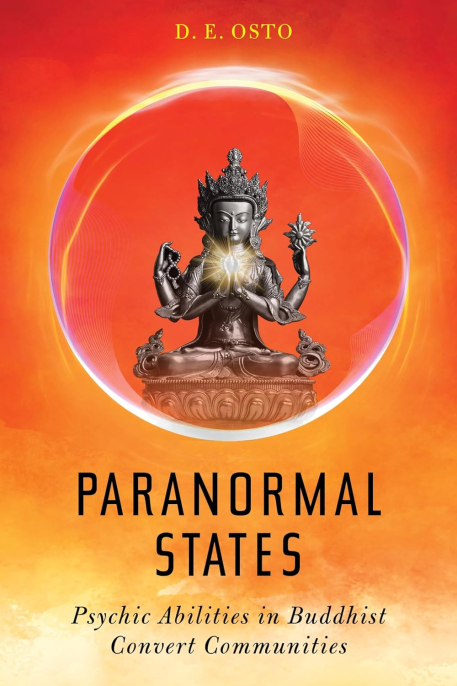
D. E. Osto is an American author and religious studies academic who is currently based in New Zealand, who self-describes as a “parent, author, scholar, artist, Buddhist practitioner, student nurse, martial artist, and nonbinary bodhisattva-wannabe”. Osto’s new book, Paranormal States, is about psychic phenomena reported by those who have at some stage taken up the practice of Buddhism. As you’ll see, I found the book to be something of a mixed bag.
The book begins with an interesting overview of the paranormal in Buddhist literature with examples of a wide variety of ‘magical powers’ that can be found in the canon and also describes how in many Buddhist traditions, “the multiverse is teeming with various nonhuman intelligent beings of all sorts” (p. 240). This is followed by what for many of us will be a familiar trawl through the science of the paranormal. This includes an overview of the work of J. B. Rhine, Charles Tart, Dean Radin, the University of Virginia’s Department of Perceptual Studies and the remote viewing programme Star Gate. The aim seems to be to establish that some scientists at least have done serious work in providing evidence for the paranormal.
However, I doubt that this summary will do much to convince sceptics. The case is not made in sufficient depth or with enough critical analysis. These sections do include some commentary about how empirical work in parapsychology might align with Buddhist teachings, particularly of course that of reincarnation and its resonance with Buddhist concepts of rebirth and karma, although this is far too cursory for my liking. This is particularly the case with research specifically regarding the relationship between Buddhism and psi, such as by Serena Roney-Dougal (which gets only a passing nod), and there is little mention of other parapsychological work related to Eastern spiritual practices, such as the associations between meditation and psi.
The main substance of the book showcases original material gathered by Osto through their research. We’re presented with the results of a survey where people practising Buddhism have reported incidents of ESP – telepathy, clairvoyance, precognition and psychokinesis. I have to say that I found these reports a little repetitive and most were not that impressive. As Osto themself remarks, some of the accounts “appear more to be examples of the random weirdness that is simply part of human life” (p. 125). Indeed. In that case, one might ask, why include them? They were also in the main not particularly ‘Buddhist’. The next chapter covers similar material but this time focused on out-of-body experiences (OBEs), near-death experiences and encounters with nonhuman entities. Whilst some of this relates to intriguing instances where people report meeting with nonhuman beings that bear a seeming resemblance to characters from Buddhist lore, many of these experiences once again got a bit of a shrug of the shoulders from me.
The final third or so of the book is where I think things get a lot more interesting. Here we find extended transcripts of interviews Osto carried out with two of their participants. These people feature prominently because of numerous paranormal experiences they’ve had throughout their lives. They relate fascinating and detailed accounts of phenomena such as OBEs, precognition and interactions with discarnate entities. Whilst some of these experiences are in the context of Buddhist practices and mythology, once again the religion itself felt to me somewhat tangential. In fact, one of the interviewees – Kat – suggests that some of her experiences related to Thai amulets with human remains may be just as pertinent to the Catholicism in which she was raised, with its rich history of quasi-magical religious relics, as it is to Buddhism. Nevertheless, there are interesting discussions of how Buddhist practices may help to initiate and sustain such experiences for these participants, or indeed sometimes to quell them by abstention. Equally fascinating was Osto’s own often remarkable paranormal experiences in the book’s concluding ‘autobiographical postscript’ (adding to those related in the preface) although, again, what many of these have to do with Buddhist practices and beliefs was not always obvious.
The penultimate chapter outlines Osto’s case for an increased emphasis on phenomenology in the study of the paranormal – a foregrounding of people’s subjective experiences without worrying too much about their supposed ‘reality’ or otherwise. They argue that this approach could help improve our understanding of Buddhist metaphysics, quoting the Dalai Lama who said “if scientific analysis were conclusively to demonstrate certain claims in Buddhism to be false, then we must accept the findings of science and abandon those claims” (see p. 246). I was also interested in Osto’s views questioning whether there is any value in trying to draw conclusions about the nature of consciousness given that ideas in this sphere are so nascent and that premature speculations may lead people to form unhelpful prejudices.
I enjoyed reading much of this book, especially the chapters that focus on the lives of those who seem particularly susceptible to paranormal experiences. How paranormal phenomena feature in Buddhism and how it might relate to certain Buddhist practices was also interesting, although I felt there was too little attention paid to whether these links might be causal rather than purely circumstantial. This issue is compounded by limiting the book’s remit to Buddhist converts. I’m guessing that this was done for ease of access to participants although this severely restricts the generalisability of whether we can attribute any association between Buddhism and paranormal experiences. Particularly when these mostly Western participants would likely have had many other cultural and religious influences beyond Buddhism.
What was also somewhat problematic was that some of the book was rather academic and dry, with exhaustive details about Osto’s methodology (for example), which I felt would be more suited to a journal paper than a book, at least in the manner in which it was presented. There was also an unfortunate tendency for Osto to repeat over a few paragraphs what their interviewees had just said without adding much – or indeed any – interpretation or nuance. I’m not sure why this was done because I don’t feel that it aided understanding.
In summary, then, I found this book to be both good and not-so-good. It may be useful to those who are interested in the intersections between religion and the paranormal. And if you enjoy reading compelling anecdotes about remarkable (and often veridical) paranormal experiences, then you’ll no doubt find much of this material to be fascinating. However, I’m not sure how much it serves to advance our understanding of the relationship between those practising Buddhism and their paranormal experiences.