




Reviewed by Tim Prasil
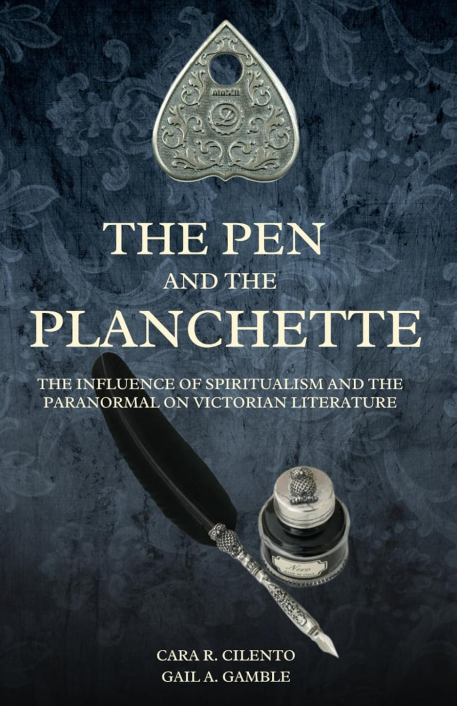
The ideal reader for Cara R. Cilento and Gail A. Gamble’s The Pen and the Planchette: The Influence of Spiritualism and the Paranormal on Victorian Literature might be someone unfamiliar with the rich diversity of nineteenth-century authors who incorporated ghostly guests or occult occurrences into their works. The co-writers devote a chapter apiece to fourteen authors and discuss a few more in the book’s conclusion. While many of the names are easily recognised—Charles Dickens, the Brontës, Oscar Wilde, Arthur Conan Doyle—some readers might not know much about their works with weird or supernatural elements. For example, I know the name of Christina Rossetti, but I’ve never delved into her fiction or non-fiction. Now, I have an introduction and a few titles for further investigation.
Along the way, however, Cilento and Gamble might mislead that novice reader with an overly broad application of two central terms. They offer no clarification or qualification when applying “Victorian” to the Americans Edgar Allan Poe, Louisa May Alcott, Emily Dickinson, and Nathaniel Hawthorne—or to W.B. Yeats, who was born when Dublin was under Queen Victoria’s rule (1837-1901) but lived well after the rise of Irish independence. “Nineteenth-century” might have been more accurate. The writers also fail to fully define what they mean by “spiritualism,” though this is key to their examination of authors’ influences. They establish that the spiritualist movement began in 1848, when the Fox sisters famously claimed to communicate with spirits (pp. 1-2). There’s no further digging, though, into the history of “knocking ghosts,” which predates the important Cock Lane case of 1762 and which the Foxes adapted; into mesmerism, with its entranced subjects and exhibitions called “séances”; or into concurrent religious movements such as Mormonism or Adventism.
This lax handling of history seems to lead the duo to make some confusing claims. The four novels by the Brontë sisters that they discuss were published in 1847-48, but we read that these authors had an “engagement with spiritualism” and wrote by “drawing upon the spiritualist movement” (pp. 31-32). Similarly, despite dying in 1849, Poe was subject to the “spiritualist movement’s influence” (p. 48) and also had an “engagement with spiritualism” (p. 49). Other authors are said to have had reservations about the movement or to have been not especially interested in it (see pp. 75, 95, 112, 124, and 153). Nonetheless, Cilento and Gamble link them to it by repeatedly labelling grief, ghosts, the divine, the afterlife, etc. as “spiritualist ideas,” “spiritualist motifs,” and “spiritualist themes.” While spiritualists certainly shared such concerns, treating them as specifically spiritualist (or Victorian, for that matter) instead of, let’s say, human weakens what seems to be a major thesis of the book.
In fact, I struggled to grasp the book’s exact thesis or theses, but I’ll attribute this to the authors not having had scholarly readers in mind. Despite the many written sources examined in the book, Cilento and Gamble provide only scant evidence in the form of quotations or paraphrases. I found no outright false claims when I knew the subject well enough to judge them, but offering supporting evidence is standard procedure in academic discourse. The bibliography is incomplete, too, in that several more works are named in the main text than are listed at the end. For example, while five of Doyle’s works are mentioned in his chapter, only one is in the bibliography. The chapter on Dickinson covers five poems and one letter, but she’s not in the bibliography at all. I found this shortcoming especially frustrating when Cilento and Gamble refer to Dickens’s “journalistic writings” debunking spiritualist frauds (p. 18), Elizabeth Barrett Browning’s letters showing “her openness to spiritualist phenomena” (p. 41), Alcott’s written record of “her belief in the continued presence of her sister’s spirit” (p. 57), Wilde’s “essays and conversations” deriding mediums and their supporters (p. 73), and other sources I would very much like to consult.
A few other fixes might have made the book more reader-friendly. Many chapters tend to wander and loop: after some author biography, a work is examined, then another work, more biography, back to the first work, etc. I recommend chapter subtitles as being helpful for both writers and readers. Titles of literary works are almost all in italics, though short story titles and most poem titles conventionally appear in quotation marks, even when academics aren’t the target audience. Perhaps the most telling sign of overly eager publication comes in the afterword: “As the chapters of Shadows and Quills have shown…” (p. 171). This title isn’t clarified before or after, and I have an inkling it was the working title of what became The Pen and the Planchette. Another draft or two would have made—and can still—make this a better, more readable book.