




Reviewed by Shannon Taggart
In one of the most iconic images of aura photography, a torn leaf appears restored by an electric silhouette. Known as the “phantom leaf,” this Kirlian effect, produced by a technique said to capture luminous energy fields, became a kind of holy grail for some twentieth-century parapsychologists seeking proof of an invisible life force. Yet it proved notoriously difficult to reproduce. Following the fragmented traces of this history, I found that explanations for the phenomenon sometimes slipped from controlled conditions into personal circumstance. I once heard a story I was unable to confirm: the research faltered when one of its most promising subjects, a teenager from Ohio, lost the ability to produce the effect soon after getting a girlfriend.
Such an anecdote hovers between fact and folklore, pointing to a dilemma: how can science study phenomena that entangle human conditions with technical ones? It is precisely this blurry terrain that Jeremy Stolow’s Picturing Aura brings into focus, reconstructing a vast, neglected history of attempts to picture the aura. Is the aura real? He moves beyond this stultifying question. Instead, he reframes it as a critical site for understanding the instability of visual truth, the entanglement of technology and belief, and the limits of academic categories inherited from the post-Enlightenment West.
Stolow’s method is central to the book’s achievement, bringing together domains of knowledge that rarely intersect. He moves fluidly across science, religion, art, and magic, spanning cultures and historical periods. This range extends from early twentieth-century Japanese psychology experiments to Cold War Soviet scientific theory, from Linda Henderson’s “vibratory modernism” to Donna Haraway’s “naturecultures,” from New Age crystal healing to contemporary mirror box therapy for phantom limb pain. Drawing on archival research, theoretical analysis, media studies, popular culture, anthropological fieldwork, and investigative journalism, Stolow shows that the aura persists as an enigmatic object, provoking questions that remain unresolved across fields.
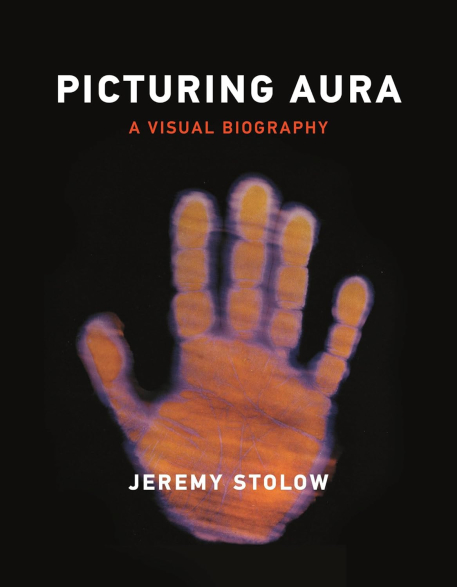
Throughout the book’s 60-plus full-colour illustrations, the hand is a recurring motif. It appears as a charged outline, a luminous imprint, in X-rayed bones, plaster casts, or constructed fields of colour. Stolow notes that with the rise of close-up photography in the 1890s, the hand became a common site for probing the soul, psychic powers, or disease. Here, the form is a point of contact where the body meets technology in the search for hidden information. In sacred art, the hand blesses and mediates divine power; in aura imaging, it is captured and measured. Hovering between icon and specimen, the hand becomes a stage for encounter, where occulted realities and empirical testing collapse into a single resonant image.
If the hand serves as an ideal form for tracing the aura’s entwined worlds, American researcher Thelma Moss emerges as an ideal figure. A central protagonist in Stolow’s account, Moss is best known in America for popularising Kirlian photography—a technique that uses high-frequency electrical currents to register an object’s electromagnetic discharge onto photographic material, such as experiments with the phantom leaf. At the University of California, Los Angeles’s Neuropsychiatric Institute in the 1970s, she expanded Kirlian investigation beyond electrified fingertips into imaginative experiments with organic matter. Her trials tracked the auras of kissing couples, a cat’s paw during acupuncture treatment, a rat’s tail post-amputation, and David Bowie on cocaine. A former actress and screenwriter, Moss fused her unlikely career in parapsychology with celebrity culture, the psychedelic imagination, and experimental psychology, embodying the entanglement of art, science, and belief that her images sought to capture.
Moss’s efforts to picture bio-energy were ultimately dismissed as unscientific. Her critics attributed the luminous patterns produced in her lab to random photographic effects influenced by moisture, pressure, or heat. Moss published counterarguments, but acknowledged that her findings required interpretation. She likened the Kirlian corona to an X-ray or a Rorschach test—a form of ambiguous data where meaning depends on the discernment of a skilled observer. In 1978, her lab was abruptly shut down, and much of her photographic archive was discarded or lost. Reflecting on her career at its end, Moss remained hopeful about the possibility of picturing the life force, insisting that her research had convinced her that human beings are not made solely of matter. Rather than argue for its scientific validity, Moss ultimately described her work as “a search for the meaning of life.”
Midway through her research, Moss discovered that many of her experiments had already been conducted, and similarly refuted, in the late nineteenth century. Stolow traces the cyclical pattern revealed in this part of her story, as techniques for picturing the aura repeatedly emerge, only to be dismissed and forgotten. Among the early figures Stolow features is Hippolyte Baraduc, a French physician who sought to capture the body’s unseen emanations on photographic material. Seeking to establish a scientific basis for the soul’s invisible light, he used photographic processes to register what he believed were visible traces of the soul in action during dreams, emotional states, and even at the moment of death. Like Moss’s images, Baraduc’s results flicker between evidence and artefact, inseparable from the interpretive frame through which they are read. He was among the first to confront photography’s capacity to both reveal and obscure the invisible, a paradox he did not fully recognise.
Baraduc’s work exposes another aspect of photography itself: the image not simply as representation, but as imprint—a trace of contact between bodies, energies, and surfaces. As Stolow points out, this logic has an ancient history. From the handprints found in prehistoric cave art to footprints pressed into sand, the imprint may be one of the oldest forms of image-making, predating even the intention to represent. In using photographic emulsion to register unseen dimensions through physical trace, Baraduc and many other experimenters were, in retrospect, strikingly prophetic. Seen from a contemporary vantage point, the miniature chips that power today’s computers, smartphones, and artificial intelligence are produced through photolithography, which uses a photographic process to etch intricate circuitry onto silicon. The same principle once used to search for invisible worlds now underwrites the construction of virtual reality. Across these distant contexts, the image persists as a kind of threshold, where something leaves a mark that gestures towards other dimensions.
Baraduc and Moss’s embrace of the aura’s ambiguous trace points to the reason there was a decisive break between psychical research and parapsychology. In seeking to make psychical research legible to twentieth-century science, J. B. Rhine moved the study of psychic phenomena away from ambiguous emotional situations, ritual contexts, and human embodiment. Rhine stepped out of the séance room and into the laboratory, determined, in his words, to “eliminate the shadows” from psychic study. He replaced mediums with anonymous subjects and ritual encounters with controlled experiments, relying on card-guessing tests, random number generators, and statistical analysis to produce measurable results. This shift brought methodological rigour, but it also redefined the field’s object of study. In stripping away theatricality and embodiment, parapsychology aligned itself with the evidentiary demands of scientific scepticism. Yet these excluded domains—art, performance, religion—have long been the primary means through which humans engage with and bear witness to unseen realities.
As parapsychology declines, the problem is not a lack of rigor, but how its pursuit has narrowed the field, excluding domains that may be central to what it seeks to explain. Such a shift can be seen in The Trickster and the Paranormal (Hansen, 2001), which draws on mythology to frame psychic phenomena and points to literary theory as one generative site for future inquiry. More recently, Dean Radin has explored the connection between parapsychology and ceremonial magic, while Joshua Cutchin has examined the confounding relationship between the paranormal and fiction. Other disciplines, too, stand to gain from deeper engagement with the rich history of psychic study. This knowledge remains insufficiently recognized across fields. It is telling, for instance, that many students of psychology remain unfamiliar with F. W. H. Myers. A founder of the Society for Psychical Research and a key influence on Freud, Myers’ work now sits largely outside the disciplinary domain he helped originate.
For those of us working across histories that intersect art, science, and parapsychology, valuable material survives only in fragments, scattered across personal archives, informal accounts, and abandoned experiments, at constant risk of being lost. In my own investigation of Kirlian photography and the phantom leaf, I was unable to identify the figure rumoured to have lost the effect after getting a girlfriend. Drawing on interviews with Thelma Moss’s former assistant John Hubacher, Stolow restores context. I now know that the young man was Alan Dietrich of Attica, Ohio and that his reputation stemmed from a three-day series of experiments conducted with his homemade Kirlian device, during which the elusive effect was repeatedly observed. The circumstances of its disappearance, however, remain unresolved.
In Picturing Aura, Jeremy Stolow suggests that the boundary-crossing aura offers an opportunity to rethink visual truth, the relation between encounter and evidence, and the categories that have long defined them. His work preserves and reframes a fragile, often marginalized history, while recovering information that might otherwise vanish. In doing so, he opens new lines of inquiry for future researchers, artists, and theorists.
Reference
Hansen, G. P. (2001). The trickster and the paranormal. Xlibris.