




Reviewed by Nemo C. Mörck
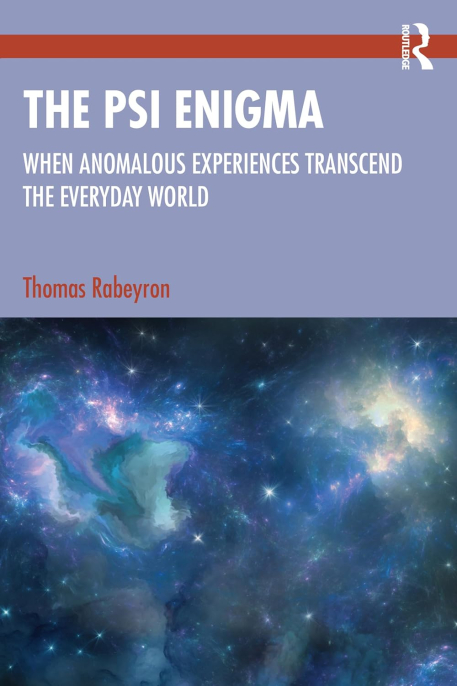
The author, Thomas Rabeyron, is a professor of clinical psychology and psychopathology at the University of Lyon 2 in France. The Psi Enigma is an English translation of Codex Anomalia: De l’énigme du psi à la relation psyché-matière, published in 2023. Ian Tierney, in the foreword, writes that it is ‘a new and ambitious attempt to understand the anomalous events and experimental results…’ (p. vi). Tierney also notes that Rabeyron has relied heavily on French sources, hence, those of us whose French is limited to a few phrases can get a glimpse of the French literature.
Rabeyron acknowledges an intellectual debt to Charles Richet, Sigmund Freud, Erwin Schrödinger, and Arthur Koestler. They are usually not mentioned in the same breath, and this suggests that the book is unusual. However, citations are given in accordance with the APA system, and elaborations are provided in boxes. Parts of the book are easy to read, but The Psi Enigma is a serious textbook. Some sections are obscure and force the reader to pause.
Rabeyron notes that evidence for the existence of psi comes from: spontaneous experiences, experimental research, studies with gifted subjects, and psi applications. Concerning the last, he writes ‘the drawback of these applications is that they are rarely published in scientific journals’ (p. 31). Some information is classified or is inaccessible. There is also a publication bias, meaning that successful attempts to utilise psi are more likely to get published. Sceptics tend to highlight instances when psychic detectives make false statements, but the police may not always reveal when they have used psychic detectives. Regardless of the evidence of psi applications, Rabeyron is right to quote Koestler:
A fundamental condition for the validity of a scientific experiment is that it must be reproducible and predictable. Yet paranormal events, whether occurring in the laboratory or spontaneously, are unpredictable, capricious and relatively rare (p. 28).
Rabeyron himself writes: ‘Psi is like an eel that slips through the hands of researchers as soon as they try to catch it’ (p. 37). He lists what it seems reasonable to regard as facts about psi and also covers theories. Rabeyron suggests that our current theories capture aspects of psi but acknowledges that there is no consensus within the parapsychology community and not all theories are entirely compatible. He even notes that we ‘observe phenomena that cannot be accounted for by a scientific model’ (p. 50).
It is fair to say that Rabeyron tends to focus on the big picture of parapsychology and its challenges. Yet sometimes he stops to study something closely. Unfortunately, Rabeyron can phrase things in a way that makes me pause. For example, he writes ‘…several people have reported how a bed was found upright, without any obvious intervention on the part of the people present at the scene. In this case, a person or a group of persons’ intentionality leads to an impact on the organization of matter according to final or teleological causes’ (p. 81).
Admittedly, I am not always up for untangling the meaning of what Rabeyron argues, but I recognise that he has made a serious effort and he does not shy away from the more complicated issues, such as paradoxes related to precognitive experiences. Rabeyron writes that the author Philip K. Dick had a precognitive experience, ‘which correspond to the circumstances of his death’ (p. 91). Yet this is contradicted by his own footnote, which says that Dick died later, in hospital after having suffered a stroke. I also note that neither Jon Taylor nor Eric Wargo, both of whom have attempted to understand precognitive experiences, is ever cited.
Sections of The Psi Enigma are interesting. However, I had lost interest by the time Rabeyron started to present his own Orpheus model. I find sentences such as ‘Transformations of the epistemic order in turn induce transformations of the ontic order, according to a reciprocity that bears witness to the bidirectional nature of relations between the ontic and epistemic orders’ (p. 109) far more tiresome than insightful.
Jule Eisenbud’s experiments with Ted Serios are singled out for unusually detailed coverage. Rabeyron then views the results in light of his Orpheus model and tries to understand the strange phenomena that Serios produced. Rabeyron later presents several ‘theoretical speculations that invite reflection’ (p. 185).
Rabeyron points out that parapsychology has value regardless of whether psi exists or not. If the answer should happen to be the latter, then parapsychology reveals the limits of the scientific method. That is what some suggested occurred in 2011, in the wake of D. J. Bem’s meta-analysis. I found Rabeyron’s final metaphor charming:
Like small animals, they [i.e. parapsychologists] work laboriously in the underground world of the real, waiting for a more favorable environment. But, as Richet imagined, they might need to hibernate a little longer, waiting for better days... (p. 233).
In conclusion, I have mixed feelings about The Psi Enigma. I noticed a variety of minor errors, such as misspelled names (Steven rather than Stephen, Miller rather than Millar) and a few oddities, such as seeing William McDougall being listed as a co-author of J. B. Rhine’s first monograph despite the fact that he only wrote a foreword. Rabeyron has also mixed up J. J. Thomson and his son Sir George Thomson. Sections of the book are interesting, but overall, this was not a book to my taste. The Psi Enigma is not an overview to be skimmed during an afternoon. The reader is meant to stop and ponder.