




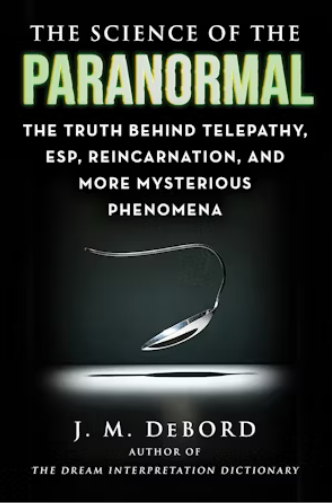
Reviewed by Nemo C. Mörck
J. M. DeBord has previously written books about dream interpretation and is appreciated by the mass media. I had never heard of him, so I approached his book with an open mind.
DeBord promises to “follow the evidence and explore the outer limits of what science can tell us” and begins by relating stories about Alex Tanous, who was tested at the American Society for Psychical Research (ASPR) – not at the SPR as DeBord writes. He provides no source for the Tanous stories, but the book is peppered with 142 endnotes, and includes an index. DeBord has deliberately adopted an informal, refreshing tone
He introduces psychokinesis (PK) by relating what he has learned from Joseph Gallenberger’s books. Then he provides sketchy coverage of PK research initiated by J. B. Rhine and later, in more detail, research at the PEAR lab. DeBord believes that the replication studies did “not replicate the cozy atmosphere at PEAR, an important factor…” He notes that if PK exists, then one would expect it to affect equipment we deal with in everyday life. Parapsychologists have also considered this possibility (see Morris, 1986).
DeBord writes.
What we find particularly intriguing is that, despite the existential impossibility of psi phenomena and the nearly 150 years of efforts during which there has been, literally, no progress, there are still scientists who continue to embrace the pursuit.
He cites Reber and Alcock (2020), but DeBord is clearly interested in learning the truth. DeBord highlights St Joseph of Cupertino’s thought-provoking levitations: “Very likely, the hundreds of witnesses on record were telling the truth as they saw it.” He notes: “At this point it looks impossible to explain a case like this in any way scientifically…” DeBord goes on to cover Ted Owens, “a trickster character obscured behind supposed feats of godlike power.” DeBord’s coverage of the Philip experiment and Kenneth Batcheldor’s research is also interesting. In addition, he writes about the power of belief.
The power of belief against psychic and paranormal phenomena may actually be hindering the apprehension of a true reality that uses our belief to deflect away our attention. There may even be blinders on our eyes to prevent us from accessing PK powers that can (if some reports are to be believed) literally make planes fall from the sky. Powers that appear to be tied closely with a person’s emotional state.
DeBord covers much that should be familiar to parapsychologists, but also mentions less well-known cases, such as one covered by the documentary Ring of Fire, by the brothers Lawrence and Lorne Blair, and the case covered by Lee and Richman (2021). However, DeBord is stingy with specific references.
Concerning metal-bending, he writes:
As improbable as it sounds, and even knowing that such tricks can be performed and smart people can be fooled, the volume of personal testimonies from researchers, reporters, and everyday folk is pretty damn impressive.
When DeBord introduces telepathy, he begins with Gilbert (not George) Murray’s criticised telepathy experiments, “some of the best evidence from that era” – according to DeBord.
But for sake of argument, assume his ability is real. He’s a telepath. What now? Well, for one, we need the scientific community to find out how it works. But for whatever reason, a century later we’re still stuck in neutral…
Frederic Myers coined the term telepathy. However, he did not establish the SPR in 1882 alone as DeBord implies. At the time Spiritualism was popular, and DeBord compares it to “modern fads like TikTok suddenly appear and are adopted widely across a society.” He moves on to Mark Twain’s (1891, 1895) accounts about telepathy and acknowledges that they don’t constitute proof. In fact, Twain “… was not shy about embellishing tales to capture the interest of readers—it made him one of the most successful authors of his era.”
DeBord provides a vague overview of Ganzfeld research, citing Milton and Wiseman (1999), but acknowledges that this line of research continued and cites Tressoldi et al. (2010).
DeBord returns to J. B. Rhine:
As you might expect, doubt was cast on Rhine’s experiments. People questioned the methods and the math, and even accused him of fraud, but the math was confirmed, and the methods checked out. And as for fraud, it’s hardly worth mentioning. By all accounts, the Duke lab used some of the tightest controls in the history of social science research.
DeBord then asks: Why is telepathy not confirmed? I presume that he means generally accepted. He suggests that the “…most plausible answer is the data conflict with existing theory that telepathy simply cannot exist” yet DeBord accepts the data and argues that it cannot be explained away. He covers some modern research too, including Venkatasubramanian (2008). DeBord acknowledges that psi is elusive yet argues that sceptics “...forget that it’s not the job of scientists to prove anything; their job is to gather data and present it.” He claims:
While the belief that the evidence isn’t there or is untrustworthy is clearly wrong, it’s also true that clear cause and effect relationships are missing.
Telepathic experiences sometimes occur in psychotherapy, and DeBord writes about the unconscious mind and senses that it is “behind the occurrences of at least some paranormal phenomena and others that resemble them.” However, he argues that psychology, as a science, avoids investigating due to the criticism Freud’s theories have endured.
The value of DeBord’s book is perhaps that he brings up the less well-known, such as the dream telepathy contest hosted annually by the International Association for the Study of Dreams. However, he covers much that is better known too, including Rupert Sheldrake’s research with animals. DeBord thinks that sceptics are quick to call it pseudoscience and argues that “what we rarely hear from them are countertheories to explain the observed effects.”
Among the less well-known, DeBord covers Keene (2021), who came to believe in reincarnation due to his own experiences. The more famous James Leininger case is also covered. More briefly, he covers speculative theories, but, more importantly, notes “the research is said to be strong enough to hold up in court, especially if we take only the strongest cases where multiple witnesses vouch for the accuracy and integrity of the people involved.”
Inspired by Mishlove (2021), DeBord also looks at historical mediumship and notes that mediumship research is still being conducted by Julie Beischel and her colleagues at the Windbridge Research Center.
Evidence for survival after bodily death also comes from near-death experiences (NDEs), so DeBord covers this subject too and claims: “Many atheists turned into believers of the afterlife after an NDE, and many of the most prominent names in the study of NDEs are physicians who experienced it themselves” but offers no citation. Bruce Greyson appears, but Raymond Moody is not even mentioned in passing. DeBord argues that Anita Moorjani’s and Eben Alexander’s NDEs “are among the best documented. They wrote books and gave numerous interviews, and their medical records are irrefutable.”
DeBord then abruptly jumps to Electronic Voice Phenomena (EVP) and then poltergeists. Concerning the latter, DeBord claims that “…scores of well-documented cases traced the source back to psychic disturbances in the minds of people involved. It’s not spirit phenomena, it’s mental.”
Later, DeBord shares his impression of what happened after Bem (2011) published his results. DeBord claims that “after a bit of controversy the establishment just moved on and acted like nothing happened.” I think he is being unfair – the debate in the wake of Bem’s article was valuable. DeBord is entitled to have his own opinions. However, his tendency to omit sources for his claims and to cite secondary rather than the primary sources is tiresome.
Concerning precognitive experiences, DeBord notes that they seem to “…have a life of their own. Like the unconscious mind itself, they operate under their own irrational sort of logic and defy attempts at explanation…” However, he shares theoretical musings throughout the book. After having drawn from Mayer (2008), DeBord suggests that proponents are not going to convince sceptics simply by presenting more data, but he does not elaborate.
In general, DeBord’s coverage feels somewhat random. However, this is a popular book. There are no strict selection criteria. Nevertheless, how familiar is DeBord with the research he covers? He cites Moulton and Kosslyn (2008) and in passing notes that it “enjoyed a lot of attention.” Parapsychologists would have phrased it in a different way. Later, when DeBord covers remote viewing, he makes mistakes and omits the criticism of the early studies. He claims that “the biggest impression in the mind of the public about remote viewing came from the movie The Men Who Stare at Goats.”
DeBord concludes his book by stating:
We need a science of consciousness that doesn’t begin with the assumption that matter is all there is.
In conclusion, I have mixed feelings about this book. DeBord has clearly seen far more movies than I have. He makes many more or less amusing asides, and has pondered on theoretical explanations. His 142 endnotes would benefit from proofreading, but the lack of sources for many claims is more troublesome. However, this is a popular work whose main value may well be that J. M. DeBord serves a unique blend of the well-known combined with the less well-known. Recommended with a few caveats.
References
Bem, D. J. (2011). Feeling the future: experimental evidence for anomalous retroactive influences on cognition and affect. Journal of Personality & Social Psychology, 100(3), 407-425.
Mayer, E. J. (2008). Extraordinary knowing: Science, skepticism, and the inexplicable powers of the human mind. Bantam Books.
Milton, J., & Wiseman, R. (1999). Does psi exist? Lack of replication of an anomalous process of information transfer. Psychological Bulletin, 125(4), 387-391.
Mishlove, J. (2021). Beyond the brain: The survival of human consciousness after permanent bodily death. Bigelow Institute for Consciousness Studies.
Morris, R. L. (1986). Psi and human factors: The role of psi in human-equipment interactions. In B. Shapin & L. Coly (Eds.), Current trends in psi research (pp. 1–26). Parapsychology Foundation.
Moulton, S. T., & Kosslyn, S. M. (2008). Using neuroimaging to resolve the psi debate. Journal of Cognitive Neuroscience, 20(1), 182-192.
Keene, J. J. (2021). Fire in the soul: Reincarnation from Antietam to ground zero. Independently published.
Lee, P., & Richman, G. (2021). Miracles and other realities: The paranormal adventures of Thomaz Green Morton, the most powerful psychic in the world. Beyond Words.
Reber, A. S., & Alcock, J. E. (2020). Searching for the impossible: Parapsychology’s elusive quest. American Psychologist, 75(3), 391-399. https://doi.org/10.1037/amp0000486
Tressoldi, P., Storm, L., & Radin, D. (2010). Extrasensory perception and quantum models of cognition. NeuroQuantology, 8(4), 81-87.
Twain, M. (1891, December). Mental telegraphy. A manuscript with a history. Harper’s New Monthly Magazine, 95-104.
Twain, M. (1895, September). Mental telegraphy again. Harper’s New Monthly Magazine, 521-524.
Venkatasubramanian, G., Jayakumar, P. N., Nagendra, H. R., Nagaraja, D., & Gangadhar, B. N. (2008). Investigating paranormal phenomena: Functional brain imaging of telepathy. International Journal of Yoga, 1(2), 66-71.