



Reviewed by Nemo C. Mörck
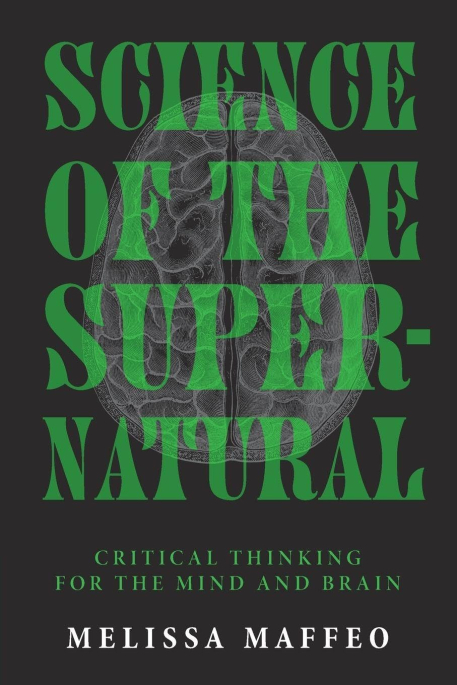
Dr Melissa Maffeo is a neuroscientist at Wake Forest University, USA. Science of the Supernatural is her first book: “The goal of this book isn’t to debunk paranormal claims” (p. 2). Like many authors, she uses supernatural and paranormal as if the words were synonymous. Maffeo appears to be sceptical and believes that most paranormal claims can be explained by normal factors. She also claims: “Empirical evidence of the paranormal might be the most important scientific finding in history, and, at the time of this writing, this evidence does not exist” (p. 2). Yet there is no shortage of evidence—what differs is how people interpret it.
Maffeo’s love for neuroscience is evident throughout the book, but SPR members might skim until she starts to deal with the possible relation between electromagnetic frequency (EMF) and reports of paranormal activity (Chapter 3). Naturally, a correlation may be due to people reacting to EMF rather than ghosts affecting EMF. I am not hostile to this idea. I used to feel the sense of a presence when I did the laundry in one house. I believe it was due to the environment rather than a curious ghost. Maffeo covers Wiseman et al. (2002) and French et al. (2009), but she also cites Braithwaite’s (2008, 2011) valuable overviews.
The coverage of Michael Persinger’s research with the God Helmet is somewhat sketchy. Maffeo claims: “There has been a paucity of studies that attempted to recreate the bizarre effects of the God Helmet, and those attempts were mostly unsuccessful” (p. 58), but she provides no references for this claim and doesn’t cite Braithwaite (2010). However, Maffeo is clearly interested in the idea that stimulation of areas of the brain can provoke hallucinations. She highlights the temporoparietal junction, which has been linked to a variety of unusual experiences, including out-of-body experiences.
In Chapter 4 she turns to sleep paralysis, sleep, dreaming, and precognitive dreams. Concerning the latter, Maffeo claims: “Precognitive dreaming is inherently impossible to study empirically, as both the dream itself and its potential predictive nature are both highly subjective” (p. 80). I gather that she is not too familiar with parapsychological research. However, naturally coincidental correlations between dreams and events can occur by chance. Maffeo also suggests that people who experience déjà vu might attribute the experience to earlier dreams. In addition, near-death experiences (NDEs) are discussed: “There are many natural explanations for NDEs, although no one explanation tracks for every NDE.” (p. 85).
Maffeo also covers alien abductions. Barney and Betty Hill are used as an example. Maffeo brings up the typical normal explanations for experiences of this kind, such as sleep paralysis, and argues that what the abductees think they remember are actually false memories, sometimes created during hypnosis.
Chapter 6 is devoted to psychic readings and Maffeo relates her own experience of a reading. She brings up Clever Hans, the horse trained by Wilhelm von Osten. Hans answered questions. Oskar Pfungst investigated and realised that the horse did not answer correctly if it could not see the questioner or if the questioner didn’t know the correct answer. This suggested that the horse had learned to pick up on bodily cues. Maffeo suggests that psychics may also learn to do so. She suggests: “Decoding our microexpressions is one way that psychics can ‘read’ our thoughts and emotions...” but this seems more dubious. However, she also brings up hot reading and cold reading.
It is less clear to me why Maffeo brings up Bem (2011) and provides brief coverage of the controversy his publication evoked. The only replication attempt she cites is Ritchie et al. (2012). Uri Geller and James Randi also appear. However, her book is not meant to cover parapsychological research. That said, Maffeo is familiar with the research conducted by Richard Wiseman and his colleagues (e.g., Wiseman & Greening, 2005). The book has a sceptical slant.
Chapter 7, Rabies, Parasites, and the Truth behind Zombies, is something else. Maffeo’s interest and enthusiasm are as evident as her eagerness to share facts. I get the impression that Maffeo is one of those researchers who loves teaching. However, I sense that this chapter lies outside the SPR’s remit.
Chapter 8 is about psychedelics, mystical experiences, and altered states of consciousness. Maffeo has tried Ayahuasca and shares her own experience. Albert Hofmann and LSD also appear. As do Timothy Leary, Walter Pahnke, and the “Good Friday Experiment” (Pahnke, 1963). Maffeo writes:
Very unfortunately for the field of scientific inquiry into the potential of psychedelics, it was later learned that Leary and Pahnke were a bit lax when it came to reporting results. They failed to mention the incidents of anxiety that were experienced by some participants, and as you can imagine, this called everything into question (pp. 172-173).
However, psychedelic research has had a renaissance and Maffeo covers some findings.
In conclusion, Maffeo writes:
We have yet to produce definitive, empirical evidence that supernatural forces exist, but we have an abundance of empirical evidence that shows that our perceptions of reality and our memories of events aren’t always accurate. They’re shaped by what we expect, by what we believe, and our brain fills in the gaps with what it thinks should be there (p. 188).
More than once Maffeo writes that people don’t like ambiguity and that we should be wary of this. To be interested in parapsychology, ufology, or Fortean phenomena is arguably to live with ambiguity. Unfortunately, the more one learns, the more complicated it can seem. Maffeo’s book has a sceptical slant, but the point is more to provide possible normal explanations rather than to debunk paranormal claims. To do this, she would need to engage with the parapsychological literature. Instead Maffeo has provided a pleasant book and the sections about neuroscience are particularly strong. Dr Melissa Maffeo appears to be a researcher who is eager to both learn and teach.
References
Bem, D. J. (2011). Feeling the future: Experimental evidence for anomalous retroactive influences on cognition and affect. Journal of Personality & Social Psychology, 100(3), 407-425. https://doi.org/10.1037/a0021524.
Braithwaite, J. J. (2008). Putting magnetism in its place: A critical examination of the weak-intensity magnetic field account for anomalous haunt-type experiences. Journal of the Society for Psychical Research, 72(890), 34-50.
Braithwaite, J. J. (2010). Neuromagnetic effects on anomalous cognitive experiences. A critical appraisal of the evidence for induced sensed-presence and haunt‐type experiences. NeuroQuantology, 8(4), 517‐530.
Braithwaite, J. (2011). Magnetic fields, anomalous experiences: A sceptical critique of the current evidence. The Skeptic, 22(4)/23(1), 38-45.
French, C. C., Haque, U., Bunton-Stasyshyn, R., & Davis, R. (2009). The “Haunt” project: An attempt to build a “haunted” room by manipulating complex electromagnetic fields and infrasound. Cortex, 45(5), 619–629. https://doi.org/10.1016/j.cortex.2007.10.011.
Pahnke, W. (1963). Drugs and mysticism: An analysis of the relationship between psychedelic drugs and the mystical consciousness. [Unpublished doctoral dissertation]. Harvard University.
Ritchie, S. J., Wiseman, R., & French, C. C. (2012). Failing the future: Three unsuccessful attempts to replicate Bem’s ‘retroactive facilitation of recall’ effect. PLoS ONE, 7(3), e33423. https://doi.org/10.1371/journal.pone.0033423.
Wiseman, R., & Greening, E. (2005). “It’s still bending”: Verbal suggestion and alleged psychokinetic ability. British Journal of Psychology, 96(1), 115-127. https://doi.org/10.1348/000712604X15428.
Wiseman, R., Watt, C., Greening, E., Stevens, P., & O’Keeffe, C. (2002). An investigation into the alleged haunting of Hampton Court Palace: Psychological variables and magnetic fields. Journal of Parapsychology, 66(4), 387-408.