



Reviewed by Gerhard Mayer
Aleister Crowley (1875–1947), the notorious and influential occultist, provided a technical definition of magic in his book Magick in Theory and Practice:
Magick is the Science and Art of causing Change to occur in conformity with Will (Crowley, 1929/1970, p. xii).
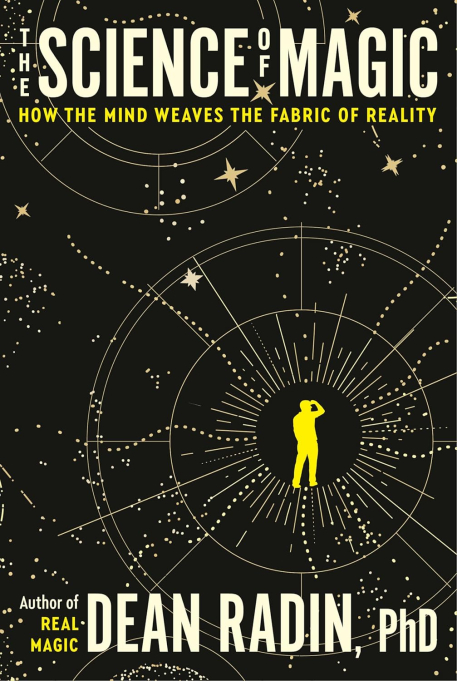
Prof. Dean Radin’s new book is simply titled The Science of Magic. However, this title has different layers and facets. It could refer to the scientific study of magic as a form of practice (from an outsider – etic – perspective), or to magic as a specific quasi-scientific approach to understanding and “causing change” in material reality (from an insider – emic – perspective, in line with Crowley), or magic could stand as an alternative term for psi. The latter meaning may be offensive to some parapsychologists, but it was already introduced by Radin (2018) in Real Magic, and corresponds exactly to his intention.
I’ve been studying magic from a scientific perspective for about forty years. For the first thirty-nine of those years I would have vigorously denied that statement (Radin, 2018, p. 11).
His new book can be seen as a variation or continuation of Real Magic (and his other previous books), but it adds a new aspect that goes beyond scientific experimentation.
The Science of Magic is a typical Dean Radin book. Like all its predecessors, it could also bear the subtitle: An Introduction to Experimental Parapsychology. In addition, like all previous books, it is elegantly written and easy to read, and is not primarily aimed at colleagues, but laypeople as well. The book benefits from Radin’s decades of experience as an experimenter, who did not devote his entire research career to refining a single line of research or pursuing a single cherished theory, but rather flexibly incorporated suggestions from other researchers, while also learning from the failure of some of his own experiments.
So why publish a new book when similar content can already be found in his previous books? As already indicated, the book can be seen as a continuation or further development of his earlier books and the ideas conveyed therein. The basic thesis, already presented in his first book The Conscious Universe (Radin, 1997), that a materialistic and reductionist model of the world is insufficient and that consciousness cannot be reduced to the brain, formed the basis of his research and increasingly led him away from focusing on the perspective that the solution must be found at the level of physics.
Radin’s own experiences with consciousness techniques such as meditation led him to, among other things, study paranormal phenomena in other cultures, particularly in India, and to evaluate them from the perspective of Western science (Radin, 2013). With his book Real Magic, he turned his attention to Western cultural history and established connections between magical practices and psi phenomena, as known from parapsychological research. He pursues and intensifies this approach in The Science of Magic by no longer viewing magic from the perspective of Western science, but rather science from the perspective of Western magic. With corresponding chapter headings, he essentially performs a reframing. This movement may seem irritating to some of his colleagues, but it has a great deal of logical consistency.
The Science of Magic is divided into four parts, which vary greatly in length. Part I: A Revolution is Brewing consists only of the introductory chapter, which describes what the book is for, what it is not for, how he understands magic (“I use the terms magic and psi interchangeably,” p. 11) [1] and what role consciousness plays in this. The most comprehensive part is the second, which, like the book itself, is titled Science of Magic and contains three chapters: Science of Enchantment, Science of Divination, and Science of Theurgy.
Science of Enchantment deals with various experimental approaches to proving the effects of targeted mental intention on the material level, that is, what is also reported in the tradition of classical magic and enchantment. This refers to various forms of psychokinesis experiments, ranging from influencing the behaviour of random number generators, cell growth, photons, plasma, and healing substances, to changing the quality of water.
Science of Divination deals with experiments that are otherwise referred to by the classical terms clairvoyance, precognition, retrocognition, and remote viewing. Finally, Science of Theurgy deals with scientific endeavours that address questions about survival after bodily death and, more generally, about a divine or otherworldly sphere. Although the question of the divine or supernatural cannot be answered directly by science, it is still possible to attempt to arrive at indirect judgements of plausibility— just as in cosmology the concepts of dark matter or dark energy can only be explored indirectly from the reactions of what is visible or measurable to us.
Part III, Understanding Magic, includes two chapters, the first of which deals with sceptical reactions and the tabooing of psi research: “… despite perpetual fascination by billions of people, psi as real is willfully ignored by over 99 percent of the academic and scientific world” (p. 163). In addition to the vast majority ignoring the evidence—most of whom may simply lack the necessary interest in the big questions raised by parapsychology—a small group of ideological sceptics is actively fighting against the recognition of the scientific findings of parapsychology. In doing so, they follow a three-part narrative, as Radin writes:
Dismiss anecdotal evidence as unreliable, loudly assert that experimental evidence that seems to support psi or magic is solely due to flaws or fraud, and then write off these phenomena as impossible because they supposedly violate physical laws (p. 169).
However, according to Radin, after a long period of disenchantment with the world brought about by science, a “reenchantment” has been evident in recent years, which, in addition to taking personal subjective experiences seriously, is based on a more nuanced understanding of human existence. The game-changer on the scientific side is primarily consciousness research, which has gained considerable momentum in recent years and also has a strong influence on theory formation.
Chapter 6, Theories of Magic, is about how practitioners of magic theoretically understand their practice and what conditions must be met for magic to work. Radin then briefly outlines the fundamental differences between central philosophical worldviews (materialism, dualism, panpsychism, dual-aspect monism) before presenting five classes of scientific theories on magic.
Part IV, Practical Magic, points to the aspect that distinguishes this book significantly from its predecessors, namely its instructional nature for practising magic oneself. Radin introduces several classical methods such as sigil magic, knot magic, and candle magic. He also offers suggestions on how to test magic for yourself. In the last pages of the book (Chapter 12, Beyond Magic), he answers questions that commonly arise in Q&A sessions on this topic, such as the usual small size of psi effects, their usefulness and significance, etc.
One can assume that it is this Part IV of the book that, despite clever preparation in the first three parts, will provoke criticism from both colleagues and sceptics. The latter have always sensed that parapsychologists adhere to magical-irrational thinking and cannot be taken seriously as reputable scientists; and the former may not want to take the step from theory to practice because the equation of magic and psi seems too daring to them, and above all, they do not want to be accused of magical-irrational thinking! I must confess that I too was initially somewhat reserved about the idea that the book would contain a practical guide. However, my reservations were dispelled after reading the book, as Radin conclusively guides readers towards the practice, emphasising its instrumental nature as part of consciousness techniques.
The criticism levelled at his earlier books (Radin, 1997, 2006, 2013), namely, that he gives too little space to sceptical voices and fails to adequately address existing problems in parapsychological experimental research, can also be applied to this book. However, this might be asking too much given his concerns, the target audience, and the relentless attacks from ideological sceptics. With decades of experience in experimental parapsychology and excellent knowledge of the specialist literature, his arguments are well-founded.
As a reviewer, I should try to answer a question, namely whether the book might be worth reading for parapsychologists who are already familiar with the research and are not normally interested in a popular science work. There are two reasons for reading it.
Radin’s overview of the many interesting experiments with positive findings, viewed from a unifying perspective of mind-matter interaction and consciousness research, provides a refreshing antidote to the often overly critical and self-destructive internal criticism among parapsychologists, who seem to be more successful in their efforts at deconstruction of their field of research than some sceptics.
Radin’s change of perspective and reframing can encourage colleagues to question familiar viewpoints in a similar way. One can, for example, develop new ideas about the recipes for success used by experimenters, about the elusiveness of the findings, and about the aforementioned small manifestations of psi without having to resort to axiomatic one-size-fits-all solutions proposed by quantum physics-based models that promise a simple way out of the complex set of conditions for psi phenomena [2].
Footnotes
1. Such an equation seems somewhat unfortunate to me, since I understand magic to be a form of action based on certain beliefs, whereas psi is a term used to describe a specific class of phenomena.
2. The following sentence by the American author and satirist H.L. Mencken (1880-1956), which has become a proverbial saying, sarcastically points out that “there is always a well-known solution to every human problem – neat, plausible, and wrong” (Mencken, 1921, p. 158). One should always consider the possibility that simple and elegant solutions might be wrong.
References
Crowley, A. (1970). Magick in theory and practice / by the Master Therion. Castle Books. (Original work published 1929).
Mencken, H. L. (1921). Prejudices: Second series. Jonathan Cape.
Radin, D. (1997). The Conscious universe: The scientific truth of psychic phenomena. HarperEdge.
Radin, D. (2006). Entangled minds: Extrasensory experiences in a quantum reality. Paraview.
Radin, D. (2013). Supernormal: Science, yoga, and the evidence for extraordinary psychic abilities. Deepak Chopra Books.
Radin, D. (2018). Real magic: Ancient wisdom, modern science, and a guide to the secret power of the universe. Harmony Books.