




Reviewed by Nemo C. Mörck
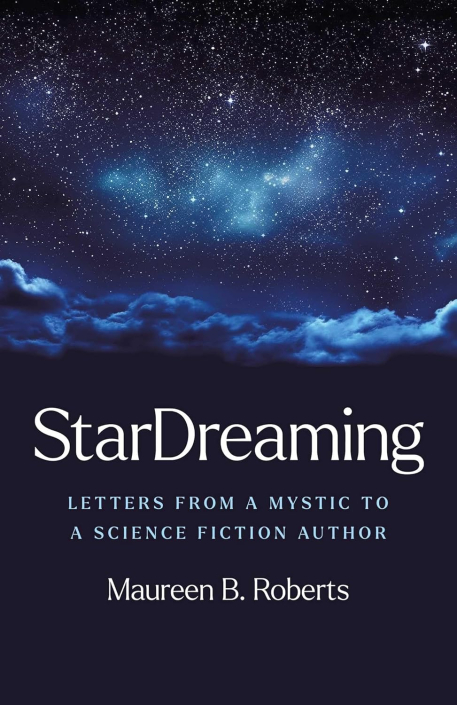
StarDreaming: Letters from a Mystic to a Science Fiction Author, by Maureen B. Roberts, is an unusual book. It mainly consists of letters written by Roberts between 1994 and 1996 to the author Damien Broderick (1944-2025), with whom she had a relationship. I never knew Broderick, but we corresponded. The parapsychology community remembers him primarily for The Lotto Effect, Outside the Gates of Science, Evidence for Psi (co-edited with Ben Goertzel), Knowing the Unknowable, and Psience Fiction. I regret that I never paid any attention to his body of fiction while he was alive.
Roberts holds a PhD, and her dissertation concerned English literature and Jungian psychology. For the past thirty years, she has run a private practice as a depth and shamanic psychotherapist. She herself has undergone ‘a shamanic initiation crisis and subsequent training’ (p. 164). Her biography also makes it clear that she has lived a rich life and been interested in many things.
StarDreaming is easier to read than to understand. Being somewhat familiar with Jungian terminology helps. I imagine that readers familiar with science fiction literature also derive further enjoyment from the letters. We only get to read the letters from Roberts; hence, we only get to see her perspective on her relationship with Broderick. She has not shared everything. Some material is lost, and Roberts deemed some too private.
Roberts first met Broderick at a conference: ‘He initially came across as a self-assured, softly spoken, shrewd, guarded and supremely intelligent man, full of brilliant insights but lacking the kind of emotional warmth and intensity that resonated with my own heart’ (p. xiv). She notes: ‘Damien’s letters differed markedly from my own. Sometimes cynical, he was also a more extraverted, disciplined, grounded and rational person than me’ (p. xvii).
In my own correspondence with Broderick, I once mentioned the Myers-Briggs Type Indicator (MBTI), which has been used by parapsychologists. I told him not to take the test result too seriously. Broderick wrote: ‘My results were stunningly INTJ, which was totally accurate’ (personal communication, 19 September 2020).
I was at first disappointed by the fact that we would not get to read what Broderick wrote to Roberts, but as I read on, I understood. It would not have been appropriate to publish his letters without his explicit permission. Roberts liked the person she rediscovered when she reread her old letters. She also grew on me as I read.
Roberts had an intense dream the same day she met Broderick for the first time. She thinks that it captured their entire relationship and returns to it in her letters. However, Roberts did not reveal how the dream ended in her correspondence, but she mentions its ending in her introduction.
From what I read, I could guess why Broderick sometimes replied to her in anger. In short, Roberts is more of a New Ager. I don’t use the term as an insult. Broderick was a friendly observer of parapsychology, but as Roberts found out, he had little patience for much that falls within the New Age. I recall that reincarnation was too far out for him.
As I read the letters, I understood why Broderick kept the correspondence going. Roberts read widely, including science fiction, Jungian literature, and more. Her perspective differs markedly from his, and she was fearless. More than once, Roberts mentions that she writes what she believes is the truth regardless of the consequences. This unusual honesty makes the letters interesting. In one letter she writes, ‘…as I’ve made clear before, you were a far cry from my ideal man’ (p. 86).
I don’t know what happened between Broderick and Roberts, but from the letters, I can guess. I think Roberts sometimes presents interpretations and speculations in the same way that she presents facts. Broderick might well have found that somewhat jarring. Roberts also notes that he seemed bothered by their personality differences.
Roberts accuses Broderick of trying to idealise her, claims that he is at war with himself, and argues that she only wants to help. She was deeply fond of Broderick, and the letters suggest that he found it difficult just to accept her love. In one letter Robers writes, ‘…you’re not an easy man to love, Damien, not because you’re unlovable but because you won’t allow yourself to be loved’ (p. 113). In another letter she writes, ‘I love you for who you are, not because you conform to my ideals, or agree with me’ (p. 104).
Roberts saw similarities between Broderick and the Trickster character Terragian in her book, An Era in Anddemar. I found her phrase ‘…dumb bimbos, for instance, make ideal targets for anima projections…’ (p. 45) memorable. From the context I gather that she argued that people who are not so clearly defined can find themselves being targeted by projections from others. Roberts meant no ill; she just writes her letters in a forthright way. I also found the expression, ‘orgasmic relish’ (p. 14) memorable, and hope to use it often if I live to write my own memoirs.
In addition to their relationship troubles and Jungian psychology, they also discuss literature and sometimes exchange feedback on manuscripts. Roberts has included a paper she delivered in 1994, Myths of Inner and Outer Space: Science Fiction and the Quest for Transcendence. However, the book also concerns a precognitive dream about Ayrton Senna’s death and experiences concerning Princess Diana after her death. Roberts rejects the labels ‘psychic’ and ‘medium’, but I gather that she would be willing to accept the term shaman.
This is an unusual book. I have deliberately tried to avoid giving too much away. However, I am uncertain about the book’s mass appeal. I enjoyed the book, but I corresponded with Broderick. I suspect that readers somewhat familiar with his style find the letters more interesting than do readers who have only heard his name. In one letter Roberts writes, ‘Let’s face it, in terms of integrity, intelligence and a commendably playful seriousness about life, friends of your calibre are hard to come by’ (p. 88).
I miss you today, Broderick.