




Reviewed by Peter G. Maxwell-Stuart
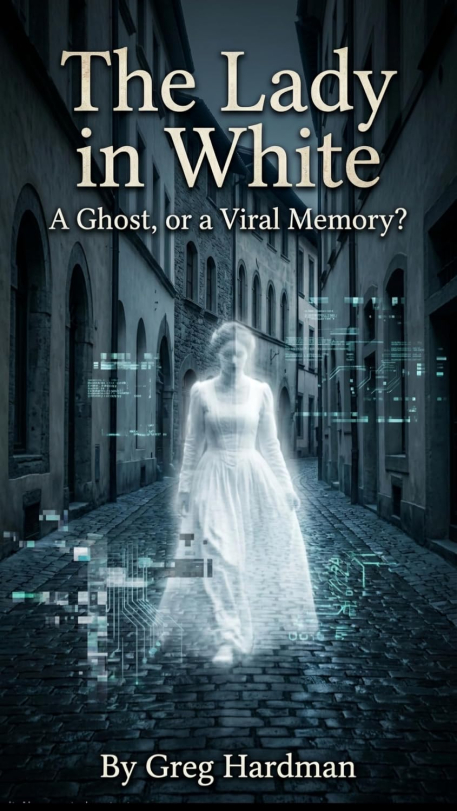
People will recognise the reference to a white lady from the title of Wilkie Collins’s novel of 1860, or (more likely these days, perhaps), from that of a film, The Lady in White, made in 1988. The lady in question is an apparition, assumed to be that of a dead woman, which appears in a variety of circumstances, many of which, however, are nocturnal and lonely. She does not speak to her living observer and tends to vanish quite quickly. Her appearance seems to be self-contained – there is no message, and she provides no guidance anywhere, even by gestures – and to that extent it is meaningless beyond itself. There are variants of her – a lady in grey, or red, or green, or blue, or pink – but to all intents and purposes they are of the same phenomenon. Gregory Hardman’s brief study of her picks up on this point and sets out to ask whether she tells us more about ourselves as her viewers than she does about any of the things usually associated with ghosts or visions or remnants of the dead.
Hardman embarks on an exploration of these sightings and makes his way through several proposals which he suggests explain, or help to explain, what is going on. The Lady in White wears white because the deceased used to be buried in shrouds or simple sheets. She changes herself as time goes by from being a nineteenth-century roadside figure which frightens the horses – the road is always lonely and dark, the viewer nervous and easily misled by a trick of the light or the movement of a farm or wild animal – while in the twentieth century, she may appear as a hitchhiker, or the victim of a road accident who vanishes without trace. Variants in both legend and the geography of her appearances differ in different parts of the world, but the essential details, (lady, white, vanish), remain unchanged and spread into modern consciousness very quickly in an electronic and digital age.
The Lady in White harks back to folk-legend but can perhaps be better explained as an embodiment of the percipient’s inherited collective guilt occasioned by the ill-treatment of women over the centuries, our common anxiety stemming from thoughts or reminders of death, or a complex trick played on our consciousness by the brain. Such a trick, says Hardman, can be played not only by the natural human inclination to make sense of disparate natural phenomena by transforming them into shapes or pictures it finds coherent and therefore satisfying, but also by such things as the possible effect of infrasound on the human eye, provoking transitory visual images from the eye’s vitreous humour.
Hardman has done the necessary research and produced an interesting commentary on his chosen phenomenon. There are, however, one or two unfortunate aspects to his exposition which interfere with the reader’s following his arguments with due attention. He gives a very full list of the white lady’s appearances all over the world. These, however, need to be cited when they are required to support a particular point Hardman wants to make. Unfortunately, the list at the end of the essay is not too useful. The other main problem is Hardman’s too-frequent use of overblown language. For example,
[The White Lady] is the “shroud” that covers our lack of understanding, a figure we have built from the bricks of our own history and the mortar of our own anxieties …. She remains the most accessible file in our cultural cabinet, a testament to the fact that while our technology may advance, the shadows we project into the night remain draped in the same snowy, ethereal cloth.
This is inappropriate for an expository approach to a complex subject and smacks of a novelist rather than a serious investigator. As a preliminary essay, then, this deserves a muted reception, but it will be interesting to see what Gregory Hardman does next.
Dr Peter G. Maxwell-Stuart is Senior Tutor at the University of St Andrews.