




Reviewed by Karen Stollznow
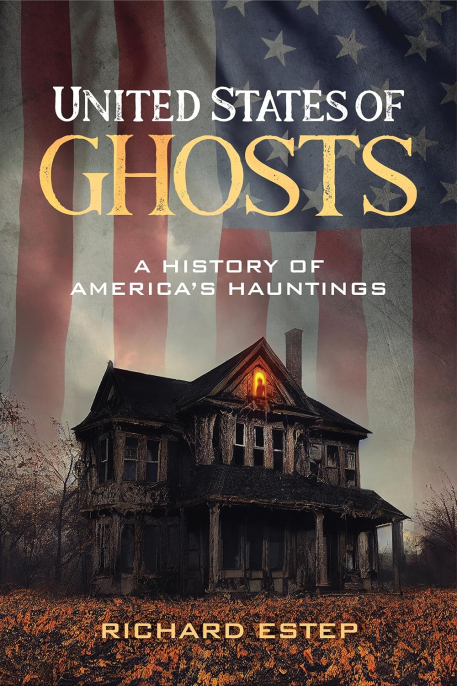
The author, Richard Estep, describes United States of Ghosts as “a voyage across the haunted history of the United States … told through the lens of ghosts and hauntings.” That is a fair description of a book that moves briskly from early American history to the modern day, pausing along the way for apparitions, séances, haunted buildings, battlefield ghosts, poltergeists, celebrity spirits, and some of the country’s most enduring paranormal legends.
The result is an entertaining survey of American ghost lore. Estep takes readers from colonial America and the American Revolution through the birth of Spiritualism and the Civil War, and on to the mining towns of the American West and the haunted history of Hollywood. Along the way we encounter familiar figures including Abraham Lincoln, Benjamin Franklin, Mark Twain, Davy Crockett, Rudolph Valentino, and John Belushi. These ghost stories provide an entry point into American history. As Estep says, “Come for the ghosts but stay for the history.” He has personally visited some of the locations featured in the book, giving parts of the narrative a first-person dimension.
There is plenty here to keep a general reader turning the pages. The chapters on wars and battles, the White House, Harry Houdini’s campaign against fraudulent mediums, the Poltergeist movie, and true crime cases make effective use of the uneasy territory where documented history and folklore meet. The stories are often intriguing precisely because they involve real people and places whose histories are already compelling without the addition of ghosts. The book shows how historical figures can acquire a second life as legends, while places marked by violence, death, and tragedy can acquire a paranormal reputation.
The case of the Fox sisters provides a good example of how a historical episode can take on a life of its own. Their alleged communications with the dead helped launch modern Spiritualism, but the sisters themselves eventually confessed to fraud. Although this confession did not immediately erase their influence, their claims are now thoroughly discredited. Estep is interested not only in what happened, but in the afterlife of the story itself: how a fraudulent episode became a foundational chapter in American paranormal history.
This is where the book raises broader questions about the relationship between history and folklore. Some of the most interesting possibilities arise when Estep treats a haunting not simply as an alleged paranormal event, but as a piece of folklore with a history of its own. Newspapers, books, films, the internet, and popular culture can give ghost stories new details, wider circulation, and an appearance of authority. This book provides examples of these phenomena, but without always exploring how those stories evolve. It also touches on the way haunted places become part of a tourism industry, where a reputation for being haunted can shape a location’s identity and appeal.
The book’s treatment of evidence varies from chapter to chapter. At his best, Estep distinguishes contemporary accounts from later recollections and questions stories that appear too good to be true. His discussion of the Alamo, for example, works particularly well when he examines how an extraordinary story developed rather than simply accepting the haunting at face value. The book is strongest when Estep actively investigates the provenance of a story, but elsewhere he documents the legend without applying the same level of historical scrutiny. Of course, not every story needs to be debunked. A ghost story can be compelling without being good evidence that a ghost exists, but a book concerned with the history of hauntings should clearly distinguish between fact and folklore.
This becomes particularly important when ghost stories are presented as a gateway to history. The introduction suggests that ghost stories can teach history. Whilst this is true, however, they can also blur the line between fact and folklore, allowing legend to distort or overshadow the history it is meant to illuminate. Ghost stories can bring history to life, but they can also end up rewriting it.
There are also some problems with historical accuracy. Among the specific errors are dates associated with the Boston Port Act and the Battle Road episode of the American Revolution, the history of the Washoe Club, and California’s death penalty in relation to the Charles Manson case. There are smaller issues too, including inaccuracies in captions and other details. None of these mistakes is central to the paranormal claims, but greater fact-checking and proofreading would have strengthened the book as a work of popular history.
The book could also do more to acknowledge its sources. The further reading list is useful, and some chapters draw on contemporary newspaper accounts, but it is not always clear where the research comes from, making it difficult for readers to distinguish between documented sources, the work of other researchers, and Estep’s own investigations and interpretation. This is particularly important when a chapter moves between established historical events and extraordinary paranormal claims.
Overall, as a work of popular paranormal history, United States of Ghosts offers an accessible and wide-ranging tour of American ghost stories and traditions. Estep brings together familiar names and places with lesser-known tales, weaving paranormal lore into the history behind them. For readers interested in American ghosts, folklore, and the stories that have grown around the past, the book offers plenty to discover.
Dr Karen Stollznow is a linguist, author, and researcher at the University of Colorado Boulder.