




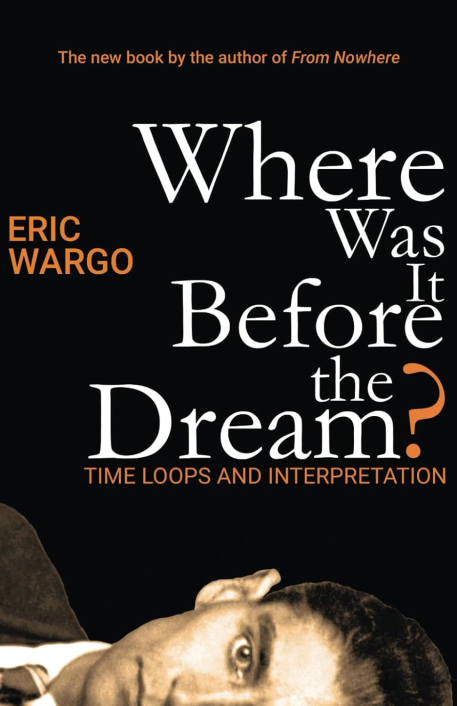
Reviewed by Richard Reichbart
This is a fascinating, well-researched book which I enjoyed immensely and which should interest anyone who wants to know about the creation of poetry and literature by such luminaries as Coleridge, Mary Shelley, Tolkien, Kafka, and Arthur C. Clarke, among others. In engrossing fashion, Eric Wargo reveals the creative moments that spawned these works, the surprising twists and turns that followed their creation, and the often unexpected future lives of these authors related to their creations. As a consequence of Wargo’s wonderfully detailed recounting, this book shall occupy a special place on my bookshelf.
What in fact are “time loops”, a term Wargo (2018) apparently introduced? Here is his definition:
A time loop is a circular relationship between a mindful being and their future. Some dream or idea coming in a moment of inspiration triggers a course of action - if only telling the dream or writing it down as a draft or a poem - and this act is the initial domino in a chain of dominos that leads to the event or state of affairs that the dream had really foretold or foreshadowed (p. 51).
Put differently, Wargo argues that a future was precognised in dreams or altered states that gave rise to the fictional stories or poems of these preeminent writers, and that the stories or poems and the underlying dreams or altered states that gave rise to them actually foretold what was to happen to the writer in his or her future life. This thesis is what explains Wargo’s somewhat strange title for the book: Where Was It Before the Dream?
I confess to being very partial to aspects of Wargo’s argument, for I made a similar observation half a century ago (Reichbart,1976; reprinted in Reichbart, 2019). I not only noted Tolstoy’s remarkable recounting of Anna Karenina’s precognitive dream in which she foresees very particular details that occurred years later when she committed suicide by throwing herself under a train (the kind of details that a parapsychologist would undoubtedly note in reality). I also ended the article by suggesting that Tolstoy predicted his own death years later when he fell unexpectedly and mortally ill in a railroad car. He had to be confined in the local stationmaster’s house facing the station, where he expired, while his wife from whom in a love-hate relationship he was now estranged, was denied entrance by him to the house and had to await his death in a local railroad car. However (as appealing as it is to invoke psi) this “time loop” if you will presents the same psi evidential difficulty as those that Wargo suggests. Let me expand upon this point.
In terms of a writer’s predictions, it is very different and much more impressive when a writer predicts a future that is not connected to the writer in any way because such a future is not a consequence of any subsequent actions of the writer, actions that may conceivably represent the dynamic working out of personal choices and preferences and thus be unrelated to precognition.
Of course, the most famous example of a writer predicting a future unrelated to the writer is probably Morgan Robertson’s 1898 book Futility, subsequently published as The Wreck of the Titan. This book seemed to predict the sinking of the Titanic twelve years later in 1912, an actual event which in its details (far beyond the strikingly similar names of the real ship compared to the fictional one) hauntingly resembled the fictional loss of the Titan written by Robertson. Jule Eisenbud has discussed the closeness of the fictional story to the actual future event and also investigated in a psychological tour-de-force the personality of Robertson that may have led to his apparent predictive ability (Eisenbud, 1982, pp. 88-122). No dream that we know of preceded Robertson’s writing. Similarly, as Wargo notes (p. 49), John Dunne in his book An Experiment with Time (1927) recounts dreaming that a volcano on a French island was about to erupt causing the death of 4,000 people only to get a mail delivery a few days later of the Daily Telegraph which reported the eruption of Mount Pele on the French Caribbean island of Martinique killing 40,000 people, which Dunne initially misread as 4,000. This too, of course, was a future event completely out of the dreamer’s control, because it did not happen to him. He only read about it.
When Wargo turns to the writers in this book, his argument (as interesting as it is) too often seems forced. He is determined to make the dream or altered state that gave rise to the work of art absolutely precognitive of the future of the artist, without fleshing out other possibilities to which the artist had motive or predilection. Wargo presents so many intriguing examples that I will focus on only two - Coleridge and Mary Shelley. With Coleridge, Wargo traces the evolution of the Kubla Khan poem, and the writing of the Rime of the Ancient Mariner, and suggests that both works contain the “prophetic template” of Coleridge’s subsequent drug dependency and loss of creative power. Wargo is disinclined to believe that when “casual opium use gradually turned to addiction” (pp, 56-57) it was determined by what leads to drug dependency in general: personality factors; and that whatever happened in Coleridge’s future was not so much precognitively determined but rather predictive based on Coleridge’s personality. In addition, that Coleridge eventually turned to religion to rescue himself is not the stuff of a precognitive engendered creation (for the Ancient Mariner is rescued by a Christian hermit) but is also imbued in the character of the author.
Similarly, after a fascinating recount of the creation of Frankenstein by Mary Shelley, Wargo then contends that the ostracism of the monster and then the monster’s murder of Victor Frankenstein’s brother, best friend and bride was precognitive of Mary Shelley’s own subsequent ostracism (“a dark shadow” thrown on her for her adultery with Percy Shelley) - and precognitive also of the subsequent death of her loved ones. What began with the suicide of pregnant Harriet Shelley (Percy Shelley’s wife at the time) when Mary was writing Frankenstein, was followed by the deaths of two of Mary and Percy’s children in subsequent years. Wargo states: “ anyone alert to the possible precognitive dimensions of fiction will also naturally see the author’s sad, haunted, corpse strewn future as possibly even more relevant” than a linear history of Mary. As in much of what Wargo writes, there is something compelling in this idea, but it escapes any parapsychological pinning down.
I can not help but remarking that In the midst of his writing, Wargo makes a gratuitous attack on the Freudian theory of repression and also contends that “[w]hat Freud called unconscious is really future consciousness (or cognition) as it refluxes back in dreams, visions, slips of the tongue, neurotic symptoms, and creative inspiration” (p. 48). As a psychoanalyst, I find both statements unfortunately to be simply thoughtless.
Nevertheless, as I said in the beginning, I very much recommend this book. Parapsychology aside, or for that matter, psi included, the fact is that life develops in strange ways that often seem to follow an unwritten but inexorable pattern. This book makes one wonder about the serendipitous nature of experience, even though the explanations that Wargo proposes elude psi evidence. For that, and for the exceptional details of these writers’ lives that Wargo shares, I am very grateful.
References
Eisenbud, J. (1982). Paranormal foreknowledge. Human Sciences Press.
Dunne, J. W. (1927). An experiment with time. Macmillan.
Reichbart, R. (1976). Psi phenomena and Tolstoy. Journal of the American Society for Psychical Research, 70(3), 249-265.
Reichbart, R. (2019). The paranormal surrounds us: Psychic phenomena in literature, culture and psychoanalysis. McFarland.
Robertson, M. (1912). The wreck of the Titan, or Futility. Mclure’s Magazine & Metropolitan Magazine.
Wargo, E. (2018). Time loops: Precognition, retrocognition, and the unconscious. Anomalist Books.