




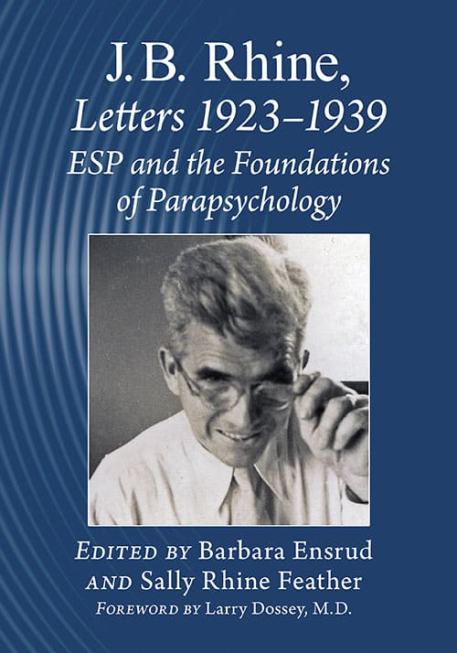
Reviewed by Nemo C. Mörck
This collection of letters has been edited by Barbara Ensrud and Sally Rhine Feather, both members of the board of directors of the Rhine Research Center in Durham, North Carolina. Together they have also written the entry about J. B. Rhine for the Psi Encyclopedia. Rhine Feather is the eldest daughter of J. B. and Louisa Rhine. She provides a Preface and Ensrud has written the Introduction. Larry Dossey has provided a Foreword, in which he refers to J. B. Rhine as: “one of the most gifted consciousness researchers our world has produced” (p. 2).
Rhine certainly has a place in the history of parapsychology and the literature about him and his impact is more extensive than the modest bibliography the editors have included (p. 541). However, they provide some context and, when warranted, include footnotes.
The editors present a nice selection of correspondence, 546 pages including index, allowing us to see how Rhine expressed himself in private. I imagine that the letters were written with far more care than most of us write emails today. Naturally, the tone varies depending on the receiver. Some letters are rather informal, others are more formal and were probably more carefully crafted. For example, letters to Frances Bolton and Charles E. Ozanne, who provided funding.
In 1923, Rhine presents himself as a former divinity student, who lost faith. However, he found something else to believe in. After having read books such as Human Personality and its Survival of Bodily Death, by F.W.H. Myers, he wrote: “I have been deeply impressed by these investigations and the tremendous importance they will be to the human race” (p. 10). Rhine could have had a mainstream career as a biologist, but he shifted focus.
Rhine wanted personal experiences and together with his wife he got to attend a séance with Margery, and several letters concern her mediumship. Afterwards he wrote: “Surely it is a most naively played game to have caused so much furor and fury” (p. 21). Malcolm Bird had been supportive of Rhine, but in the wake of the séance J. B. came to appreciate the more sceptical psychical researchers instead, Walter Franklin Prince and Prof. William McDougall. In a letter he notes: “It would be wise to drop the whole matter ...” (p. 35), but, evidently Rhine could not. In a letter to Prince, in 1927, he noted: “I am torn between high elation over the strong evidence for survival and gloomy dejection over the maze of difficult entangling suspicion in which the whole is lost” (p. 41). Concerning McDougall he wrote: “... he is a man whose leadership would be very profitable for a time” (p. 42), and later “one of the greatest minds I have ever met” (p. 51).
Rhine and his wife were impressed by some of the mediumistic material gathered by Thomas (1937). In a letter, he wrote: “We read some stirring records last time we saw Thomas. They were singularly far from the dribble and balderdash we were accustomed to” (p. 45). Letters also concern the allegedly telepathic horse Lady. Rhine was initially enthusiastic and also interested in accounts of other animals that seemed to have psychic abilities. However, it became clear to him that the horse was responding to cues from the owner and during their second investigation it did not enter what he described as a trance-like state.
In addition to describing research letters also reveal that J. B. successfully used hypnosis to help people. Perhaps more surprising is his letters to the conjurer Joseph Dunninger, who in private had apparently claimed to have psychic abilities – yet did not allow himself to be tested. In contrast, the medium Eileen Garrett agreed to be tested in 1934. However, prior to her visit Rhine admitted that he did not feel ready to deal with the survival theory yet, “to approach the problem of survival we have to know first, what the capacities of mind really are” (p. 139). This would remain his stance and it comes up several times in his correspondence.
Rhine comes across as a careful man. He was certainly aware of many potential lines of research, but he was not in a hurry and was concerned about making parapsychology a respectable field. From his perspective psychic phenomena were natural rather than supernatural, yet remained mysterious. Rhine and his colleagues also had evidence for psychokinesis and precognition long before their formal publications. From the letters we also learn that Rhine’s general attitude was that the press should not get anything until the results had been published.
Letters in the wake of the publication of Rhine’s (1934) monograph, Extra-Sensory Perception, naturally concern publicity, and Rhine was interested in the criticism the research provoked. I think it is fair to say that J. B. paid more attention to what his critics wrote than they paid to the research. The editors have included letters to critics, even a letter that Rhine never sent, addressed to James McKeen Cattell (pp. 456-457). The reader can sense his frustration. Rhine’s frustration is as evident in a letter written to a producer of ESP cards (p. 417). The cards were defective and Rhine was rightly angry and disappointed. Due to the defects B.F. Skinner was able to call 100 cards correctly (p. 424). Some critics focused on the commercially made cards and ignored the experimental conditions. Naturally, correspondence concern this.
Rhine maintained an extensive correspondence throughout his life, with a wide range of people. For example, he corresponded with H. F. Saltmarsh, G. N. M. Tyrrell, and S. G. Soal in England. However, he also corresponded with people such as C. G. Jung and Hans Bender. This is only mentioned in passing in letters, but Rhine met Jung once and Sloane (1975/2006) related his recollections of the meeting. It was a meeting of giants. Both wrote themselves into history.
Rhine is remembered as a charismatic leader and in a letter he even recalls having somehow become fast friends with John Mulholland, the conjurer, who had “been quite antagonistic” (p. 422). This was one of the more surprising revelations, I was also amused by a letter Rhine wrote to H.L. Mencken. A brief somewhat tactless letter in which Rhine admits that he had not actually read anything Mencken had written about the research, but that he welcomed criticism (p. 456). I was also surprised by Rhine’s humour. For example: ”A psychologist is apparently a person who disagrees with all other psychologists; or he may be otherwise defined as one who may psychologize everybody but himself” (p. 424). Less surprising to me was that experimenter effects and the general atmosphere during testing are recurring topics in the letters. At one point he even suggests that psychic abilities are ”extremely delicate” (p. 452).
I have noticed some unfortunate errors, for example, Gurney’s first name was Edmund not Edward (p. 362). However, I would certainly be happy to recommend this collection of letters. It is mainly of historical interest. That said, I think one needs to be somewhat familiar with the history of parapsychology in the United States and the various individuals to truly appreciate the letters.
References
Rhine, J. B. (1934). Extra-sensory perception. Boston Society for Psychic Research.
Sloane. W. (2006). Jung and Rhine. Journal of Parapsychology, 70(1), 167-171. (Original work published 1975).
Thomas, J. F. (1937). Beyond normal cognition. Boston Society for Psychic Research.
A separate review by James G. Matlock appeared in the Journal of the SPR (86.3)