




Reviewed by Michael Solomon
An historian of magic once assured me that more books had been written about Houdini than about any other luminary. It’s possible. Beginning with Houdini: His Life-Story (Bess Houdini’s reminiscences about their life together); through biographies like Ken Silverman’s Houdini!!! and Bernard Myer’s Houdini: A Mind in Chains (a psychoanalytic study); to a plethora of fiction— mysteries, graphic novels, the bestselling Ragtime—Harry Houdini, né Erich Weiss, has intrigued writers.
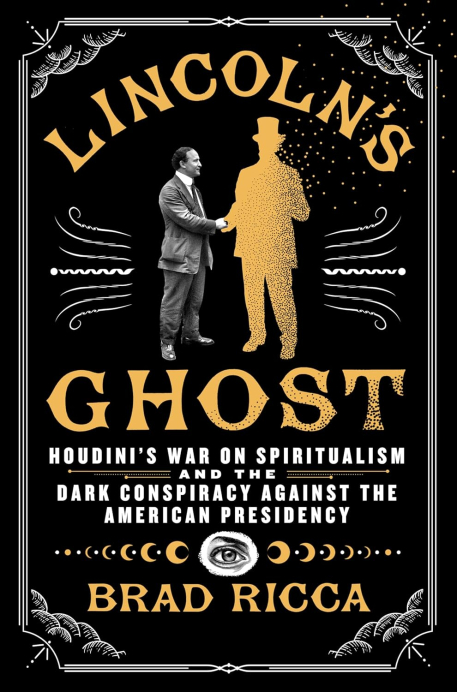
Now Brad Ricca’s Lincoln’s Ghost: Houdini’s War on Spiritualism and the Dark Conspiracy Against the American Presidency has joined the list, and is a worthy addition. Lincoln’s Ghost, with its novelistic style, is a kind of hybrid. When Rose Mackenberg, Houdini’s undercover investigator of fake mediums, arrives at a séance, we learn that “The front room was perfectly pleasant. For a house of horrors, thought Rose.” Ricca tells us that “she missed her money already.” And during her investigation, Rose “hoped” and she “wondered.” But how does Ricca know this?
Initially, I was put off by the specter of an all-knowing author—a scribe who is privy to his characters’ thoughts, and who is even able to quote their private conversations. But finally I warmed to this omniscience—and thoroughly enjoyed reading Lincoln’s Ghost. In an endnote, Ricca explains that much of the dialogue he presents has been “imagined around facts.” That is to say, it is a plausible reconstruction of what was said at the time, based on known facts that he has uncovered in his research. Fair enough! That research has resulted in twenty-five pages of endnotes, an impressive bibliography, and a long list of acknowledgements—all of which attest to the depth and diligence of his scholarly labors.
Once I had accepted that narrative convention (one that has become common in biographies), I relaxed and enjoyed this latest book about Houdini. And I can recommend it to fans of the celebrated magician; to anyone interested in learning about his campaign to expose fraudulent mediums; and to general readers in search of an absorbing read. It is a tour de force of research and writing. Particularly effective is Ricca’s account—based on the official transcript—of Houdini’s testimony before a Congressional subcommittee that was investigating mediumistic fraud. During that hearing Houdini faced off against angry mediums in the audience.
Lincoln’s Ghost contains welcome additions to Houdini scholarship, made possible by the resources of the digital age. Obscure newspaper stories from around the country have been located for the first time. And while some of the material pertaining to Lincoln (whom Houdini admired) is a digression of sorts, it is nonetheless fascinating. Ricca explores the possibility that John Wilkes Booth escaped from his pursuers and lived on for many years in secret!
Was Houdini an enemy of Spiritualism, as its adherents accused him of being? He insisted repeatedly that he was not. It was only the frauds that he went after, he explained—the con artists who were giving Spiritualism a bad name. Ricca tells the story of his efforts.
SPR readers should enjoy this tale of the dark side of Spiritualism— the egregious fraud, trickery, and chicanery that Harry Houdini was determined to expose.
Michael Solomon has written, under the name Professor Solomon, a series of biographies of stage magicians, and is employed at a high school for the arts in Baltimore, Maryland.