



Reviewed by Gregory M. Westlake
Two things fill the mind with ever new and increasing admiration and awe, the more often we reflect upon them: the starry heavens above me and the moral law within me - Immanuel Kant (quoted on p. 204).
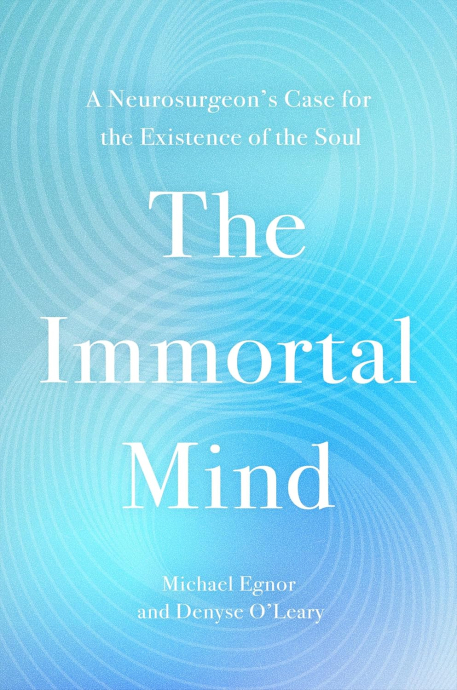
Prof. Michael Egnor at Stony Brook University, New York, is a practising neurosurgeon, with 45 years of practice and over 7,000 brain surgeries. Egnor has co-authored this new, groundbreaking, insightful book, regarding the transcendent, eternal mind with Denyse O’Leary, a scientific author. This is a fascinating, courageous study focusing on the indomitable consciousness of the human soul. Egnor and O’Leary have eloquently presented spellbinding, conclusive scientific evidence for the spiritual meaning of life. Egnor’s mysterious brand of Catholicism argues for the existence of God and the rejection of atheism. He passionately defends Aristotelian dualism – our mind-body dualism.
This is a vital volume for those grappling with these ideas and for those wondering what it truly means to be human, during this our fugacious time on Earth. The book is engaging, thought-provoking, a crucial vantage point for the inquisitive, psychological, mystical reader. The neurosurgeon’s awareness and perception are enthralling and absolutely absorbing. Who better to lecture us on this exceptional, heady theme? The book comprises thirteen chapters, with an introduction, and a conclusion. The text runs for 226 pages, with 29 pages of detailed notes.
Personally, I found the following chapters to be sincerely inspirational; firstly, the introduction, whereby we learn of Egnor’s conversion experience, and a divine miracle. Secondly, chapter five, where we encounter the extraordinary Pam Reynolds, ‘beyond death’. Thirdly, chapter seven concerning the immortality of the soul, in particular for a certain disabled citizen. Finally, chapter twelve, which focuses on the belief in God. So, this is a critically original title, that is accessible, and intelligible for the intellectual individual; and potentially, a most enjoyable read, possibly a revamp for your psyche.
The introduction of the work, informs us of the transformation of a rural medical student, to a firm Christian believer. Egnor was brought up to understand that to be a brain surgeon was the pinnacle of academic achievement; that is, to be a central player in the ‘life-and-death drama’. The most intimate way to get to know what it is to be human, and unravel the mystery of life. Even then, though Egnor was an atheist, who suffered occasionally from ‘hauntings’, when he was alone, glimpsed a sunset, or woke up at night. Perhaps, these were breakthroughs of the deepest reality, in his pathologically normal life.
This other-worldly sense became worse when Egnor changed his lifestyle during fatherhood. This was the turning point, when his younger son was born; Egnor was terrified his son might be autistic. He recalls total desperation and anguish. That is, until he prayed to God in a hospital chapel for the first time. Miraculously, soon after his son was cured, and behaved as a perfectly natural young boy. The very next Easter, Egnor was baptised, with other members of his family.
Moving on to chapter five, and the remarkable narrative regarding the American singer, songwriter Pam Reynolds. Due to an aneurysm on the basilar artery of her brain, she had to undergo an extraordinary technique called hypothermic cardiac arrest. Her heart would be stopped, and her brain would have to be drained of blood. This would give the surgeon a thirty-minute time window to remove the neurological defect in the patient’s brain; whilst her body would be unable to react. The operation was a success, amazingly, with Reynolds being brain dead for a while, and even experiencing a truly authentic near-death experience (NDE). Here the text becomes intriguing, with fascinating quotes from Pam Reynolds, herself recalling the duration when she was dead, with,
I noticed that as I began to discern different figures in the light – and they were covered with light – they were light…Everyone I saw, looking back on it, fit perfectly into my understanding of what that person looked like at their best during their lives (p. 89).
Her NDE also entailed detailed knowledge of events in the operating room during her recorded clinical death, that were confirmed afterwards, making this a veridical experience. Witnesses were so startled by her recall of the procedure that they refused to discuss it with Reynolds.
Penultimately for this review, there is chapter seven, Immortality of the Soul is a Reasonable Belief, where we learn of the eloquence of a pastor, presiding over the funeral of a young disabled citizen. The room was packed with at least a hundred people, with others spilling into the hallway. It was the best-attended funeral Egnor had ever witnessed. One must remember this individual had been severely crippled and disabled. Muffled sobs were heard as the pastor moralised,
Now Jenny is whole, fully healed, running and laughing in the fields of an immeasurably more beautiful land, loved there as she is here, but loved not just by us fallible mortals, but by Love Himself, Who she sees now face-to-Face (p. 122).
This emotional homily made Egnor reflect very deeply. Could the pastor perchance be right in his thinking? From neuroscience, the immaterial aspect of the human soul is unity; it cannot be divided, or bisected, the human person is still wholly present, not in part. Thus, the human soul cannot just decompose, as the dead human body does. Spiritual people tend to formulate thought patterns that are more methodical, with a deeper sense of meaning – an anchor in times of distress.
Finally, chapter twelve, And This All Men Call God, which explores the relevant cogitation that faith and religion enable survival and procreation in mainstream society. According to certain academics, religion helps the resilience and mental fitness of a nation. Between two barbaric nations, the one that was generally more superstitious would be more united and powerful. Generally, all the religious traditions assume the existence of a divine Mind outside the created order. Although, interestingly Buddhists don’t typically think in terms of divine creation:
Our present is the latest in an infinite past series. Thus, infinity itself is the creator (p. 195).
The authors then discuss a number of logical arguments for the existence of God, developed and put forward by Aquinas, a priest and Dominican friar, including Cosmological Arguments, concluding with The Fifth Way, a divine Mind that is not part of the natural order.
‘By wisdom the LORD laid the earth’s foundations…’, Proverbs 3:19. And that is what all men call God.
To draw to a conclusion with respect to this work, I can recommend the book. However, be aware, though, this is the vision of an American Catholic, very conventional, and conformist. Professor Michael Egnor clearly is a very high achiever, who has realised his wisdom via the established, traditional system. Although, the stance and attitude of a celebrated neurosurgeon, is always going to be entirely engaging, and thoroughly spellbinding. The book offers a unique vantage point onto the cosmic quandary of the immortal, eternal Mind. An essential, vital, intelligent professorial text for the library. I can sincerely prescribe this voice of authority.
Gregory M. Westlake can be reached at: [email protected]