



Reviewed by Ciaran Farrell
Dr Stephen Dietrich-Kolokouris is a historian and a remarkable man with a diverse set of interests, skills, and talents. He is not only a historical researcher and author who specialises in the unravelling of dark cultural episodes in the history of crime as revealed in his published books about the Chicago Ripper Crew, and the Waffen-SS. Stephen is also a cyber-security expert, and a former CIA intelligence contractor. In addition to this, he has featured in the Australian Esquire magazine, and has published a book on the culturally dark subject of Hitler as a socialite.
On the 22nd of November 2022, Stephen was dead for three and a half minutes and he describes his Near-Death Experience (NDE) as terrifying, disorientating and transformative. He observed that his latent psychic sensitivity which he had been exploring with the evidential medium, Cindy Kaza, increased after his NDE. He was able to perceive the cosmic or psychic consciousness which he considers to be waiting and watching humanity from just beyond the veil. This may be why Stephen has dedicated his book to: “Just the universal: For those who keep vigil in the dark. For every soul who ever asked the question and waited for an answer.”
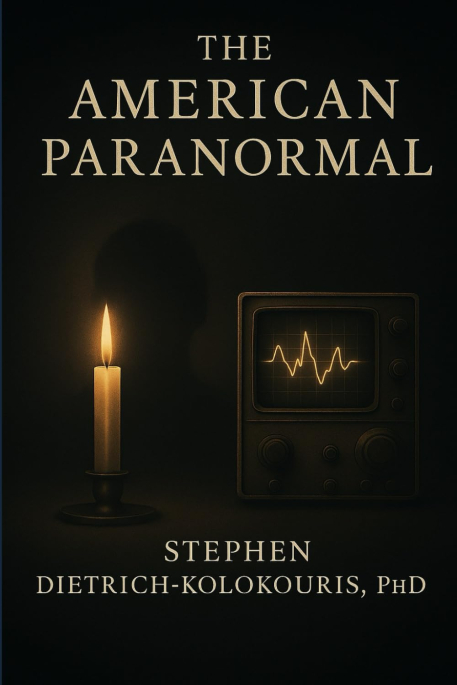
Stephen’s book has a very definite international flavour, although he begins his constructively critical narrative of Spiritualism and technological innovation to address the question of survival with the Fox sisters in 1848 in Hydesville, New York. He covers the birth of the Spiritualist movement, and the way in which Spiritualism developed and spread across the world in various different incarnations, including Theosophy and Spiritism.
Stephen considers that the way in which the Spiritualist movement developed in America was part and parcel of what he describes as true American values (hence the title of his book). These values are not only the search for truth, and the application of justice to the question of human survival, and the existence of a cosmic consciousness, but also the American way in relation to the democratisation of people’s ability to engage in contact with the spirits of the departed, and the ability to also make contact with a cosmic consciousness of which they may form part.
He describes this process in practical terms in which a person or their family need not consult a priest to play an intercessory role in ensuring that a person’s prayers and therefore their messages to the departed would be heard by them as facilitated through God as if He were some kind of cosmic telephone exchange. The intercessory role being broadly equivalent to that of an operator of a telephone exchange. This role could also be occupied by the priests of other religions as well as specialist practitioners like shamans, occultists and fortune-tellers.
Stephen then goes on to discuss the rising age of technological achievement born out of the scientific revolution, in which people found that they themselves could buy, use, and adapt various spirit-based technologies such as Ouija boards and planchettes, as well as various automatic writing techniques. He describes how these new technologies of the day were used by increasing numbers of people who wanted to contact their deceased loved ones directly.
These technologies include various electromechanical devices of one sort or another as well as the emerging technology of radio, and later television, and the audio recording of séances. He covers the endeavours of the various generations who sought to contact the deceased through the resulting hybrid of spiritual beliefs and practices combined with the use of technological instrumentation to make contact with the spirits of the deceased both plausible and feasible.
Stephen’s book is unusual in the sense that the other major perspective from which he sets out his narrative is the presumed viewpoint of the cosmic consciousness which he considers to be waiting and watching humanity, and may be seeking to guide us, or impose its will upon us. He also considers that it wants to keep itself largely out of human sight and therefore scrutiny, and thereby keep us guessing about its existence and intentions. This, he argues, is why it has not been possible to develop truly successful technologies, and thereby prove survival after bodily death. However, he considers that this cosmic consciousness or global psychic awareness just beyond the veil might be ever closer on the horizon with new evolutions of ghost hunting technology.
He then blends together today’s science-based technology and our continuing search for the existence of the paranormal and so the spirits of the deceased with his vision of a brave new technological world in which contact with people’s deceased relatives has become a reality through Artificial Intelligence (AI). This he considers would be achieved through human endeavour to essentially outmanoeuvre, capture, and use the cosmic consciousness he has described to serve humanity, although it is an unruly beast.
Stephen describes how his initial dream of his AI technological Nirvana in which the veil between the worlds is routinely pierced turns into a nightmarish vision of an extremely socially, culturally and economically divided society. This division within society he considers would be brought about because of the inevitably high cost of the AI technology involved. Therefore, only the more aspiring, wealthy and educated within society would be able to benefit from the knowledge, wisdom and advice of departed souls and the cosmic consciousness. The remaining members of society would be left behind and eventually left out, forming an underclass within an ever more divided society.
I think the way in which Stephen has set out what I consider to be a modern Gothic scientific and science fiction-based book is reminiscent of the way in which Henry James, who in 1898 wrote The Turn of the Screw. This is because The American Paranormal essentially also contains two competing and contrasting narratives, the first one being composed of a series of historical vignettes in which the author describes the history of significant technological and spiritual/ghost hunting events, and the second is composed of a series of deductions, questions and thought-provoking comments in relation to the first. Although both narratives can be read semi-independently, they rely on one another to provide the facts involved in a historical account of the development of spirit-based technologies, and their cultural, spiritual and technological meanings and implications.
In each chapter, Stephen uses this approach combined with various cultural scene-setting vignettes which are designed to make the reader feel more at home in the historical period in which the significant events he describes occurred. In this sense, The American Paranormal is far more of a docudrama than a straightforward historical account of those events. This adds a considerable splash of colour and richness to the events he depicts, and also to his vision of their consequences for society, the Spiritualist movement and for the development of ever more ambitious spirit-based technologies spanning both world wars and the cultural changes they produced.
It is apparent to me as a psychical researcher, a paranormal investigator, and a ghost hunter that Stephen has spent many long hours waiting in the dark for something to happen with an array of technological gadgets deployed around him. During these sessions he has contemplated the nature of the paranormal universe and what contact with discarnate entities and a universal cosmic consciousness would mean for him, the world and humanity as a whole. In this sense, The American Paranormal is very much a philosopher’s book for those who engage in these activities, although there is also something there for the devotees of the theories of cosmic consciousness, spiritists, spiritualists and technologists as well as historians.
I think The American Paranormal is a very unusual, interesting, and challenging book in which the reader will see that the author has considered in some considerable depth and breadth the matter of there being more questions than answers in the world of the paranormal, its history, and development, as well as its future, and of that of humanity itself.
The book is written in a very fluid and modern rhetorical grammatical style which prompts the reader to consider the questions he regularly poses in the second narrative of his book which is a critical commentary on his first and original narrative. In this respect, the same seminal events in paranormal history are considered from different perspectives and points of view, most particularly from that of the psychic cosmic consciousness that is waiting out there for us to finally prove its existence. Therefore, The American Paranormal comes across to me as a novel, friendly, enthusiastic, as well as thought-provoking, philosophical journey through the history of Spiritualism from a technological perspective for those who love the challenge of the paranormal.