



Reviewed by Nemo C. Mörck
Dr Helané Wahbeh “grew up in California as the New Age movement was flourishing” (p. 18) and appears to have remained fascinated by psychic phenomena ever since. She joined the staff at the Institute of Noetic Sciences (IONS) in September 2015 and is now its Director of Research. Wahbeh has a doctorate from the National University of Natural Medicine and a background in alternative medicine. Wahbeh has co-authored Free To Be Me: A Journey of Transformation through Generational Healing with Maha Kury. Her mother, grandmother, and uncle are all trance channellers. Wahbeh relates that she has also learned how to channel.
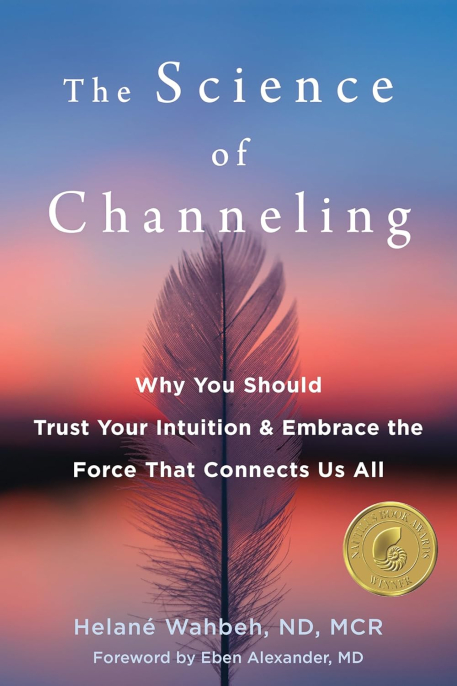
The Science of Channeling is Wahbeh’s first solo book, published by Reveal Press, which appears to focus on New Age books. Wahbeh’s book could be regarded as popular science and she includes an extensive reference list and a glossary (but no index). However, her subtitle, Why You Should Trust Your Intuition and Embrace the Force That Connects Us All, serves as a warning. Wahbeh herself writes: “The goal of this book is to give an overview for the layperson and so may gloss over nuances for the science-minded reader” (p. 201).
Parapsychologists may be hesitant to touch channelling (but see Cunningham, 2019), preferring to leave the subject to historians of religion and other scholars less concerned about the veracity of what is being delivered (e.g., Riordan, 1992). Channelling has been defined as “the communication of information to or through a physically embodied human being from a source that is said to exist on some other level or dimension of reality than the physical as we know it, and that is not from the normal mind (or self) of the channel” (Klimo, 1998, p. 2). However, Wahbeh shares her personal definition:
Channeling is the process of revealing information and energy not limited by our conventional notions of space and time that can appear receptive or expressive (p. 21).
Wahbeh is aware of previous debates concerning terminology in parapsychology, but allows channelling to cover more than it traditionally does. She also allows clairvoyance to include more phenomena than usual. Wahbeh writes about channelling experiences when others would have written psychic experiences. (This takes some time to get used to.) Usually channelling refers to mediums conveying a philosophy, a world view, a belief system, and a history of the world (sometimes involving Atlantis and Lemuria) from entities, sometimes dead people, sometimes angels, and sometimes aliens. Famous trance channellers include Jane Roberts, who channelled Seth, and J. Z. Knight, who channels Ramtha. Wahbeh gives two examples: “Carla Rueckert, who channeled the Law of One material, and Eva Pierrakos, who channeled the Pathwork series” (p. 35), and mentions others just in passing.
Wahbeh points out that there is a taboo against channelling (cf. Radin, 2008) and relates how two papers she was involved in got rejected, one without ever having been sent out for peer review. Everyone who has been involved in parapsychology for some time is likely to agree with Wahbeh – there is a bias against this kind of research. However, at the same time Ramtha’s School of Enlightenment and Edgar Cayce’s Association for Research and Enlightenment in the USA appear to be tolerated. In addition, Marianne Williamson, known for her interest in the channelled material A Course in Miracles, ran for president in the USA in 2020. Nevertheless, Wahbeh keeps being contacted by people eager to relate anomalous experiences that they have never related before. She provides examples throughout the book.
Given her expansive definition of channelling, Wahbeh naturally provides limited coverage of what is generally considered parapsychological research, but she does not delve into debates about the research. Wahbeh also briefly covers surveys of psychic experiences. She has been involved in a large survey (i.e., Wahbeh et al. 2018) and writes:
We asked three groups of people in the United States: average Americans, scientists and engineers, and channeling enthusiasts. Everyone was asked via email to complete a survey about unique human experiences. They checked whether they had had any of twenty-five different channeling experiences and, if so, how often they experienced it. Nearly nine hundred people finished the study. Including everyone, 96 percent reported having at least one of the twenty-five channeling experiences! (p. 45).
Wahbeh omits something important here. That survey was sent to 254,102 email addresses, was opened by 41,605 individuals, and started by 1,193 participants. Only 899 people completed the entire survey. In addition, her three-sentence description of Rocha et al. (2014) strikes me as being too vague, especially since the reader may not know anything about Chico Xavier.
However, Wahbeh can be an engaging writer and make the reader interested in getting the cited publications. She has an informal style, asks the reader to consider questions, and proposes exercises. In addition, Wahbeh generously shares information about her own background. She is familiar with the science, acknowledges earlier work (e.g., Hastings, 1991), and writes from personal experience.
Wahbeh notes that some entities appear to argue that “… channelers’ education, vocabulary, languages spoken, and so forth ... influences how the communicator can communicate” (p. 86). That seems rather unfortunate since parapsychologists are unlikely to pay much attention unless the channelled material seems to go beyond what one expects from someone with a particular background (e.g., Pearl Curran and Patience Worth). However, Wahbeh points out that to many researchers, such as anthropologists, the actual source is not important in their studies – the channelled material is of interest regardless of whether it derives from the unconsciousness or from aliens.
Allow me to share a personal anecdote. A friend of mine was into A Course in Miracles and to humour her I agreed to read Renard (2004). We ended up having an argument before I had finished reading the book. I took a sceptical stance and was bluntly told that it does not matter if the story is true. At the time I was taken aback, but what I think she meant was that it does not matter as long as the teachings are useful.
Wahbeh notes channelled material tends to overlap: “Channeled transcripts are full of content on ageless wisdom present at the core of many of our world religions” (p. 147) and brings up other examples, such as everything being interconnected. William James allegedly once “said that 50 percent of the channeled spirit teachings seemed to be written by the same person. This percentage holds true in our time also” (Hastings, 1997, p. 203).
Wahbeh recognises that the Western materialistic paradigm regards channelled material as being due to imagination and other normal factors. However, she argues: “Despite this dismissal, channeled content matches many ancient stories of visitations, guidance, and other connections with multidimensional nonphysical beings throughout time” (p. 149). Personally, I would have welcomed more scepticism, but what Wahbeh does rather well is encouraging the reader to learn more.
She also acknowledges that:
I and others have found that some channeled material is nonsensical, redundant, or irrelevant. Some communicators can seem to have their own agendas and desires not related to the channeler or audience. Some even appear to be deceptive. Some provide unreliable information and do not take responsibility for the implications of the material (p. 141).
Wahbeh cites Hastings (1991) here, but does not dwell on the possibility that some of the entities are not who or perhaps what they purport to be (cf. Fisher, 2001).
Wahbeh is familiar with the scientific literature and has herself been involved in research on trance channelling and shares findings throughout her book. However, she also writes things that bring New Age literature to mind. For example:
Awakening humanity one person at a time seems like a tall order. Balancing your masculine and feminine aspects is one specific guidance for how to do this (p. 146).
Channeling can act as a detoxifier. If you experience this, you can support your detoxification pathways. Rest. Drink lots of water. Take an Epsom salt bath. Take more minerals and eat nutrient-rich foods. Gentle movement, stretching, or yoga can support your body. Ask your body what it needs (p. 159).
Dr Helané Wahbeh writes for laypeople and readers interested in learning how to channel. I am not the intended reader. Nevertheless, Wahbeh is a researcher with an unusual background that allows her to write from personal experience. This strikes me as valuable, and she will make readers interested in learning more about channelling.
References
Cunningham, P. F. (2019). A contribution to the study of the possession trance mediumship of Jane Roberts. Journal of Parapsychology, 83(2). 248-267. http://doi.org/10.30891/jopar.2019.02.09
Fisher, J. (2001). The siren call of hungry ghosts: A riveting investigation into channeling and spirit guides. Paraview.
Hastings, A. (1991). With the tongues of men and angels: A study of channeling. Holt, Rinehart and Winston.
Hastings, A. C. (1997). Channeling and spiritual teachings. In C. T. Tart (Ed.), Body mind spirit: Exploring the parapsychology of spirituality (pp. 198-213). Hampton Roads Publishing.
Klimo, J. (1998). Channeling: Investigations on receiving information from paranormal sources (2nd Ed.). North Atlantic Books.
Radin, D. (2008, 15 January). Science and the taboo of psi. Google Tech Talks. https://www.youtube.com/watch?v=qw_O9Qiwqew
Renard, G. R. (2004). The disappearance of the universe: Straight talk about illusions, past lives, religion, sex, politics, and the miracles of forgiveness. Hay House.
Riordan, R. (1992). Channeling: A new revelation? In J. R. Lewis & J. G. Melton (Eds.), Perspectives on the New Age (pp. 105-126). State University of New York Press.
Rocha, A. C., Paraná, D., Freire, E. S., Neto, F. L., & Moreira-Almeida, A. (2014). Investigating the fit and accuracy of alleged mediumistic writing: a case study of Chico Xavier’s letters. Explore, 10(5), 300-308. https://doi.org/10.1016/j.explore.2014.06.002
Wahbeh, H., Radin, D., Mossbridge, J., Vieten, C., & Delorme, A. (2018). Exceptional experiences reported by scientists and engineers. Explore, 14(5), 329-341. https://doi.org/10.1016/j.explore.2018.05.002