



Reviewed by Nemo C. Mörck
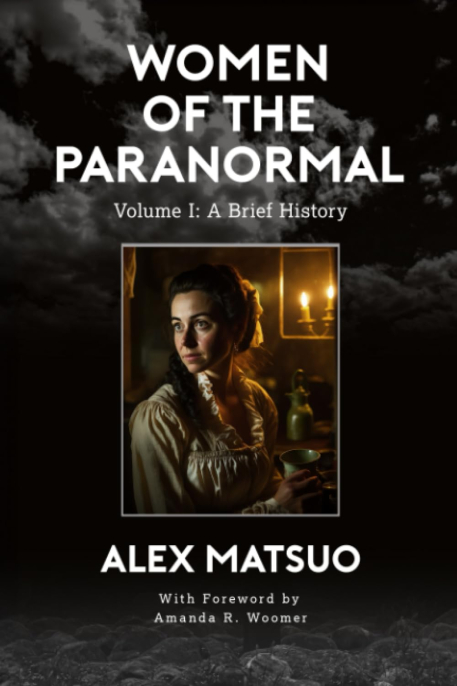
Alex Matsuo is a paranormal researcher, a content creator, and an author. She has written several books. Women of the Paranormal is among the most recent. It is an ambitious work of thirty-three chapters spanning 271 pages that covers writers such as Catherine Crowe, Jane Barlow, and Violet Tweedale, mediums like Eileen Garrett and Leonora Piper, researchers like Louisa Rhine, and theosophists like Annie Besant. Many are famous, but some are less well-known.
Amanda Woomer, the creator of a journal, The Feminine Macabre, has provided a Foreword. Woomer complains that many women in the field have been forgotten and regards Crowe as having been the first “ghost hunter” in 1852 (her quotation marks). Matsuo was at ConCarolinas in 2022, and also found that the audience didn’t know who Crowe was.
The first chapter is devoted to Crowe. Unfortunately, the heading says that she lived 1790-1876 rather than 1790-1872. Some readers may know about Crowe due to a scandal in 1854, which Matsuo claims “may have been more fictional than fact” or thanks to her work, The Night Side of Nature; or, Ghosts and Ghost Seers, published in 1848. It was famous at the time, and favourably reviewed by Charles Dickens. With that work Crowe popularised the words doppelgänger and poltergeist. The claim about her being the first ghost hunter came about due to a story Crowe (1859, pp. 135-147) related.
Crowe was allegedly seen walking naked in Edinburgh in 1854, and Dickens passed the story on. Matsuo’s attempt to refute this story seems rather hopeless. Robert Chambers, a neighbour of Crowe, wrote about the event before Dickens (hence he didn’t just parrot Dickens). When Crowe learned about the rumours she wrote a letter to the Daily News. Crowe wrote that she had been seriously ill and had been unconscious for five or six days (see Dash, 2010). Matsuo also notes that Crowe’s diary says that she had no memories of a few days. However, Matsuo writes that no record of Crowe has been found in the Lunacy Registers and Warrants.
Matsuo also covers Achsa W. Sprague and the more famous Helena Blavatsky, one of the founders of Theosophy. The literature about the latter is extensive. SPR members are likely to be aware of “The Hodgson report on Theosophy” which Matsuo appears to believe was retracted and unpublished in the wake of Harrison (1986), but this is incorrect.
The literature about the Fox sisters is also overwhelming and Matsuo devotes one chapter to them. Other mediums such as Cora L.V. Scott and Leonora Piper also get chapters. Each chapter usually ends with a list of references, but it is not always easy to tell where Matsuo has relied on a specific source. This is a popular rather than a scholarly work. There is no heavy academic prose or pages full of endnotes.
Some psychical researchers like Eleanor Sidgwick and Ada Goodrich-Freer also receive attention: “While brilliant, Eleanor was described as quiet, shy, and unassertive” yet she was not so shy in writing. Modern authors like Vernon (2025) admire her.
Helen Peters Nosworthy (part of the Ouija board’s origin story) is one of the less well-known women covered by Matsuo. Rosina Despard, who is intimately connected to the Cheltenham Ghost, is probably also not too well-known. Jessie Adelaide Middleton, who published popular books with true ghost stories, was a new name to me. Alas, Matsuo notes that we don’t know much about her. Pamela Colman Smith, who made the design for the Rider-Waite-Smith Tarot deck, also appears.
Matsuo also writes about Florence Barrett, who, after her husband’s passing, sat with Gladys Osborne Leonard (who has her own chapter), and included the results of the séances in her book, Personality Survives Death: After-Death Communication from Sir William Barrett.
Alexandra David-Néel, perhaps best known to SPR members for her account about creating a tulpa, has also earned a chapter. Parenthetically, her husband, Philippe Néel de Saint-Sauveur, is first said to have died in 1930 and later in 1941. There are a variety of minor mistakes in the book, typical of independently published books, but I didn’t find it distracting. Matsuo has set out to introduce the reader to a number of women and she does that well.
Frances Payne Bolton and Eileen Garrett share a chapter thanks to their association. (Radclyffe Hall and Una Troubridge also share a chapter.) Bolton is best remembered for her financial contributions to parapsychology. Garrett was a famous medium and founded the Parapsychology Foundation, which has also contributed to parapsychology. However, the story about Garrett needs to be updated in light of Coyle (2024) and Warwood (2025).
As should be clear by now, Matsuo has cast a wide net and captured a variety of women. Dion Fortune, Zora Neale Hurston, Rose Mackenberg, Mary Hyre, Sarah Wilson Estep, Lorraine Warren, and Aiko Gibo appear. As do parapsychologists like Louisa Rhine, Gertrude Schmeidler, Shafica Karagulla, and Thelma Moss. The penultimate chapter is devoted to Rosemary Ellen Guiley, and the final chapter to Linda Godfrey, a cryptozoologist. This is followed by an honourable mention, Antoinette du Ligier de la Garde Deshoulières, who came to appear in a ghost story long after her death. Few if any readers are going to be familiar with all women in this book. I am sure that Matsuo struggled to do them all justice. She concludes:
It is my hope with this book that it brings all of these women together into a centralized place that can be used as a source and guide. I also hope that this book can be a valuable resource for people…
Some chapters must have been easier to write than others, but it is clear that Matsuo have devoted an enormous amount of time to this. However, the book could have benefited from some editing, and the Kindle version I read did not even list the women in the table of contents. I can think of other women that were not included, such as Felicia Parise, Pearl Curran, and Mary Rose Barrington, so perhaps Matsuo will produce a second volume.
References
Coyle, J. (2024). The early life of Irish psychic and trance medium Eileen J. Garrett: Fact or fabrication? Independently published.
Crowe, C. (1859). Ghosts and family legends: A volume for Christmas. Thomas Cautley Newby.
Dash, M. (2010, October 5). Naked as nature intended? Catherine Crowe in Edinburgh, February 1854. Charles Fort Institute. https://web.archive.org/web/20111225221342/https://blogs.forteana.org/node/143
Harrison, V. (1986). J’Accuse: An examination of the Hodgson Report of 1885. Journal of the Society for Psychical Research, 53, 286-310.
Vernon, A. (2025). Ghosted: A history of ghost hunting, and why we keep looking. Bloomsbury Sigma.
Warwood, E. J. C. (2025). Behind the medium's mask: Eileen Garrett’s shadow self. New Directions Network.