




Reviewed by Kate Cherrell
Spiritualism, as both a new religion and historical movement, is often a tough nut to crack for would-be readers. Rather fittingly, the subject of Spiritualism seems to exist in multiple worlds, separate from its contemporary practitioners. Firstly, the term ‘spiritualism’ is used as shorthand for nebulous new age beliefs, or is roughly wedged into Victorian-themed ghost hunting evenings, where the phrase ‘Victorian Spiritualism’ is used as a means to legitimise the evening’s activities. Conversely, attempts to learn from historic accounts and contemporary biographies can so often seem overwhelming, prohibitively academic in nature and almost deliberately inaccessible to the common man. While there remains a great need for and appreciation of in-depth spiritualist histories, there remains a noticeable paucity in the field of accessible social and cultural histories.
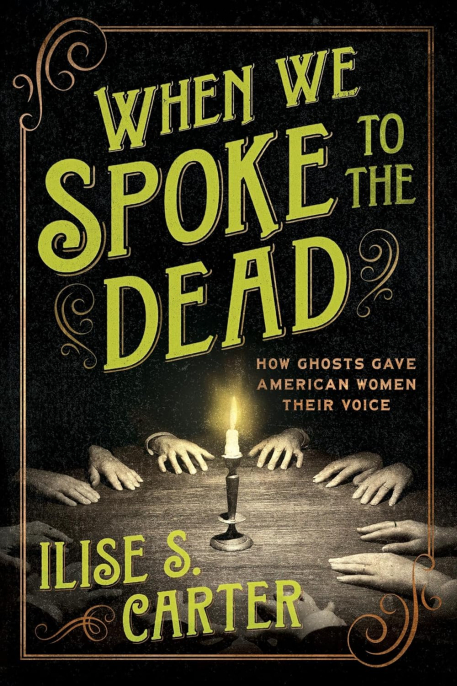
Ilise S. Carter’s When We Spoke to the Dead isn’t a book for those wishing to sift through the precise movements of specific mediums and psychic theories, but it certainly is a book for those wanting to know the big questions of Spiritualism’s foundations: where, how and why? Taking her own grief and mourning processes as a launchpad, Carter steers through a potted history of early American Spiritualism, tracing the movement from its official birth in 1848 through to modern wellness influencers and its prevalence in female spaces, uplifting female voices and experiences. Subtitled with ‘How ghosts gave American women their voice’, Carter’s angle is certainly more female-centric but does not limit itself to the confines of Spiritualism as a religion. Rather, she addresses a broader field of American spirituality and wellness cultures which appear to be enjoying a contemporary revival.
A self-proclaimed ‘nosy journalist’ by trade, Carter is well positioned to navigate the murky waters of Spiritualist past and present as she consistently pierces the vein of deeply human experiences that run throughout the movement and its modern incarnations. She frames her approach as ‘going into hidden rooms’, asking ‘why?’ and ‘really listening to the answers’, and the results make compelling reading. Carter writes with a tangible and immersive warmth throughout, offering a guiding hand through convoluted histories and across state lines, always stopping to listen to experiences, voices and personal accounts. Carter doesn’t address Spiritualism and spiritualist beliefs through the safety of her computer screen, but takes a welcome journalistic and immersive approach, spending time in Lily Dale Spiritualist camp, visiting purportedly haunted spaces and speaking to practitioners of historical and modern arts.
While the overall work is more of an overview rather than a strictly feminist cultural history, the journey is paced well, with substantial space dedicated to prominent female figures and the reality of their lived experiences. Within these profiles, Carter blends cultural history with contemporary reflection, contextualising their experiences while discussing them within accessible, contemporary language. The Fox Sisters are not painted as two-dimensional women, defined by their work in the séance room, but as troubled young women whose claims emerged into a tumultuous political and religious new country. Similarly, the lives of mediums such as Cora L. V. Scott are reappraised sensitively, and humorously, in a welcome alternative to the oft-repeated biographies that define her by her multiple marriages. Instead, Cora is presented alongside contemporary references, such as Taylor Swift and Britney Spears, while her very public and scandalous divorce proceedings are treated with contemporary sensitivity and reflection.
The duality of frippery and sensitivity is a fine line to tread, especially as the work addresses the unsteady positions of women experiencing financial and public successes in a society set upon preserving traditional gender norms. Despite the discomfort of two such seemingly opposing narrative styles, Carter deftly weaves the two together, framed against her own personal journey across America’s haunted landscape.
Some of Carter’s greatest moments come at the intersection of her personal interests and those of supernatural American histories. A sideshow performer herself, Carter’s passion for performance and spectacle comes to the fore during an excursion to Edgar Allan Poe’s Baltimore stamping grounds. Here, the worlds of paranormal tourism, proto-parapsychology and the physical mediumship of Leonora Piper are deftly interlinked by her journey throughout Poe’s haunted house and its reported ghostly residents.
Carter does not shy away from America’s uncomfortable relationships with religion, gender and race, exploring how cities such as New Orleans blended Spiritualism’s spectacular claims with pre-existing creole traditions and mythology. The real and diverse America presented by Carter isn’t a polished or faultless one, but a country that presented the ‘American dream’ to men, and expected women to do little other than decorate it.
With a background in cosmetics journalism (Carter has previously written a celebrated history of lipstick in America), her journeys into contemporary wellness cultures are made with confidence and expertise, offering a fresh insight into another female-focused field so often dismissed and overlooked by contemporary historians and cultural commentators. Linking magnetic healers with the promises of modern aesthetic practitioners facilitates further opportunities for contemporary gender reflection. She presents a contemporary obsession with surgically-gained youth and beauty alongside our repugnance towards accepting death. In more cutting reflections, her commentary on the precarities of the American healthcare system, and her use thereof, offer an explanation as to how alternative remedies have returned to popularity once more.
When We Spoke to the Dead doesn’t follow a true chronological timeline, but jumps between mediums and healers, ghost hunters and debunkers, offering concise, accessible and genuinely enjoyable reflections throughout. Carter does not push a judgemental or especially sceptical viewpoint throughout, save for comments confined to her own personal experiences. Carter presents herself with a seemingly impossible task, tackling all facets of an enormous movement that has spanned – in many incarnations – nearly two centuries. As such, she has not covered all facets of mediumship and parapsychology. While these gaps may irk some, the narrative is no weaker for it. Indeed, some of her choices, such as including a substantial reflection on the place of sentimental hair work in 19th-century mourning cultures, were unexpected, but not unwelcome.
Carter writes for a modern, internet-savvy reader, using a lexicon that may sit uneasily with some potential audiences. Terms such as ‘boss babe’, ‘totally legit’ and ‘powerful divas’ decorate the text, which came as a surprise at first, but were soon enjoyable features of Carter’s distinctive voice. While modern colloquialisms may not be traditionally happy bedfellows with Spiritualism, I found When We Spoke to the Dead to be a welcome update of well-trodden arguments, pulling countless biographical elements into the 2020s. Ultimately, the work is as much about Spiritualism as it is Carter, who offers herself as an honest and open sacrifice, onto which we can project our own understandings of grief and the afterlife, or lack thereof. Carter writes with both a warmth and vulnerability that is testament to her immersion in the subject and respect for its believers, past and present. In allowing the reader into her own mourning process, she places herself in the unenviable position of addressing a history of American Spiritualism and womanhood with fresh and considered grief, pacing between parallel histories as she too understands her ‘new normal’.
I found When We Spoke to the Dead to be accessible, fun and profound in equal measure. I devoured the book in a weekend and was left feeling as though I’d gained a new friend and a renewed appreciation for the movement so often dismissed as a revenant of a less enlightened time.