




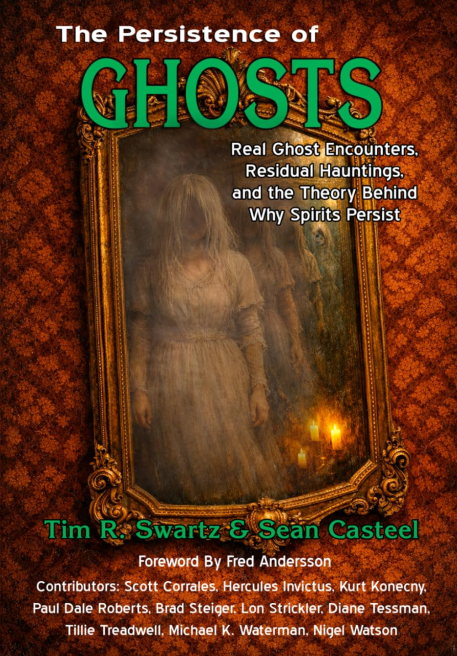
Reviewed by Melvyn Willin
This large-sized text paperback book, dedicated to Timothy Green Beckley (“Mr UFO”), has been edited by Tim R. Swartz and Sean Casteel. The anthology contains numerous black and white, somewhat ‘grainy’ illustrations, sporadic, brief bibliographies, a useful index, and biographical information (all paraphrased below).
- Fred Andersson undertakes work for Swedish television which includes notable work on UFO mysteries.
- Sean Casteel is a freelance journalist who writes about UFOs, alien abductions and other paranormal subjects.
- Scott Corrales writes prolifically about UFOs and paranormality in the Hispanic community.
- Hercules Invictus “is a Lemnian Greek, a proud descendant of Argonauts and Amazons” (p. 353).
- Kurt Konecny co-hosts a podcast “The Strange Sessions” with a fellow “ghosthunter”.
- Paul Dale Roberts is a “Fortean Investigator who investigates all things paranormal…” (p. 354).
- Lon Strickler is a Fortean researcher, author and publisher of the syndicated Phantoms & Monsters blog.
- Tim R. Swartz is an Emmy-Award winning television producer and videographer, and author of several books.
- Diane Tessman has investigated UFOs since the late 1970s and was “abducted twice by UFO beings in 1952/53” (p. 356).
- Tillie Treadwell has authored books such as The Cat Knew Tarot and previously co-headed a paranormal investigation and exorcism team.
- Michael K. Waterman has studied Egyptology for many years and is “The High Priest and founder of the Per-Ntjeru Temples” (p. 358).
- Nigel Watson has investigated reports of UFO sightings since the 1970s and has written numerous books.
After a foreword, by Fred Andersson, and an introduction, the book is divided up into five main sections altogether containing twenty-six chapters, by the various contributors and the editors themselves. It is not possible to outline a detailed content of each chapter. They vary in length and emphasis, however, a flavour of the subject matter and its presentation can be suggested by their titles which include ‘Ghosts of Ancient Egypt’, ‘Ghosts: I’ll be seeing you’, ‘Did Spring Heeled Jack Ride a Saucer?’, ‘Hydrological Haints’ etc.
The largely autobiographical foreword stresses the need for “the freedom to believe or disbelieve, to take it all too seriously, or just have a laugh at the madness of it all” (p. 11). The following introduction, by Tim R. Swartz, suggests that the life-after-death concept encompasses ghosts, poltergeists, and other paranormalities, including UFOs and alien phenomena, hence the “stellar group of writers and investigators, each with their own ideas about the mysteries of ghosts and hauntings” (p. 17).
Swartz has also written the first chapter which contains a mini-history of ancient hauntings up to modern times with input from African stories. This heralds chapters on the “ghost friendly” ancient Egyptians from the author who “knew I’d lived at that time” (p. 34) and about the exploits of the ancient Greeks from the author who provides a “brief overview of his life-death-rebirth process” (p. 38).
Moving on from what some readers might view as mythology the second editor, Sean Casteel, introduces the Church’s attitude towards ghosts. A number of quotes are provided, but (alas) no references are provided leaving the reader no knowledge as to where to pursue the actual statements made. The following chapter ‘Di-er Circumstances’ starts very autobiographically before touching on the Tibetan Book of the Dead and then returning to personal assertions.
The ‘Latin American Phantasmagoria’ recounts some interesting stories from newspapers with sources provided, whereas the next chapter (‘Ghosts I’ll be seeing you’) suggests different interpretations including “ghostly molecules” (p. 81), “holograms and time warps” (p. 85), “ghosts are thought forms” (p. 88) and the account of “an alien came out of the closet” (p. 93). In some ways this philosophical approach is continued with Swartz’s following chapter, where he intriguingly compares David Attenborough’s investigation of nature with his own investigation of the “unnatural”! Spirits of the dead appearing from limited spaces are outlined, with suitable psychology-based comments plus some useful references as to sources.
More autobiographical accounts follow plus information on how to investigate the phenomena with specific examples which readers should (as always) make their own minds up about – the techniques including exorcism, “full submersion baptism” (p. 123), and use of Electronic Voice Phenomenon (EVP) methods.
A chapter with a brief bibliography is devoted to ghost hunting (pp. 125-33) and the Society for Psychical Research (SPR) is mentioned. However, surprisingly, the next chapter introduces “nonhuman people” (p. 138) and “fairy godparents” (p. 142) which are concepts that the SPR and other scientifically-based societies might have problems with accepting as being within their remit.
One is then brought back into the better-researched world with a chapter on lithobolia (anomalous stone-throwing) with some good examples described which even mention a source possibly being the Djinn of Muslim origin and again a useful bibliography. More Hispanic examples of hauntings follow and then self-explanatory haunted Hollywood, Spring-Heeled Jack stories, UFO connections with cryptids and ghosts, and ghostly spacemen.
Examples of alleged apparitions from the past and, more strangely, from the future fill the next chapter. Arguably from the world of folklore or fiction, Sean Casteel then introduces ‘Vengeful ghosts and spiteful demons’ (pp. 229-43) which include serial killers, witchcraft themes, and the demonic. It’s almost with a sense of relief that the following ‘Phantasm Fire Starters’ contains more verifiable accounts of spontaneous fire phenomena.
Tillie Treadwell starts with autobiographical material, before moving on to some information from the book Phone Calls from the Dead (Rogo & Bayless, 1979/2025), and Dean Koontz’s experience of a phoned warning that may have saved his life. I must admit that when I first read ‘Hydrological Haints’ I thought it was a typo for ‘Haunts’, but on further scrutiny I discovered that a ‘haint’ is a South Carolina, USA word indicating a malicious ghost. The ‘hydrological’ obviously refers to the presence of water in the incidents concerned.
The final chapters in the book concern ultraterrestrial entities; poltergeists, including the views of Paul Eno; and a philosophical chapter (‘The Fragmented Ghost’) on trying to understand the nature of “crisis apparitions”, “the conscious spirit”, “the polyfurcated mind”, and “the many alters of Doris Fischer”.
The book is an easy read, perhaps a little too easy, since the language used by some of the contributors is somewhat too ‘chatty’ and there is a general lack of academic scrutiny amplified by a frequent lack of references. There are also a few typos. As has been made clear, the anthology encompasses far more than just ghosts which may be favourable for a general reader interested in the paranormal, and disappointing for someone wanting more detailed and focused study. Many of the examples derive from the USA, which again might be disappointing for a non-USA reader.
Although they are mentioned in passing, the leading ghosthunters Peter Underwood, Harry Price, and Andrew Green are all omitted from the index as are the equally famous cases of Borley Rectory, the Brown Lady (Raynham Hall, Norfolk), the Tower of London, the Treasurer’s House, York etc. As far as poltergeists are concerned nothing is written about the most famous case of all, namely the Enfield Poltergeist.
To conclude, I can only recommend this book to a general reader interested in the paranormal who is not concerned about the frequent lack of references from many of the contributors; who does not require specific information about well-known and well-investigated cases outside of the USA; and is happy with the emphasis on autobiographical material from some of the contributors.
Reference
Rogo, D. S., & Bayless, R. (2025). Phone calls from the dead: The results of a two-year investigation into an incredible phenomenon. White Crow Books. (Original work published 1979).