




Reviewed by Nemo C. Mörck
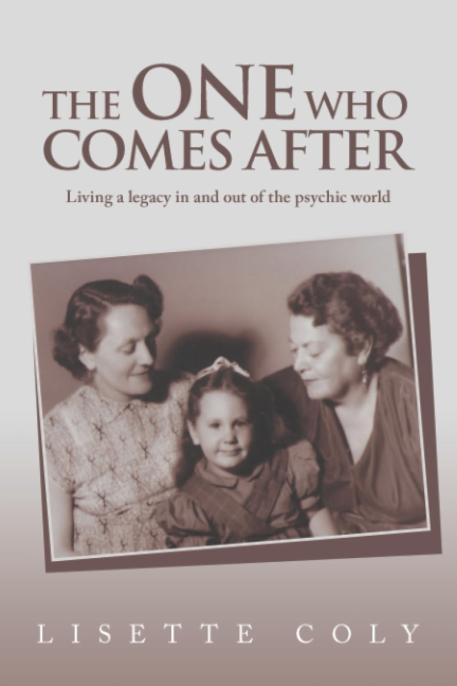
The author, Lisette Coly (b. 1950), is the daughter of Eileen Coly (1916-2013) and the granddaughter of Eileen Garrett, the medium and founder of the Parapsychology Foundation (PF). Garrett cast a big shadow and left big red boots to fill. After her death in 1970, Eileen Coly took over the PF and kept it running. According to Prof. Stanley Krippner, who has provided a foreword, she was an excellent administrator. Nevertheless, the PF originally came about in 1951 thanks to the generosity of Frances Bolton. Without significant income, changes were eventually necessary.
When Lisette Coly begins her story in May 2004, things have changed. PF conferences had not been arranged since the 1990s and the International Journal of Parapsychology had been discontinued. Coly and the others involved in the PF were preparing to move the offices and the research library. By now she was the President of the PF and had to oversee it all. However, the book is not about the PF. This is Lisette’s story. It is a personal account, and the reader gets to follow her closely.
In 2004, she discovered a transcribed conversation between Nandor Fodor and Abdul Latif, one of Garrett’s so-called spirit controls. The conversation from the 1940s suggested that Latif had once interfered when Garrett called for help to save her sick daughter Eileen – to save the one who comes after, a soul that the spirit controls were interested in. Coly first thought that this meant her, but her husband pointed out that it could refer to someone else. However, years later she came across another conversation, from the 1950s, between Fodor and Latif, in which it was made clear that “the one who comes after” (p. 10) was indeed Lisette Coly.
The spirit controls seemed to know that Eileen Coly would have a daughter. Latif once said that Eileen would have lived through 32 or 33 summers by the time she had her daughter (p. 14). Eileen had just turned 34 when Lisette Coly was born on 6 April 1950. Understandably, Lisette wondered what this meant and tried to find out as much as she could about Abdul Latif, allegedly a physician in the court of Saladin.
Garrett herself famously was unsure about what her spirit controls actually were and sometimes said that it varied from day to day. She also argued that “… everyone should listen to their own internal voices for personal direction rather than ceding control for life decisions to someone who might solely be desirous of parting us from our money” (p. 43).
Garrett is present in the background in Lisette’s story, but the focus is on the latter. We learn about her upbringing, education, and how she got more involved in the family business, the PF. It is not so easy to tell exactly when things happened. However, much of the story appears to take place after the death of William G. Roll in 2012 and before the death of Robert Van de Castle in 2014. The reader gets to follow Lisette as she participates in Robert Narholz’s documentary, appropriately titled The One Who Comes After, which was meant to air in 2021.
The book is written like a personal blog with long paragraphs. Admittedly, I found it overly wordy. Coly has adopted a rather informal style. She describes both everyday life and curious coincidences that are perhaps something more. The colours blue and red attain significance.
However, she keeps both feet on the ground. In fact, she comes across as being far more grounded than one might expect given that she is the granddaughter of Garrett. Lisette writes: “It is always helpful to keep an open mind and a skeptical mindset in dealing with the paranormal” (p. 248).
Nevertheless, as coincidences start to pile up, Lisette cannot help but feel somewhat like Alice in Wonderland (p. 85). The reader gets to follow her and Robert as they go to Hawaii and meet kahunas, who advise Coly to stop looking for proof and just accept what happens.
Eventually, Abdul Latif reappears in the story. He appears in Lisette’s dreams, and this provokes her to read The Image of an Oracle (Progoff, 1964), about Garrett’s mediumship and spirit controls. However, it is not easy to say what Latif really is and, like Garrett herself, Lisette also wonders yet resonates with some of his reproduced commentary. Throughout the book she also shares sections from books that she senses are significant.
Understandably, Coly wants to know what it means to be the one who comes after. Mediums tell her that she is psychic, a healer, and a leader of a movement. Apparently, Robert is also an important person, but we learn less about what exactly the mediums say about him. I was reminded of the cross-correspondences, an aspect of which concerns Henry Coombe-Tennant, from which the spirits expected great things. However, Lisette remains grounded throughout the book and the reader gets to participate in her sittings with mediums and in one of Kai Mügge’s physical séances.
This is a book that is very much about the journey rather than the destination. It is a personal, intimate story about Lisette Coly’s search for meaning and purpose.
Reference
Progoff, I. (1964). The image of an oracle. Garrett Publications.