




Reviewed by Peter A. McCue
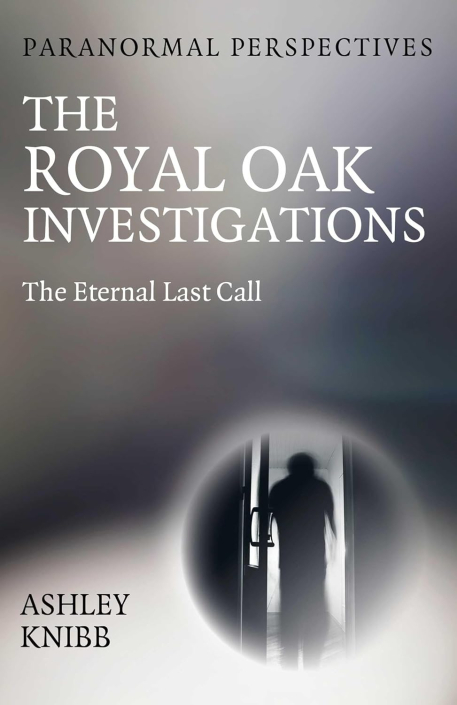
Ashley Knibb’s latest book, The Royal Oak Investigations: The Eternal Last Call, is part of a series called ‘Paranormal Perspectives’. It includes eight other books, by different authors, and there may be more to come. The supposedly haunted Royal Oak in question is an old, stone-built pub on the High Street of the seaside town of Swanage in Dorset. However, I find the subtitle, ‘The Eternal Last Call’, rather enigmatic.
Like too many books on the paranormal, Knibb’s book lacks an index, which it badly needs. Disappointingly, it also lacks photographs. However, photos of the Royal Oak can be found on the internet.
The ‘about’ section of Knibb’s blogsite describes him as a paranormal explorer, investigator and researcher, but it doesn’t give personal information about him, such as what his ‘day job’ is. However, it’s evident that paranormal investigation is a great passion for Knibb, who is a council member of the SPR and an active member of its Spontaneous Cases Committee.
Unfortunately, I don’t find the book very lucid, and if I hadn’t undertaken to review it, I would probably have given up partway through. Even trying to work out when Knibb first visited the Royal Oak is problematic. According to a timeline of his visits (pp. 209-210), they began on 15 March 2010 and continued, at intervals, until 2024; and in the first chapter (pp. 1-11), he describes an investigation at the pub that he and others supposedly conducted in “March, 2010”. However, a few pages later, he contradicts himself, by stating that as far as he can remember, he first visited the Royal Oak in early April 2010 (p. 14). To add to the confusion, elsewhere in the book, he states that “even before our first investigation in March, 2010, we managed to spend some time interviewing a few of the locals in what was the Pool Room; now it is probably called the back bar area or even just the back room” (p. 10).
The manifestations at the pub have reportedly been many and varied, such as pictures being thrown from walls; footsteps being heard coming from above the bar area when no one was up there; objects temporarily or permanently disappearing; and apparitions. Regarding the latter, after a human vertebra was found in the garden, “Sharan [a former landlady] saw an apparition of a man. The bone was said to be dated over three hundred years old and as such too old to investigate by local police. Following this discovery, tapping on people’s necks became a regular occurrence” (pp. 27-28).
‘Time slips’ have reportedly occurred at the Royal Oak, although it’s unclear how many people have actually experienced them. Knibb explains that when looking out of a window in a top-floor bedroom, Sharan “would sometimes see orchards rather than the houses that should be seen” (p. 92). Later in the book, he also refers to a female visitor to the pub who looked out of the window of her room and saw an orchard rather than the present-day housing estate (p. 188). The expression ‘time slip’ implies involuntary time travel, but a more plausible explanation, in my view, might be hallucinations or tampered memories (McCue, 2020).
During the investigation described in Knibb’s first chapter, he and a man called Pete (a cousin of Rachael, the current landlady) spent some time in a loft space in the pub. During that time, a pocket watch owned by Knibb, which had formerly belonged to his late grandfather, ran for about 20 minutes, although normally it didn’t work. Was this brought about by the ‘spirits’ that Knibb and Pete were calling out to, or could it have been due to psychokinesis, unconsciously manifested by Knibb or Pete? Or was the cause entirely prosaic?
Knibb states that “Rachael’s encounters with paranormal activity started not long after she [became] its new landlady” (p. 88), which Knibb believes was in May 2006 (p. 28, 30). However, Rachael also shared a recollection from when she’d worked at the pub some years prior to that. Knibb writes:
[At] one point she was sent upstairs for something and finding herself alone on the first floor, she realised she did not like it. When I asked [her] about this experience, she could not provide any real additional information other than that the younger version of herself just did not like the feeling she had upstairs at the Royal Oak (pp. 28-29).
Knibb explains that Rachael’s aversion to going upstairs in the building persisted “until she became the pub’s landlady and would have to overcome this fear” (p. 88). Rachael, who is still the owner and landlady of the Royal Oak, recently co-authored a short and inexpensive book about the pub and its phenomena (Aplin & Hancock, 2026). It mentions the above incident but depicts it differently (pp. 9-11). Rachael remembers being thrown down the stairs and into the glass front door of her home when she was ten years old. She doesn’t say whether she was physically injured, but the event left her with some aversion to using stairs. Mostly, though, she copes satisfactorily with them. As for the incident at the pub itself, it seems that Rachael didn’t get as far as the first floor, as Knibb states, but froze halfway up the stairs. Of course, it’s impossible to know whether there was anything paranormal about that. It may have been wholly attributable to Rachael’s bad experience when she was ten.
In the course of his ‘ghost hunting’ activities, Knibb didn’t normally develop such long-running attachments to places as he did with the Royal Oak. He writes:
[There] was certainly an undeniable feel to the place, which remained just out of reach, hidden from view, that would connect with certain people and draw them in, making them a part of the story. Initially, I did not believe that would happen to me too, but as I look back over the years, it is completely obvious that I was connected and fascinated with the place from early on in my relationship with the pub (pp. 15-16).
Of course, to the extent that Knibb found Rachael and other people at the Royal Oak friendly and welcoming, it’s understandable that he would feel some attachment to them and the pub. But he seems to be alluding to something more than that. Indeed, later in the book, he writes: “In places, I thought the Royal Oak was a little like a church or a school. A place of belief, faith and learning” (p. 116).
It appears that during his involvement with the Royal Oak case, Knibb leaned more towards spiritualism and its practices than he had before. As well as considering straightforward spirit communication and intervention, he alludes to other possibilities. For example, he writes about “the possibility that the consciousness of the pub’s past residents could actually be seeping into the present through its current residents. Is this to be considered just a weird phenomenon that occurs at the Royal Oak or is there an underlying reason behind this communication and this crossing of two times?” (p. 200). However, because I don’t find these speculations very clear, I won’t dwell on them further.
The book would have benefited from competent editing and proofreading. I noticed instances of bad grammar, faulty punctuation and word confusion. The following are some examples (in each instance, the emphasis is mine): “I could feel my interest being truly peaked by the occasion”(p. 15); “that both her and Andrew had entwined past lives” (p. 18); “astral plain” (pp. 64-65); “as was the obvious connections to my own family” (p. 126); “it’s elusive in every case of phenomenon we may investigate” (p. 193).
Knibb mentions numerous people throughout the book, usually giving only first names. Some of them crop up repeatedly. Since there’s no index, it would have helped if he had added an appendix, giving a few details about each of these people.
If the Royal Oak really has been the setting for disparate types of anomalous phenomena, there may be no single explanation that can account for all of them, unless we posit the existence of a resourceful ‘master trickster’ that is able to generate a wide range of manifestations. If a variety of different factors has been behind the phenomena, it’s possible that some of them have been primarily related to the building itself, while others may have been ‘person-centred’.
References
Aplin, R. & Hancock, J. (2026). Haunted: The Royal Oak. Independently published.
McCue, P. A. (2020). Paranormal memory tampering. Seriously Strange Magazine [a publication of the Association for the Scientific Study of Anomalous Phenomena], (155), 15-17.