




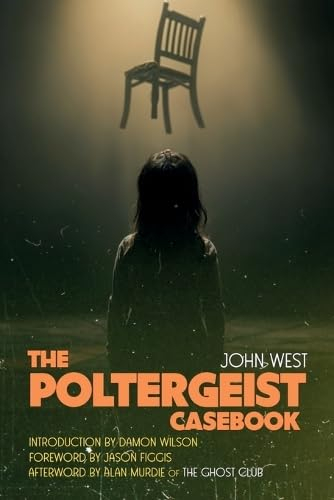
Reviewed by TyLean Tuijl
“Never judge a book by its cover” is something I used to take quite literally. However, as someone who obsessively must finish a book once I start ... I eventually learned that I was wasting far too much time on books that didn’t deserve my time. Instead, I adapted a method to complement my madness. I never just start reading a book. I investigate it thoroughly: the table of contents, the number of pages, the appendices, the white space even. It’s become my way, and I do it even when I am certain that I will be reading the book: a survey of the time I am about to gift to the author.
Admittedly, I wasn’t impressed on first inspection. The Poltergeist Casebook has 19 chapters despite being only 132 pages. It includes a foreword, a preface, an introduction, and an afterword. There is also a lot of white space. Perhaps more egregiously, I saw the Black Monk of Pontefract, the Bell Witch, and the Enfield poltergeist invoked, cases I’m – quite frankly – bored to death of hearing about. Despite a very dead fish initial handshake, I ended up enjoying this book a great deal!
The foreword and preface of this book were quite unnecessary. They come across as positionality where none is needed. Most readers are not like me and will make their decision to read the book after reading a few pages, and these sections do this book a disservice. They do not add to the book in a meaningful way. The introduction by Damon Wilson (Colin Wilson’s son) is where the book truly begins to explain the journey you are about to embark on with the author, John West.
Nevertheless, in my opinion, Chapter Two, ‘Poltergeists Through the Ages: Echoes of Fear, Faith, and Frenzy’ would have been better before Chapter One, ‘The Haunted Child: Annie Cleave and the Durweston Mystery,’ because it’s a lovely chapter that takes us on a journey through time, starting with ghost tales from the ancient Roman Empire and moving chronologically through time to the 20th century. Both Chapter One and Chapter Three, ‘A Harmless Joker?’ feel misplaced, as they sandwich Chapter Two, which would otherwise have set the book up beautifully.
Chapter Four, ‘The Seven Stages of the Poltergeist,’ also feels misplaced after three chapters of ghost stories have already been told, although it is a solid chapter. Chapter Five, ‘The Devil in the Hearth: Poltergeists, Witchcraft, and Fear in the 17th Century,’ and Chapter Six, ‘The Devil of Tedworth,’ take us to the era of the English Civil War.
Chapter Seven covers the Epworth Rectory Haunting (which has detailed supplemental information in the appendix) and begins the transition away from the era of devils and witches to the Enlightenment. Chapter Eight, ‘The Cock Lane Haunting,’ is where the book truly finds its stride as it covers the case with a fresh perspective that does not assume fraud.
Colin Wilson is mentioned throughout the book, but the first chapter dedicated to his fascinating research is Chapter Nine, ‘The Outsider Investigates: Colin Wilson and the Poltergeist Enigma.’ Chapter Ten, ‘The Split Brain,’ delves further into his research as well as the psychokinetic talents of Uri Geller, and Nina Kulagina and the work of Allan Kardec. The argument is posed that if Geller and Kulagina were – indeed – masters of psychokinesis, then human psychokinetic abilities are too limited to satisfactorily explain the sort of phenomena that occur in poltergeist cases.
Chapter Eleven, ‘Earth Energies and Place-Centred Poltergeists,’ covers the concept of Ley lines. Chapter Twelve, ‘Poltergeists and Possessed Relics,’ was the most memorable chapter, as it posed questions I pondered for days regarding residual energy and emotional imprints.
Chapter Thirteen, ‘The Black Monk of Pontefract,’ and Chapter Fourteen, ‘The Bell Witch,’ cover these well-known cases. The Fox Sisters are covered in Chapter Fifteen, ‘Interpreting the Unseen: Evidence and Argument in the Age of Spirits.’
Chapter Sixteen, ‘Theories, Myths and Misconceptions,’ discusses the formation of the Society for Psychical Research (SPR) and contains two sentences that I absolutely adored: “In the past, we blamed demons, fairies, witches, or ghosts. Today, we blame telekinesis or fraud.” Chapter Seventeen, ‘Pete the Poltergeist,’ was a very enjoyable tale, but I was devastated that the family did not welcome the ghost when they moved to their new home. Chapter Eighteen, ‘The Enfield Case’ covers that well-known case once again.
Chapter Nineteen, ‘The Search for the Truth,’ brings us back home to Colin Wilson’s explorations which provide a reframing of psi phenomena that was long overdue after the period of Enlightenment, and the thumbprint of that shift in thinking is felt and understood throughout the book. I enjoyed reading this book mostly because so many chapters ended with questions provoking a re-examination through the lens of Wilson. The writing is solid, even if the chapters are seemingly out of order. John West’s writing style packs a punch without waxing lyrical, which was refreshing.