




Reviewed by Sharon Rawlette
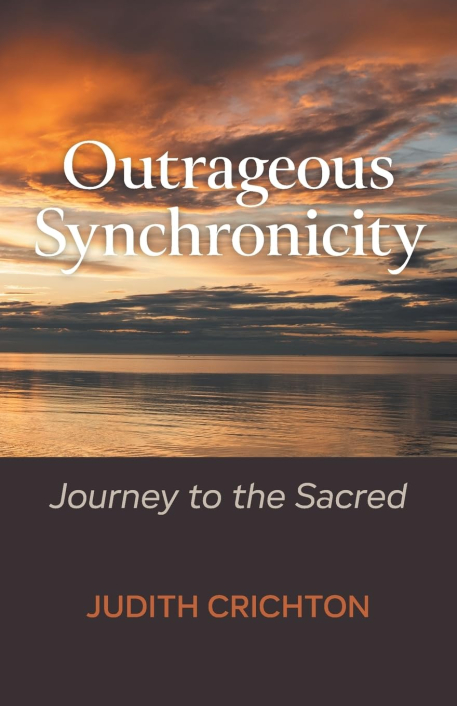
Judith Crichton’s paranormal memoir—or, as Bernard Carr, the author of the foreword calls it, her “anomalography”—is just the sort of book that parapsychology (and the world at large) needs more of. Crichton beautifully describes the “normally anomalous” events of her life, from synchronicities to precognitions to near-death experiences to readings with various psychics and deftly explores the way each of these events has contributed to her spiritual reflection and shaped her destiny.
Crichton’s narrative spans almost seventy years, beginning with some formative events that occurred during her childhood in the 1950s and culminating in 2023, on the cusp of her ninth decade of life. While she noticed a marked increase in spontaneous psi experiences following the two near-death visions she had when she came down with hepatitis A in her 50s, a pattern that nevertheless began early in life was that of anomalous events at the time of a loved one’s death. The book contains at least five such stories, possibly more.
Another guiding thread of the book concerns Crichton’s difficulty extricating herself from a long-term, common-law marriage. She recalls that, when she was first getting to know the man who ended up causing her such grief, she heard a “faint voice of caution” in her head. However, she candidly admits that, while she had an excellent instinct for business (and quickly became very successful in the corporate world), her instincts related to her “emotional well-being” left much to be desired. A psychic she visited near the end of that relationship told her, “You give away your power to others. As you leave him, claim what is yours. Do not be noble.”
In fact, Crichton devotes several fascinating chapters to detailing her readings with a pair of psychics who gave her much valuable insight through the years. Despite not knowing each other, both of them perceived some of the same important elements of her life: namely, her connection to a nun seen hovering in her aura (Marie de l’Incarnation, on whom Crichton would write her dissertation in comparative Canadian literature) and a past-life entwinement with a tall, kind, fair-haired man who was a member of the German military. One of them even suggested this person was a soulmate and would reconnect with her in this lifetime. I won’t spoil the ending by telling you how things turned out.
In addition to foretelling a future romantic relationship for Crichton, this psychic repeatedly mentioned someone named “Nancy.” The reference stymied Crichton until one day she finally met a woman named Nancy who quickly became a dear friend. The importance of friendships in spiritual development is another valuable theme woven throughout this well-crafted memoir.
It’s clear from the quality of Crichton’s writing the amount of time she has spent studying autobiographical literature as part of her professional research. Her narrative is well-structured and her descriptions have a carefully honed literary quality, without any of the floweriness that might risk distracting the reader from the book’s deeper meaning.
Additionally, Crichton is a parapsychologist’s dream, as she carefully documented many of the events of her life at the time of their happening—and she encourages readers to do likewise in her appendix describing how to keep an “anomalog.” Crichton doesn’t overdramatize and is forthcoming about details that could provide a prosaic explanation for some of her experiences but that make her even more credible when it comes to the more inexplicable ones. She also frequently refers the reader to helpful passages from the work of other researchers that provide additional context for the events described, including authors such as Eric Wargo, Jeffrey Kripal, Dean Radin, and Iain McGilchrist.
Finally, of particular interest to me were Crichton’s experiences related to destiny and the idea that we may plan some of the events of our lives before we are born. While certainly not proof of anomalous cognition, it’s very interesting that Crichton describes a moment as a child when she saw a well-dressed professional woman carrying a briefcase and experienced a “profound inner knowing” that one day she would be exactly like this woman. She says it felt to her as though the future was pulling her “towards a story that had already been written.” Her whole book, in fact, is a testament to the power of surrendering to “the greater will of the forces . . . that connect us to . . . a love beyond our comprehension . . . that marries past, present, and future in each precious, delicious, eternal, moment.”
I highly recommend Outrageous Synchronicity.