




Reviewed by Nemo C. Mörck
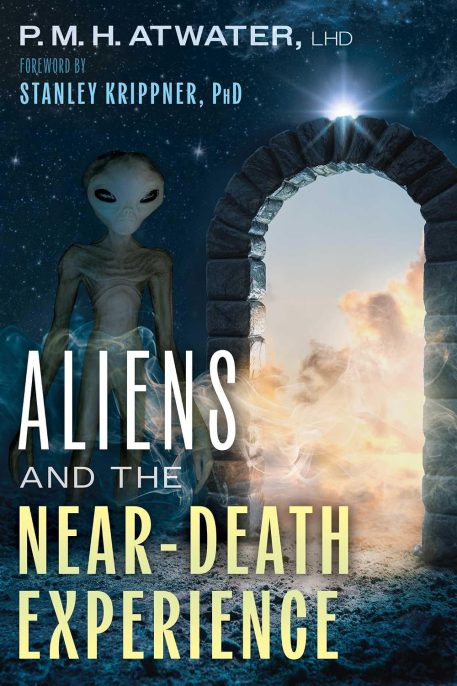
Aliens and the Near-Death Experience by P. M. H. Atwater (1937-2026) was her final book. I have not read her earlier books, so I did not know what to expect. Her book turned out to be something else. Stanley Krippner has provided a sober foreword and notes that Atwater presents case stories from thirty-eight percipients who have reported near-death experiences (NDEs) involving encounters with aliens and UFOs. Krippner notes,
The psychological term “fantasy-prone” may well apply to many of these UFO experiencers, making them “encounter-prone.” These terms may apply to Atwater herself, as she describes her three seminar NDEs that occurred in 1977 (p. xi).
However, Krippner also points out that regardless of what actually happened, the effects of the experience are very real:
While some may dismiss NDEs and alien encounters as mere hallucinations or delusions, the profound transformative effects they have on individuals cannot be ignored (p. xi).
Once Atwater is at the wheel, she takes the reader on a wild ride: First to a UFO landing site and then to the past. She sketches out her life story, her interest in Edgar Cayce, and more. In 1977, Atwater wrote a small booklet, I Died Three Times. Only fifty copies were produced, yet one of them was read by Kenneth Ring. He introduced her to the International Association for Near-Death Studies (IANDS) and the rest is history. Atwater writes about having conducted thousands of interviews, but the point of this book is not to summarise what she learned from them.
Atwater does not slow down. The contactee Greta Woodrew and the parapsychologist Andrija Puharich flash by. She writes:
He picked twenty-four people to be active in his program, to become a cohesive group, all of them taught to use the intensity of love to shift the vibration of the world. Social and political changes have resulted from their projects. Today, his Space Kids still make appearances on various talk shows to explain the program they were in and what they still do (p. 29).
Atwater drives on and takes us to a conference in 1989. R. Leo Sprinkle spoke at the conference and held a group meeting afterwards. Atwater attended the meeting. Sprinkle related what he had learned from hypnotising contactees. He also said that he had met the major investigators of ‘alien abductions’ in 1975 and that most did ‘not report sightings anymore because of the very real possibility they may lose credibility’ (p. 31). Ufology is not my field, but it seems fair to point out that there is no shortage of people in 2026 who are not worried about losing their credibility.
The first section of Atwater’s book is titled Personal Questions with No Answers. However, she is not shy about making statements, such as, ‘…it is broadly felt that extraterrestrials must have been behind the numerological symbols, structures, and stories that make up the I Ching Book of Changes’ (p. 33) and that our ‘DNA is far too complex and intricate to have been accidentally created in the primordial ooze on planet Earth’ (p. 34). Footnotes seem warranted.
Atwater drives us to 2000. That year The Complete Idiot's Guide to Near-Death Experiences, co-authored by Atwater, appeared. She notes that it was not a bestseller, ‘I mean less than maybe two hundred copies nationwide!’ (p. 37). When Atwater asked bookstore managers why it did not sell, they all laughed at her. That attitude toward NDEs has really changed since then. Later, she wrote The Big Book of Near-Death Experiences and noted that some percipients reported that they had interacted with aliens and UFOs during their NDEs.
As I read on, I increasingly felt like an insolent child in the back seat of a car, asking questions like, ‘Why are we stopping?’ After a detour to Turkey, Atwater takes us back to Kenneth Ring. She notes that people seemed uncertain about how to react to his book, The Omega Project: Near-Death Experiences, UFO Encounters, and Mind at Large. Ring had discussed with Whitley Strieber, and Strieber provided a foreword. Ring suggested that percipients had an ‘encounter-prone’ personality and Atwater sketches out his findings.
At some point, Atwater ran into John Mack, who knew about her work and wanted to discuss her research. She joined his group, Program for Extraordinary Experiences Research. Atwater relates what Mack learned from his research and notes that regardless of what the percipients had experienced, the after-effects seemed very real, some negative and some positive. Allegedly, some were cured of illnesses such as leukaemia.
The second section of Atwater’s book concerns the percipients who have encountered aliens during their NDEs. She started to gather experiences about this in 2023 and presents thirty-eight accounts (pp. 58-161). They are all very raw and very strange. Atwater deliberately decided to show full and minimally edited case stories rather than just excerpts.
The third section of the book concerns what Atwater has never shared about her third NDE. After having observed her past lives, she saw an alien being. Atwater felt that she had been this being too. She relates what it said. Its short speech ended with these words, ‘You earthlings fascinate me. Worth dying to live as one of you…turn from my kind to yours, be human’ (p. 166). Atwater calls it Arrakkus. The entity interjected itself into her everyday life and sometimes spoke through her, scaring people.
Arrakkus could answer questions after Atwater had been hypnotised. She shares a transcript from a session that took place on 18 July 1979. (Atwater now writes that she encountered Arrakkus after her second NDE rather than after her third NDE.) She writes, ‘The voice of Arrakkus is strikingly different, deep, guttural, edgy, somewhat raspy, yet anxious to converse. Laughs a lot’ (p. 167). Among other things it said, ‘Our blood is not the same color, does not flow in the same manner, more on the green side. Like Mr. Spock on what you call television. Your science fiction often not fiction’ (p. 170). Readers interested in channelled material may well find the transcript fascinating.
Mack learned about Arrakkus and wanted to know more. He promised to write a preface if Atwater wrote a book about what Arrakkus had related. However, Mack died in 2004, before Atwater had written her book and after his death her interest shifted to other matters.
Eventually, Atwater explains why she decided to write Aliens and the Near-Death Experience. Atwater writes that she gave a presentation for IANDS in 2024 and talked about NDEs and aliens. Afterwards she learned that people wanted to learn more and compare notes. Atwater felt compelled to tell her story and write this book. One of her final paragraphs begins, ‘I feel privileged to have lived the life I have…’ (p. 182). She died on 10 July 2026.
The book includes an appendix with notes for the book about Arrakkus that she never wrote. There are also a bibliography and an index. However, there are no footnotes, so the reader has to guess when the sources have been utilised. Suffice it to say, Aliens and the Near-Death Experience is not like the books I usually review. It is truly something else.