




Reviewed by Ashley Knibb
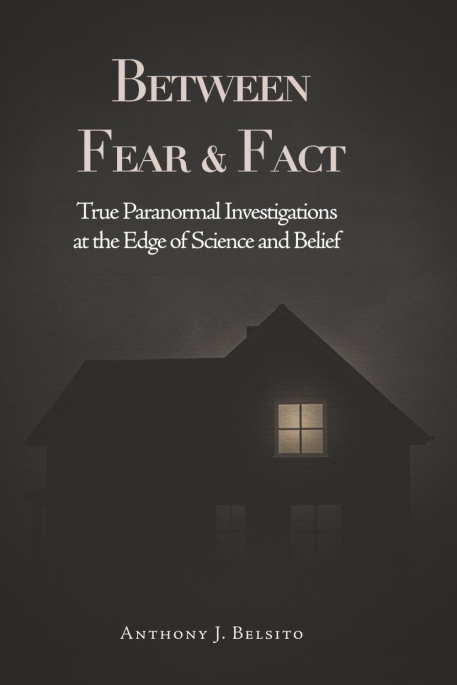
Anthony J. Belsito is the founder and lead investigator of Archangel Paranormal Society. In his book, Between Fear and Fact, Belsito relates why he became an investigator.
Belsito has had an interesting career, twenty-five years in pharmaceutical sales management and fourteen years in law enforcement. He states that his own paranormal work focuses on ‘ethical, evidence-based investigations that prioritise compassion, scepticism, and the well-being of those seeking help.’ Belsito also says there is a focus on good documentation, psychological awareness, scientific inquiry, and most importantly understanding that some experiences have rational logical explanations, but some remain unknown.
Between Fear and Fact is Belsito’s first non-fiction book. He shares some of the investigations that the Archangel Paranormal Society has embarked on. Belsito has described around nine cases which the group investigated, each with similarities and some interesting differences.
The first half of Belsito’s book focuses on his personal journey and how he became interested in the paranormal. Something that really interests me personally is this: how people come to be interested in the paranormal and then move to actually investigate. For Belsito, his interest was due to a deeply personal experience connected to his own mother. Regardless of your own attempts to explain anomalous experiences, they can change your belief in the paranormal and shape your perception as an investigator.
I enjoyed this first part of the book as it provided an excellent insight into the author’s background. Often paranormal books focus on either famous cases or their own cases, leaving out details about themselves. Belsito not only provides the reader with a deeply personal connection he has to the paranormal but goes on to explain his journey.
Before discussing cases in which he has been involved, Belsito spends some time discussing some more well-known aspects of the paranormal and its research. This includes things like the 21 grams experiment, whether cells could be conscious, near-death experiences, mediums, psychics, and more. Granted, Belsito does not go into a great deal of detail on these subjects, but in fairness, any one of these subjects could easily expand into its own book, so deciding how much or how little detail to go into is really not an easy task. For some, what Belsito included will be sufficient, but personally I desired a little more information, as it often felt like a side note on some really interesting subjects.
Unfortunately, Belsito carries this approach forward into the section of the book that has him discuss some of Archangel Paranormal Society’s cases. I felt the cases lacked the detail they may have actually had in reality. Perhaps Belsito chose to keep them short, most only being a few pages long, in order to maintain them as digestible case reports, something that would likely appeal to a wider audience of many ghost hunters. However, most investigators, like me, would have preferred more detailed reports.
Many of the cases described appeared to be more about belief than actual investigation. Belsito often discusses demonic undertones, multiple spirits and other spiritual beliefs. This meant that the cases often felt sensationalised by the more spiritual beliefs displayed by the investigators, which was a real shame, as I was hoping for some better rational, logical investigation of these phenomena. Obviously, I am not one to fully dismiss the use of a spiritual approach, as I have involved mediumship within my own investigations. However, it’s important to remain balanced in our approaches.
One area that Belsito did spend a little time on, which surprised me somewhat, was when he discussed paranormal investigator salary and the general subject of people being paid for investigating the paranormal. In fact, some of the average salaries he provided in the chapter were actually quite high. It was shocking to be fair. However, as Belsito progressed, he began to reveal that some of those high earners may be related to TV personalities, influencers and such. These are often people who are working on their social media presence with the paranormal as a subject to help obtain that position.
In fairness, there are some TV personalities or influencers that do have a serious interest in the paranormal and their screen presence is a way to allow them to embark on their paranormal journeys full-time. It really is a difficult area to navigate sometimes, as understanding who a charlatan might be, and who’s genuine is never easy. I believe Belsito was trying to allude to this too, while also highlighting that many out there are more about the money than actually helping people with their strange experiences.
Between Fear and Fact is an interesting addition to the paranormal literature, providing some good insight into Belsito’s own journey. However, he also mixes and discusses some good points, varying very much from scientific aspects to spiritual beliefs. There are certainly some nice chapters that I did really enjoy and some areas which sounded fascinating. That said, if I were to have to mention negatives regarding the book, then primarily it would have to be what I believe is a lack of detail in most chapters, especially those concerning cases. I really wanted to learn a little more. The chapters were also short and leaned much more towards the spiritual than covering more aspects of the actual investigation.
All in all, the book was quite enjoyable, but does have some flaws. That said, it’s a book that provides some good insight into Belsito’s own paranormal journey. It is often those personal stories that provide the greater narrative. For that reason, it’s certainly worth a read. After all, these experiences are often the very things we seek as investigators.