




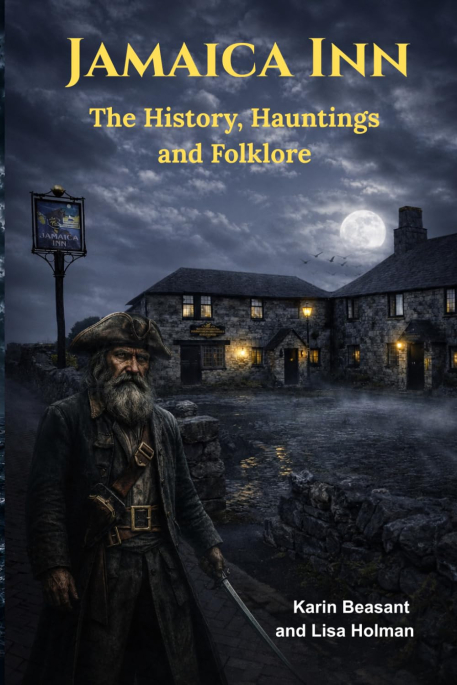
Reviewed by Peter A. McCue
This book describes Karin Beasant, its first author, as “a highly respected paranormal consultant, historian, public speaker, researcher and event organiser” (p. 239). Lisa Jane Holman, Beasant’s co-author, is described as a “British-multi-genre author, public speaker, and paranormal investigator” (p. 240).
The Jamaica Inn that’s featured in this book is in the hamlet of Bolventor on Bodmin Moor in north-east Cornwall. Beasant and Holman state that a local historical and genealogical researcher, Dr Lesley Trotter, has determined that it was built in 1776, not in 1750, as some have claimed (p. 22). It seems that when it was first built, the intention was for it to be a dwelling house with stables and haylofts, rather than an inn (p. 50). However, it went on to become a coaching inn, and for many years it was a temperance establishment. It wasn’t until 1950 that it regained its licence to sell alcohol (p. 113). The authors explain that, over the years, “the Inn has been altered, extended and remodelled […] many times” (p. 218).
I’m basing this review on a paperback version of the book, which came with a separate item, a set of six floor plans. These relate to the ground floor of the original building, the first floor of the original building, the ground floor as it was in the 1970s, the first floor as it was in the 1970s, the modern ground floor, and the modern first floor. En-suite facilities were added to the bedrooms some years ago, but they’re not shown in any of the floor plans. None of the floor plans has an arrow showing the direction north.
Although the inn has reportedly been the setting for many paranormal phenomena (discussed below), its fame is no doubt based, in good part, on its being associated with a bestselling novel, Jamaica Inn, written by Daphne du Maurier (1936/2025). It was first published in 1936. While writing the novel, du Maurier spent some time living at the inn. The fictional events her book describes are set in the early part of the nineteenth century. There have also been screen adaptations of the story, such as the 1939 film Jamaica Inn, which was directed by Alfred Hitchcock.The film is available on YouTube.
There are numerous differences between the storyline of du Maurier’s novel and that of Hitchcock’s film, although a principal character in both is a young, orphaned woman called Mary Yellan, who moves to Jamaica Inn to be with her Aunt Patience. The latter is married to the landlord. Mary discovers that he’s a brutal character, who leads a gang of murderous wreckers. They lure ships onto the rocks on the coast and plunder the cargo and personal possessions of those who were aboard. In the novel, it transpires that the overall head of this criminal enterprise is a local vicar called Francis Davey. In the Hitchcock film, this nefarious role is played by Sir Humphrey Pengallan, the local squire and justice of the peace.
Beasant and Holman are unclear about whether Jamaica Inn really was associated with criminal activity. They state that there’s little historical evidence to link it with smuggling (p. 81). However, they seem to contradict themselves later, when they refer to “the pivotal role Jamaica Inn played in the history of contraband crossing Bodmin Moor” (p. 148).
Structure of the book
The book starts with a dedication to a former maintenance manager at the inn, Robert Gumbrell (1969-2026). Following a list of the book’s contents, there are acknowledgements, and then two short forewords, one by Dr Kate Cherrell, the other by Dr Katie Goodland. Then, after brief statements by the authors (pp. 14-15), one comes to the main part of the book. Most of its unnumbered chapters are clustered into four groups: ‘The Beginning’, ‘The History’, ‘The Hauntings’ and ‘The Folklore’.
Historical aspects
The chapters comprising ‘The Beginning’ and ‘The History’ sections provide a lot of background information, including details about former owners of the inn.
Alleged paranormal phenomena
Beasant and Holman state that “The first recorded sighting of a ghost at the Jamaica Inn was in 1911”, at which time, “the Inn had reverted to its original use as a farmhouse” (p. 217). The apparition was that of a man sitting on a wall outside, dressed in old-fashioned clothing.
An in-house Jamaica Inn Paranormal Investigation Team was established by a businessman called Allen Jackson, who owned the inn between 2014 and 2022, when he sold it to the Coaching Inn Group. During Jackson’s ownership, the number of guest bedrooms increased to 36. Currently, the investigation team has five members: Karin Beasant, Lisa Holman, Craig Williams, Gemma Tredwin, and Kim Morgan. All five of them claim to have experienced anomalous phenomena on the premises. For example, in 2008, Beasant and four others saw an apparition there of a girl aged about seven or eight (p. 133); and on unspecified dates, Holman “has seen, as well as heard, the giggling of [ghostly] children all around the inn” (p. 146).
As well as ‘sensory’ phenomena, there’ve been reports of physical manifestations, such as “glasses unexpectedly shattering [...], and pepper pots being found on the floor after seemingly being thrown from the bar” (p. 202). But the authors sound a cautionary note: “Unfortunately, many of these incidents were either not witnessed on CCTV or were not reported until after the recordings had been overwritten” (p. 202).
Members of ‘ghost hunting’ groups often display a spiritualistic leaning, and that seems to be the case with Beasant and Holman. For example, they refer to having “witnessed the spirit of an American Soldier at the Inn” (p. 125); and they state that, “Lisa instantly fell in love with the building and the spirits of the long departed” (p. 145).
Members of the public can attend “paranormal nights” at the inn. “Included in the investigation”, Beasant and Holman explain, “is a two-course meal, where you will meet some amazing people and the team members who will be your guides” (p. 236). Bookings can be made by phoning the hotel. It would have been helpful if the authors had given some idea of how much it costs to attend one of these events.
‘Private’ investigations also occur at the inn, where established paranormal investigation teams are given access to parts of the inn. However, I presume that there’s still some oversight by members of the in-house team or hotel staff – if only to make sure that hotel property isn’t misappropriated.
Comments
I noticed some presentational problems, such as grammatical errors. The book lacks an index, although it’s well illustrated. There’s no bibliography.
There’s geological faulting beneath Bolventor, but it receives no mention by Beasant and Holman. That’s unfortunate, because it’s been claimed that there’s a link between geological faults and localized anomalous experiences (e.g., Persinger & Koren, 2001).
A small amount of uranium is present in granite rock and soil containing granite. As uranium undergoes natural decay, radon gas is produced. It’s colourless, odourless and tasteless. But it’s radioactive and can seep into buildings. Long-term exposure to high concentrations of radon gas can be conducive to lung cancer. Although it may have no bearing on the phenomena at Jamaica Inn, it’s worth noting that Bolventor is in a high-risk radon area.
To the extent that the reported phenomena at Jamaica Inn have been genuinely paranormal, and not simply the result of misperception, misinterpretation or deliberate invention or fakery, I would suggest that it’s the wish of people for there to be ghostly phenomena that helps to maintain the paranormal activity. In other words, ‘ghost hunters’, and members of the public who pay to participate in paranormal nights at the inn, could be more than passive observers – they could be stoking the fire, so to speak, and helping to generate manifestations.
References
Du Maurier, D. (2025). Jamaica Inn. Virago Press. Original work published 1936.
Persinger, M. A. & Koren, S. A. (2001). Predicting the characteristics of haunt phenomena from geomagnetic factors and brain sensitivity: Evidence from field and experimental studies. In J. Houran & R. Lange (Eds.), Hauntings and Poltergeists: Multidisciplinary Perspectives.(pp.179-194). McFarland. [NB: The references cited in Persinger and Koren’s article are included in a collective bibliography for the book as a whole, on pp. 310-328.]